
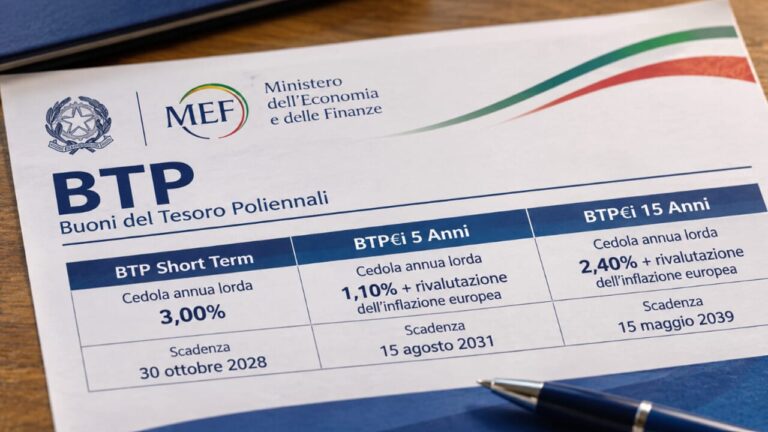
The Ministry of Finance will auction three new issues of Treasury bonds tomorrow, Wednesday 25 November. These are two different families of fixed or indexed rate government bonds, subject like all state bonds to the preferential taxation of 12.5% and with a minimum denomination of 1,000 euros. These are the titles below:
- Short Term Btp with annual coupon of 3% gross (maturity October 2028).
- Btp€i 5 years (maturity 2031): 1.10% gross per year (to which is added the revaluation of European inflation).
- Btp€i 15 years (2039): 2.40% gross per year (also in this case the revaluation due to inflation must be added).
Only operators “specialists in government bonds” will be able to participate in the auction, while the retail public will be able to ‘book’ the purchase of the bonds until today, within the closing time set by their bank. Since these are new issues of existing BTPs, they are already listed and traded on the Mot of the Italian Stock Exchange. Anyone can buy them at any time directly from their securities account at the current market price.
How much does the Short Term BTP yield
And the returns? The Short term BTP pays a coupon of 3% gross per year on the nominal value. This means that if it is bought at par (i.e. at 100), minus the 0.2% stamp duty and the 12.5% tax, we arrive at an effective net yield of 2.425%. In short, by investing 10 thousand euros you earn 242.5 every year divided into two tranches. Coupons are paid every six months, on April 30th and October 30th.
Is there anything better? In terms of interest, undoubtedly yes, but the characteristic of this BTP lies precisely in the very close maturity which protects the security from market shocks and makes it less exposed to the risk (however remote) of bankruptcy of the issuer. To be clear. A BTP that has a maturity of 5 or 10 years offers higher returns, but remains more exposed to price fluctuations determined by market prices and interest rates. Those who are in no hurry to get their capital back can turn to securities with longer duration (and duration), but for an investor who wants to risk little, a short-term BTP may be the most suitable solution. As long as you settle for a lower interest rate. It goes without saying that even a closer maturity does not completely protect against the risk of insolvency of the issuer.
| Title | ISIN | Expiration | Gross annual coupon |
| BTP Short Term | IT0005729733 | 30/10/2028 | 3.00% |
| BTP€i 5 years | IT0005657348 | 08/15/2031 | 1.10% + inflation |
| BTP€i 15 years | IT0005547812 | 05/15/2039 | 2.40% + inflation |
Securities linked to European inflation
And the other two titles up for auction? Btp€i are securities designed to protect capital from the high cost of living in the euro area. Both the capital repaid at maturity and the half-yearly coupons are revalued based on the trend of the harmonized index of consumer prices in the euro area which over the last 20 years has averaged just over 2%. The 5-year BTP will pay 1.10% in two semi-annual coupons, while the bond maturing in 2039 will pay 2.40% gross per year. To these fixed rates will be added, for both securities, the revaluation linked to the trend of European inflation.
For the two Btp€i it is difficult to make forecasts on the yield as the latter is determined by the fluctuation of consumer prices. What if there is negative inflation? On this point, the Treasury specifies that the Btp€i “guarantees the repayment of the nominal value subscribed: even if a reduction in prices occurs during the life of the security, the amount reimbursed at maturity will never be less than the nominal value”.