

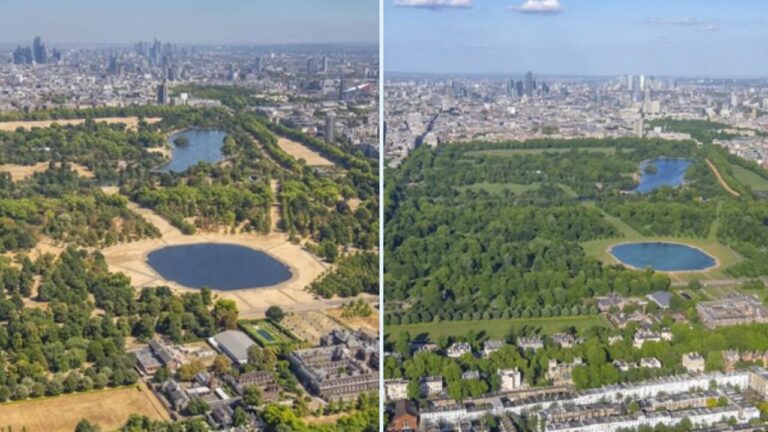
Forget for a moment the greenery of Hyde Park, one of the symbols of London. Images taken in early August show an almost completely yellow and brown expanse, with parched ground and sunburned grass. A transformation so evident that some areas of the large London park seem more similar to a steppe than to the landscape normally associated with the British capital.
What changed the face of Hyde Park was one of the most exceptional droughts ever recorded in the south of England.
The office numbers weather British explain better than the images how anomalous the situation is. England received just 6.5 millimeters of rain in July, around 10 per cent of the climatological average for the month. It was the driest July since records began in 1836 and the third driest month overall in the English historical series. The previous record for July, dating back to 1911, was 13.4 millimeters: more than double.
In the south of the country the figure is even more impressive: 1.9 millimeters in an entire month, just 3 percent of the normal quantity. Such a dry month has never been recorded since 1836. In the area that includes the south-east and south-central parts of England the total dropped to 0.7 millimetres, around 1 per cent of the average.
In practice, for weeks no significant amount of water fell on the British capital.
The result is the one visible in the large London parks. When the soil loses much of its moisture and precipitation remains absent for a long time, the grass drastically reduces its vegetative activity and loses its green color. The brown lawn, therefore, does not necessarily mean that all the grass is dead: some can grow again with the return of sufficient rain.
However, the problem does not only concern the appearance of Hyde Park. Prolonged periods of drought put pressure on trees, soils, ponds, streams and urban wildlife. The Royal Parks, the organization that manages Hyde Park and the capital’s other large royal parks, has long considered drought, extreme heat and violent rainfall among the effects of climate change to which these spaces must adapt.
The lack of rain was also accompanied by persistent heat. Throughout July the average maximum temperatures in England and Wales remained above the climatological average. In the south of England, July 2026 was simultaneously the hottest, driest and sunniest month ever observed: average temperature of 20.1 degrees, just 1.9 millimeters of rain and 333.7 hours of sunshine.
Half of England is officially in drought
It is therefore not just about yellowed lawns. At the end of July the Environment Agency officially declared seven areas of the country to be in drought conditions, equal to around half of England, including London and the south-east.
Water scarcity is also affecting rivers and water reserves. Already in the second half of July only 13 percent of the monitored waterways had levels considered normal for the period, while in several areas restrictions on the use of water had been introduced.