
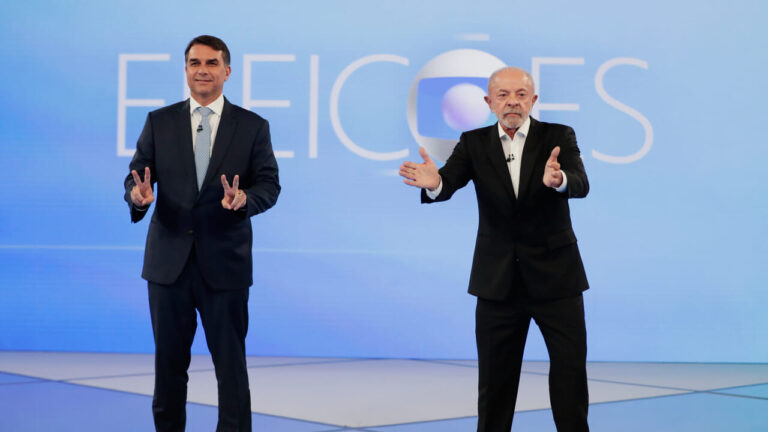
Brazil returns to the polls today, Sunday 25 October, to choose the next President of the Republic. Contending to govern the country for the next four years are the outgoing president Luiz Inácio Lula da Silva, a member of the Workers’ Party (PT), and senator Flávio Bolsonaro, right-wing candidate and son of former president Jair Bolsonaro.
In the first round, last October 4, Bolsonaro obtained 47.03% of valid votes, equal to approximately 56.1 million preferences, against Lula’s 45.16%, which stopped at 53.9 million. A difference of just 1.87 percentage points, corresponding to approximately 2.2 million votes.
Over 158.7 million voters were called to vote. Polling stations in Brazil will be open from 12pm to 9pm, Italian time, while counting will begin immediately after voting closes.
Who wins in Brazil
The latest survey by the Futura institute, released on Saturday 24 October, photographs a situation of substantial balance: Bolsonaro collects 50.1% of valid voting intentions, against Lula’s 49.9%. The difference is just two-tenths of a point, well within the margin of error of 2.2 percentage points. The survey was carried out on 23 and 24 October on a sample of 2,000 voters, with a confidence level of 95%.
What is at stake is control of Latin America’s largest economy, in a consultation marked by strong political polarization and a result that polls do not allow us to determine with certainty.
The polarization between the USA and China
“A victory for Bolsonaro would bring Brazil closer to the United States and the Trump administration” underlines Oscar Campanini Gonzales, of the Centro de Documentación e Información Bolivia (Cedib), interviewed by the Dire agency in view of the presidential run-off. According to Campanini, the possible political change is part of a context of international rivalry. “Globally we are witnessing growing tension between two major economies, two major poles of political and economic power: China and the United States,” observes the expert. His thesis is that South American right-wing parties “are moving very close to the United States and the Trump administration, while distancing themselves from China.”
In the case of Bolsonaro’s victory, according to the expert, “the rapprochement with the United States would become more marked”. However, this would not be a definitive break with Beijing, since China represents “the main market and one of the main producers of almost everything we consume”. Campanini therefore believes that a radical transformation of economic relations is difficult, although he highlights that some projects, certain investments and some positions with respect to international politics could change.
Finally, the expert places the elections in Brazil in more general dynamics of political alternation which, in his opinion, affect multiple countries and continents. “People don’t necessarily vote in favor of someone, an opposition or certain promises,” emphasizes Campanini. “They vote against what they are tired of.”