

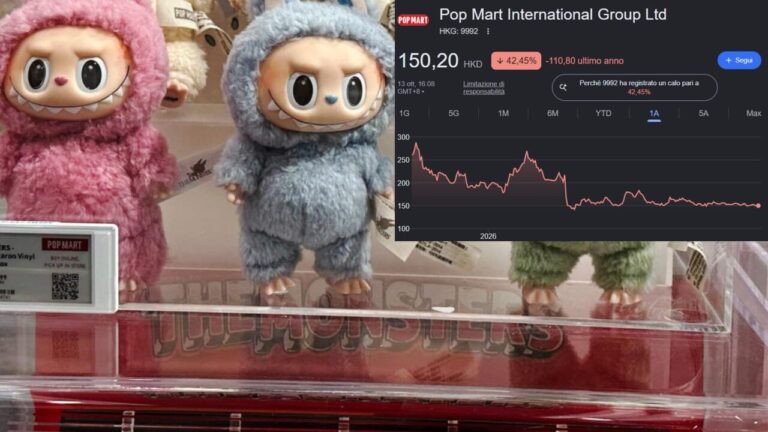
A “freak show” already over. A “ridiculous bubble”. “It couldn’t last.” Reading the comments on Reddit, it seems that Pop Mart’s funeral has already been celebrated: coffin buried and everyone at home. The parable of Labubu, the hairy little monster with sharp teeth created by the artist Kasing Lung and marketed by the Chinese giant, is becoming a case study. Between viral posts on social media, alarmist carousels and sensational headlines that scream of “33 billion dollar chasms”, the financial reality is a little more complex. The numbers, in reality, tell the story of the inevitable deflation of a speculative bubble based on artificial scarcity, without, however, coinciding with an immediate industrial failure. Let’s see why.
That hellish ride of 2025
To understand the extent of the ongoing “correction”, we need to reconstruct the impact of 2025. In that year, Pop Mart closed with overall revenues of 37.12 billion yuan (approximately 5.38 billion dollars), recording a jump of 185% compared to the previous year.
Driving the push was almost exclusively The Monsters line, led by Labubu. The single character managed to generate over 14 billion yuan, covering 38-40% of the entire company turnover alone. A frightening concentration when compared with the data of previous years: in 2023 Labubu accounted for only 5.8%, rising to 23.3% in 2024.
Everyone has it. But really everyone
Last year the puppet became in all respects a pop phenomenon and a “social currency”, thanks to the combination of blind boxes (surprise boxes), limited editions and spontaneous or controlled endorsements by global celebrities such as Lisa from Blackpink and Rihanna. Everyone wants those furry little monsters, everyone proudly displays them dangling from their bags. When a temporary store at Rinascente opens in Milan, there are kilometre-long queues. By August 2025, investor euphoria had pushed the market capitalization of the Hong Kong-listed company to nearly $56 billion, placing founder and CEO Wang Ning among the top ten richest men in China. To clarify, the whole ‘show’ was worth more than historic brands like Mattel or Hasbro.
The awakening: 30 billion market caps eliminated
Roller coasters, as we know, go up very fast, but they go down just as quickly. The hyper-valuation of the stock market proved unsustainable as soon as exponential growth showed the first signs of deceleration. Between late 2025 and mid-2026, Pop Mart stock experienced a retracement of up to 60% from its all-time highs.
The estimated loss in market value ranges between $30 and $33 billion. As a result, Wang Ning’s personal fortune fell by more than $11 billion.
However, talking about a “collapse in sales” – as we read on social media – is exaggerated. Market analyzes show that in the first half of 2026 Pop Mart’s turnover still grew by 24% on an annual basis (reaching 17.1 billion yuan), with net profit increasing by 10%. The collapse, in fact, did not come from the accounting books, but from the disproportionate expectations of the financial markets, which priced in infinite triple-digit growth.
The “Lafufu” effect and the secondary market
The fragility of the model emerged in the management of supply. Faced with the spread of scalping – i.e. the hoarding by touts to resell pieces at prices increased up to 25 times the list price -, Pop Mart reacted by massively increasing industrial production.
This choice solved the problem of availability in shops, but destroyed a psychological pillar of collecting: perceived scarcity. In the space of a few months, prices on the secondary resale markets collapsed between 70% and 80%, eliminating the “margin” for speculation. At the same time, the market was flooded with a wave of pirated copies (nicknamed “Lafufu”), which further devalued the perception of exclusivity of the product. For example: global search interest on Google for the term “Labubu”, as easily observed on Trends, has dropped by 90% compared to its peak popularity.
Are we saturated?
The consumption trend confirms the saturation phase in Western markets. In the United States, credit card spending surveys conducted by Bloomberg show a decline in sales of between 40% and 45% in the spring of 2026 compared to the same period of the previous year, reversing the positive trend of the first months of the year.
At the same time, warehouse inventories have accumulated rapidly: at the end of 2025, the company’s inventory reached 5.47 billion yuan, marking an increase of 259% compared to the previous year. The push of occasional consumers – who entered stores attracted by the social trend without a real connection with the culture of “designer toys” – quickly ran out.
Beyond the bubble
Pop Mart management initiated a strategic repositioning to reduce reliance on a single persona. The Chinese group is diversifying production by offering new product lines (even small household appliances) and pushing for the expansion of its theme parks and licensing contracts with entertainment giants such as Sony Pictures (a film directed by Paul King, director of Paddington, has been announced).
Pop Mart, for now, remains solid. Digital virality can create financial empires in record time, but it can equally make them crumble. The law is simple: if the object of desire goes from being unobtainable to extremely findable, no one is willing to pay its weight in gold for it. For the brand now the most difficult challenge: surviving the end of the hype.