


From next year you will retire later and with a lower allowance. As the increase in requirements for leaving work approaches, the Ministry of Labor has published the decree which updates the transformation coefficients: the percentages used to convert the social security capital accrued during one’s career into an annual pension. The new values, less favorable than the current ones, will apply from January 1, 2027.
Two changes that affect the future of workers, but derive from separate measures. The decree of 16 October intervenes on the calculation of the amount; the postponement of the exit is instead already foreseen by the previous rules. For the old age pension you will need 67 years and one month in 2027 and 67 years and three months in 2028, subject to the exceptions provided for. How much will the new coefficients weigh on the check? Let’s try to understand it together.
Because the value of checks goes down
To understand how much you will receive, you need to start from the contribution amount: the social security capital formed by the contributions credited during your working life, revalued over time.
For an employee, the contributions that feed the amount generally correspond to 33% of the gross taxable salary, including both the employee’s and the employer’s share. With an annual taxable amount of 30 thousand euros, for example, 9,900 euros are added to the amount. The calculation includes the worker’s and employer’s contributions, not just the deduction visible on the pay slip. Different rates may apply for self-employed people and those registered with the separate management system.
To fully understand the functioning that regulates the value of future pensions, we must think about two distinct phases. During working life, the accredited contributions are added up and revalued every year based on the average five-year change in nominal GDP: this is how the contribution amount is formed. Upon retirement, this capital is multiplied by the transformation coefficient, a percentage that depends on the retirement age and takes into account above all the residual life expectancy, as well as any survivors’ benefits and financial parameters. The result is the gross annual pension, or the contribution rate alone for those who fall into the mixed system.
In general, if the expected duration of payments increases, other conditions being equal the coefficient decreases, because the same capital must finance the pension for a longer period. And this is one of the reasons for the decline in the value of the transformation coefficients and the “devaluation” of the checks compared to the previous year, as we will see.
How much is lost with the new parameters?
At the time of retirement, the amount is multiplied by the coefficient corresponding to the worker’s age. The result is the gross annual pension calculated with the contributory method; dividing by thirteen gives the monthly payment.
At age 67, the coefficient goes from 5.608 percent in 2026 to 5.514 percent in 2027. A lower percentage means that the same amount, at the same age, produces a lower check. But how much do you actually lose? Let’s take concrete examples.
Let’s consider a worker with an amount of 250 thousand euros. Applying the coefficient expected at 67 years of age, with the parameters of 2026, approximately 1,078 euros gross per month are obtained. With those of 2027 the amount drops to 1,060 euros: approximately 18 euros less for each of the thirteen monthly payments, with an annual difference of 235 euros.
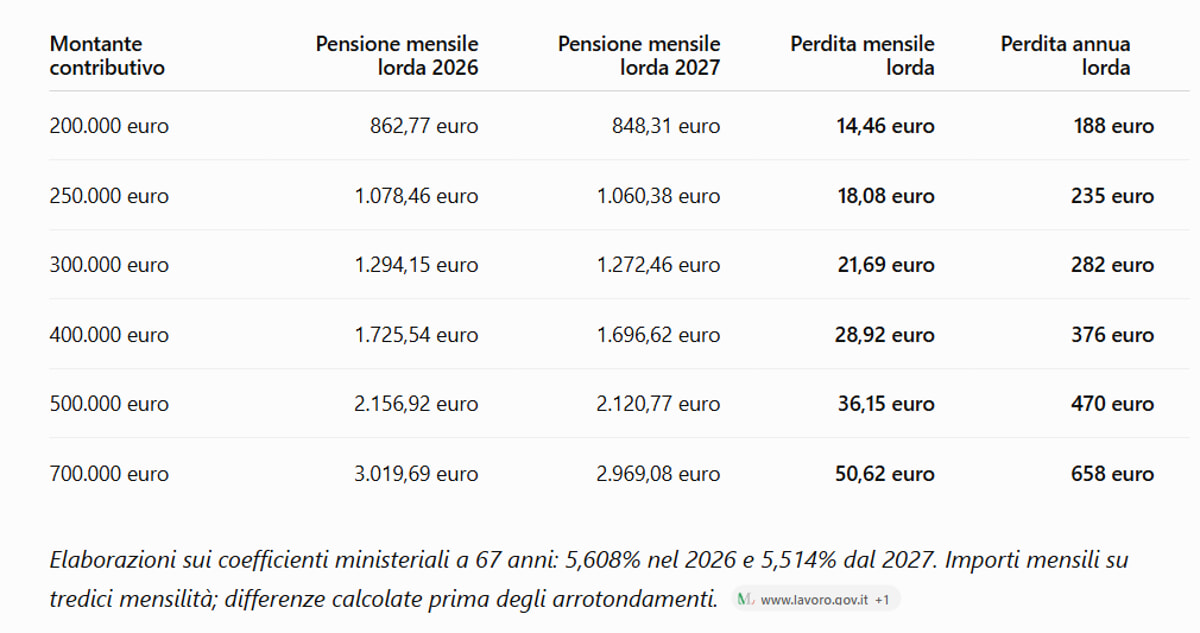
With 300 thousand euros, again at 67 years of age, the contributory pension goes from approximately 1,294 to 1,272 euros gross per month. The reduction is almost 22 euros per month, equal to 282 euros per year.
The distance increases in absolute value for those who have accumulated more contributions. With an amount of 500 thousand euros, the allowance goes from approximately 2,157 to 2,121 gross monthly euros: 470 euros less per year. With 700 thousand euros, you drop from around 3,020 to 2,969 euros, almost 51 euros less per month and 658 euros over the course of the year. In all these cases, the percentage reduction at age 67 is approximately 1.68 percent.
Be careful though: the simulations isolate the effect of the new coefficients. It does not mean that those who postpone their pension to 2027 will necessarily receive less than they would have received by leaving in 2026: in the meantime, both the amount and the coefficient linked to the actual retirement age can increase.
Because the age at which you retire affects your benefit
In fact, the coefficient increases with age: the later the pension is paid, the higher the percentage applied to the pension capital.
With an amount of 300 thousand euros, using the parameters from 2027, the calculation produces approximately 1,156 gross monthly euros at 64 years of age, 1,272 euros at 67 years of age and 1,473 euros at 71 years of age, again on thirteen monthly payments.
And, to keep in mind, there is the new general calendar communicated by the INPS which provides for an increase in the requirements by one month in 2027 and by a total of three months in 2028 compared to 2026.
Important note: the coefficients obviously only concern pensions, or pension shares, determined with the contributory method. For those who started paying on January 1, 1996, the mechanism normally affects the entire check. For those who fall within the mixed system, however, it applies only to the contributory part, to which the salary part must be added.