

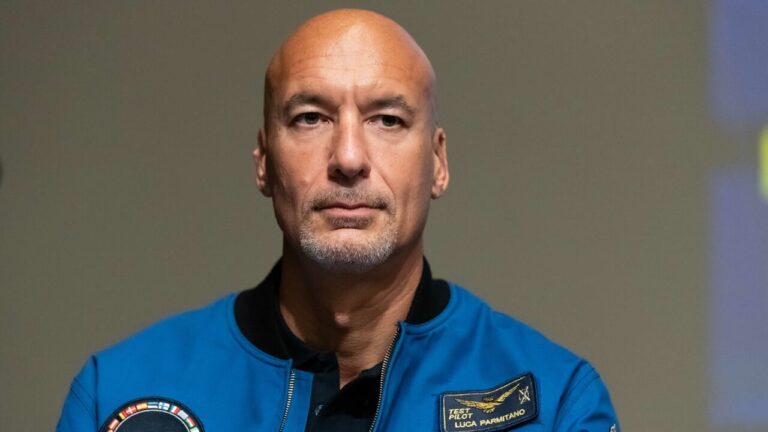
There is also Luca Parmitano in the crew of Artemis III, the NASA mission which in 2027 will test the coupling between the Orion capsule and the future lunar landers of SpaceX and Blue Origin in Earth orbit. The Italian ESA colonel has been chosen as pilot and will be the first European astronaut on an Artemis mission. That he would be part of the Artemis III crew, Parmitano found out on the train: “I was so incredulous that I asked my boss to repeat exactly what he had said, that is, ‘Luca, you have been assigned as a pilot to the Artemis III mission’. I was surrounded by people. So I knew I couldn’t say anything out loud so I was left speechless.”
The pre-mission to the Moon: the Orion service module is also Italian
NASA has announced the crew of Artemis III, with astronauts who will have to prepare the ground for the return of man to the lunar surface. On board the Orion capsule there will be US commander Randy Bresnik, mission specialists Andre Douglas and Frank Rubio, and Parmitano, astronaut of the European Space Agency, in the role of pilot. Bob Hines was listed as a reserve.
It is the first time that an ESA astronaut has been assigned to an Artemis mission. For Europe, and for Italy, it means joining the crew of the program with which the United States wants to build a stable presence on the Moon and prepare, in perspective, future missions to Mars. The objective will be to test systems and procedures essential for subsequent missions: rendezvous, approach and docking between Orion and test versions of the commercial lunar landers developed by Blue Origin and SpaceX. The Orion service module structure is produced by Thales Alenia Space in Turin, before final assembly entrusted to Airbus in Bremen. According to ESA, companies from 13 member states contribute to the program, with 20 main contractors and over 100 suppliers.
The expected sequence is as follows: first the pathfinder of the Blue Origin lander should leave, destined to remain in orbit waiting for the crew. Then Orion, launched with the Space Launch System rocket from the Kennedy Space Center, will reach Earth orbit with the four astronauts and dock with the test vehicle. After about two days of testing, the capsule will separate and await the pathfinder of Starship, the lunar system developed by SpaceX. Even in that case docking, checks and operational tests are planned. Only afterwards will Orion return to Earth, landing in the Pacific. The estimated duration of the mission is approximately two weeks, but NASA specifies that the final timetable will depend on launch, rendezvous and docking operations.
Who is Luca Parmitano and what he has done in space: the announcement video
Born in Paternò, in the province of Catania, on 27 September 1976, an Air Force officer, test pilot and ESA astronaut since 2009, Parmitano already has two long-term missions on the International Space Station behind him: “Volare”, a mission of the Italian Space Agency which started in 2013, and “Beyond”, between 2019 and 2020. In the latter he became commander of the Space Station international: the first Italian and the third European to hold that role.
Parmitano spent a total of 366 days in space, carried out six extravehicular activities for over thirty hours and worked on hundreds of scientific experiments. Before joining the astronaut corps, he had been selected by the Air Force as a test pilot, with training at the French Epner school in Istres. He has accumulated more than 2,000 flight hours, qualifications on more than twenty military aircraft types, and operations on more than forty aircraft types.
Trump changes plans to get to the Moon (and risks costing us dearly)
The announcement was made in Houston by NASA Chief Administrator Jared Isaacman, for whom the Artemis III mission “will demonstrate the strength of American innovation and international cooperation as we test complex rendezvous and docking operations and advance technologies that will one day take us even further into the Solar System.” Visibly moved, AstroLuca: “my launch base was my country, Italy, which gave me the necessary education to achieve this mission. ESA was the launch tower, which allowed me to build relationships and express my full potential. NASA was the rocket, and I thank it for allowing me to be part of this incredible crew”. Then the astronaut thanked his family, in particular his daughters: “you are the energy for my soul” and then said goodbye with a ‘thank you’ pronounced in Italian.
“(My) launchpad is my country, Italy…The European Space Agency is like a launch tower… the rocket, literally and figuratively, is NASA.” @ESA astronaut and Artemis III pilot @Astro_Luca shares words of gratitude. pic.twitter.com/a3w2AsCZcs
— NASA (@NASA) June 9, 2026
ESA Director General Josef Aschbacher is satisfied: “The pilot role entrusted to Luca Parmitano reflects the depth of European expertise in human spaceflight and is based on his extensive operational experience in high-pressure situations”. And then, addressing the astronaut in Italian: “Dear Luca, we are proud of you, have a good flight!”.