

A divided country, where none of the main parties has the numbers to govern alone and must calculate alliances with surgical precision. This is how Israel looks after the vote. The counting is underway and it must be said that at this stage the “double envelopes” – those with the vote of soldiers and diplomats – which could change things as has already happened in the past, have not been calculated. It is no coincidence that the final official results will be announced on November 4th. However, important indications are already arriving now, we understand what happens and what the scenarios are.
Voting in Israel
Let’s keep one fact in mind: the Knesset, the Israeli Parliament, is made up of 120 deputies. To obtain an absolute majority, 61 seats are needed.
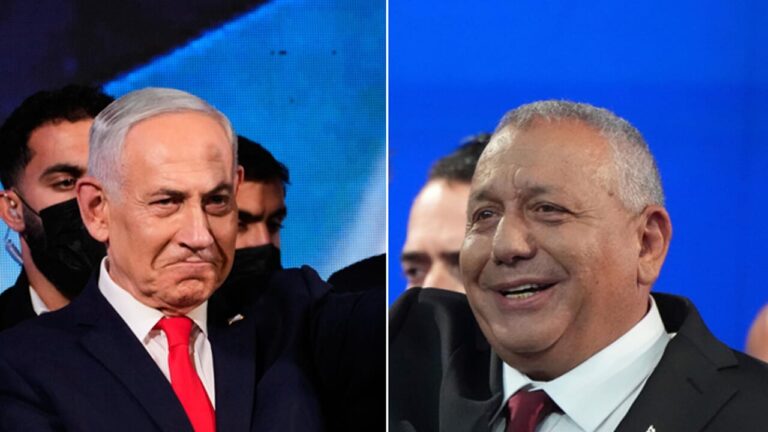
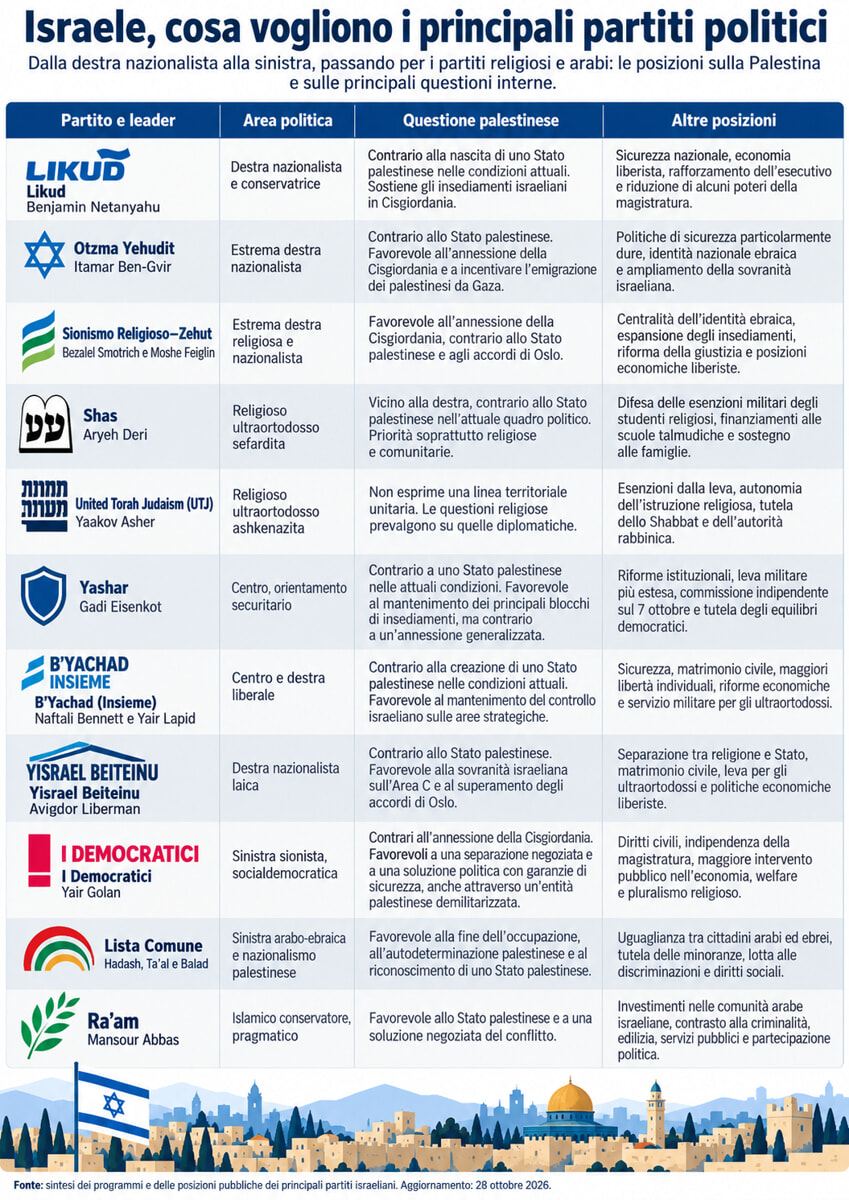
There are two main sides: one headed by the outgoing Prime Minister Benjamin Netanyahu and the other by the former general Gadi Eisenkot.
When 84.5% of the ballots have been counted, this is the situation: Prime Minister Benjamin Netanyahu’s bloc is ahead of the opposition by 54 seats to 49. The remaining 17 seats are held by the Arab parties: the “Joint List” and the “Ra’am” formation.
Within the coalitions, Benjamin Netanyahu’s Likud would confirm itself as the first party despite not having the numbers to govern on its own.
The Reservists party (which obtained 2.6%), Amcha Yisrael (The People of Israel, stuck at 1.7%) and the ultra-Orthodox Charedi Public (0.2%) did not exceed the threshold of 3.25%. By remaining outside Parliament, these parties will not be able to help the two blocs. In particular, the coalition led by the outgoing prime minister counted on the Reservists, while Ofer Winter of Amcha Yisrael had opened up the possibility of entering into a coalition with the opposition led by Eisenkot.
“Double envelope” unknown
As mentioned, we must calculate that there is a great unknown: the votes cast via “double envelope” which will be counted at a later stage. We are talking about 650 thousand votes: those of diplomats abroad, sailors, IDF soldiers. But also people hospitalized, for example. It is called “double envelope” because they are expressed on a card then placed in a double closed envelope.
Considering that each seat in the Knesset is equivalent to around 40 thousand votes, these ballots could have a significant impact on the final panorama.
The 4 scenarios
What happens if no one gets the 61 seats needed? The first scenario is that of a coalition government. After the official announcement of the results, President Isaac Herzog appoints a candidate to form a government. Negotiations then begin. In the previous elections in 2022, it took Benjamin Netanyahu 58 days to build a coalition. Even if Benjamin Netanyahu’s Likud confirms itself as the first party, it does not mean it will have an easy path, because it is the one that has the most vetoes in alliances. Gadi Eisenkot’s camp, on the contrary, could count on defections within the prime minister’s camp or on the votes of Arab parties.
The second is that of the minority government, based on the occasional support of some deputies. In this scenario, the two Arab-Israeli lists loom as a balance. Mansour Abbas’s Raam formation has repeatedly declared itself ready to collaborate with Gadi Eisenkot’s camp, while the Joint List has proposed offering a “safety net” to any coalition that manages to oust Netanyahu from power.
Third way: the government of national unity. There is recent precedent: in 2020, Benjamin Netanyahu and centrist Benny Gantz reached a power-sharing agreement but the peace lasted less than a year.
Last option: new elections. If no candidate manages to form a government, the Israeli population will have to go back to the polls. Meanwhile, Netanyahu would remain in office as interim prime minister.
Netanyahu’s first words
In a speech to his supporters gathered at the Likud party headquarters in Jerusalem, Netanyahu spoke about the prospect of creating a new executive. “I said, and I repeat, that we must form a strong, national and right-wing government”, Netanyahu’s words. “This is what we need to do.”
According to the prime minister, “it is simply forbidden to endanger Israel and form a government supported by anti-Zionist Arab parties who oppose our very existence, who consider Hamas a charitable organization and who define our soldiers as war criminals.”
Record turnout
One thing that is certainly worth mentioning is the turnout. Voter turnout reached 77.7%, the highest figure recorded since 2001. In total, 5,695,682 voters voted, 7.1% more than in the previous elections.
Trump takes credit
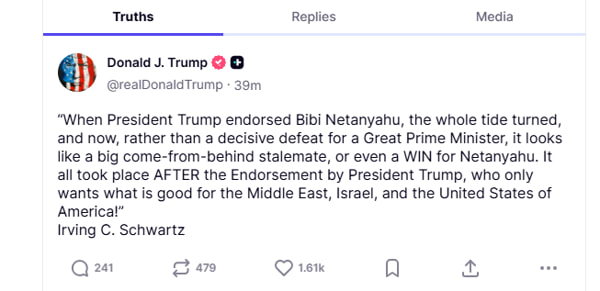
Meanwhile, Donald Trump takes credit for Netanyahu’s recovery from Washington and does so with a post on the Truth platform. “When President Trump supported Bibi Netanyahu – we read – the situation completely changed and now, instead of a crushing defeat for a great prime minister, a sensational comeback seems to be looming which ends in a draw, or even a victory for Netanyahu. It all happened after the endorsement of President Trump, who only wants the good of the Middle East, Israel and the United States of America”.
Italy’s reaction
“Let’s see what the new government will be. We hope that it can make a fundamental contribution to the conclusion of the war and to solving the problems of Hormuz and the entire Middle East”, the comment of the Foreign Minister, Antonio Tajani, on the sidelines of the Assembly of the Presidents of the Chambers of Commerce underway in Rome.