

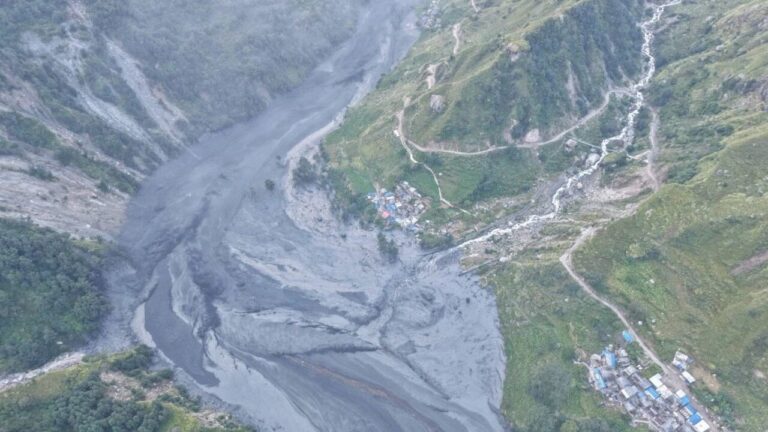
There is no peace for Nepal. After the enormous landslide that caused thousands of deaths and missing people last August, yesterday, Sunday 11 October, a huge wave of mud and debris overwhelmed the valley of the Budhi Gandaki river, in the central part of the country, sweeping away buildings, bridges and sections of the paths used by hikers. Five people are missing, while over a hundred foreign tourists are stranded in various locations along the Manaslu trekking route.
The searches continue with the support of four helicopters. “We continue search and rescue operations, we have no news of the five missing,” Nepalese army spokesman Raja Ram Basnet told AFP. Second Reuters321 people were rescued on Monday, including twelve foreigners. At the moment there are no confirmed victims.
The landslide and the failure of the dam
The flash flood occurred over the weekend in Gorkha district, about one hundred kilometers west of Kathmandu. According to the authorities’ initial reconstructions, a landslide that occurred before dawn blocked the river’s course, creating a temporary barrier. The subsequent collapse released the accumulated water, causing flooding downstream. The warning to the population was issued on Sunday morning.
Videos released on social media show a mass of dark water, full of debris, falling from the mountain and hitting dozens of buildings. The authorities’ toll shows over 200 damaged homes, five bridges and several hydroelectric plants. Reuters reports damage to three systems.
The river level has fallen, but the army announced that rescue efforts will continue on Tuesday. Prime Minister Balendra Shah assured on social media that the government has taken the necessary measures to restore living conditions in the affected areas and reactivate the infrastructure.
Over one hundred hikers are unable to return
The flood also interrupted part of the popular Manaslu itinerary, a high-altitude trek around the eighth highest peak in the world. Bhuwan Raj Ojha, a project official managing the conservation area, told Reuters that more than 100 foreign hikers were in locations from which they could not return because sections of the trail had been washed away.
“Hikers who want to return due to the flood must be rescued. Those who want to continue can do so from safe locations,” said Ojha, specifying that there are restaurants and refreshment facilities along the route that remain safe.
The previous disaster in August
The emergency comes as Nepal still faces the consequences of the catastrophe of August 26, when the collapse of a glacier and a portion of the mountain caused a devastating wave in the Trishuli valley, of which the Budhi Gandaki is a tributary. According to the toll reported by Reuters, that disaster caused 1,457 deaths, while thousands of people are still missing.
The causes of the latest flood remain to be explored. The International Center for Integrated Mountain Development, Icimod, believes that preliminary information is compatible with the failure of the barrier created by the landslide. Director General Pema Gyamtsho stressed that understanding the mechanism that triggered the flood will be essential to reduce future risks.
Floods and landslides are frequent in Nepal, especially during the summer monsoon. According to scientists cited by AFP, climate change can aggravate these phenomena, accelerating the melting of glaciers and increasing the instability of the Himalayan slopes. Basanta Raj Adhikari, director of the disaster study center at Tribhuvan University in Kathmandu, called for the need to review warning systems based only on river levels.