

On Friday 30 October the state budget bill for 2027 and the multi-year budget was stamped by the State Accounting Office and sent by the Ministry of Economy to the Presidency of the Council of Ministers for sending to the Presidency of the Republic. Then the head of state, Sergio Mattarella, authorized the presentation to the Chambers and the text was sent to Montecitorio. Among the new features that have emerged is the 100% revaluation of pensions only up to four times the minimum. In short, the government cuts the revaluation of medium-high social security checks, reviewing the mechanism for adjusting pensions to inflation.
Losses from 100 to a thousand euros per year
The annual revaluation of allowances is one of the most impactful points for state coffers relating to pensions. The automatic mechanism is very expensive for social security, and provides for an annual increase in the amounts of the checks to recover inflation. Given the narrow mesh in which we can operate, one of the hypotheses being maneuvered to raise cash is precisely that of reviewing this mechanism: we move from the system by brackets to that by bands.
A more penalizing system for those receiving pensions: in short, the increases in benefits in 2027 would be lower for some. With increase “losses” ranging from around 100 euros per year for those with a gross monthly pension of 2,500-3,000 euros, up to a thousand euros per year for the highest allowances (from six thousand euros gross and up). The loss grows as pensions rise. Those with a monthly pension of up to two thousand euros gross would lose nothing: with the adjustment to 100% of inflation there would be monthly increases of around 45-60 euros.
Today the law provides for three different percentages, depending on the amount of the social security check:
- 100% for checks up to 4 times the minimum treatment;
- 90% for those between 4 and 5 times the minimum;
- 75% for higher amounts.
The six bands
The budget law for 2027, the last one passed during this legislature, provides for 100% revaluation only for checks equal to or less than four times the INPS minimum payment (611.85 euros), equal to 2447.4 euros. After which the revaluation is progressively cut:
- for treatments “equal to or less than five times” the minimum (3,059.25 euros), the revaluation is 85%;
- the revaluation is 53% for checks “greater than five times” the minimum and “less than six” (up to 3,671.1 euros);
- by 47% between six times the minimum and eight times the minimum (4,894.8 euros);
- by 37% for those between eight times the minimum and 10 times the minimum (6,118.5 euros);
- 32% above 10 times the minimum.
The fund for the “new quota 100”
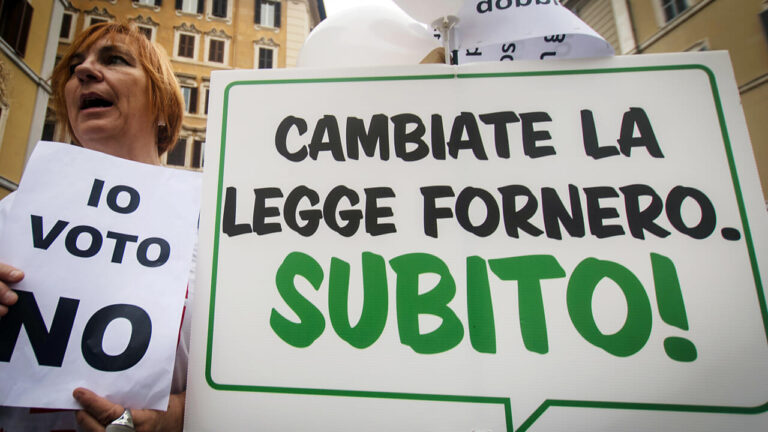
On the subject of pensions, there is also a fund “for support in leaving the job market” of 850 million euros per year for the three-year period 2027-2029. This is the measure which, according to the League, is intended to help overcome the Fornero law on pensions: it should finance people leaving work at 64. The fund is “intended to finance interventions, to be adopted – we read in the text – with subsequent legislative provision, aimed at regulating support measures for exiting the labor market, also with reference to specific individuals in difficulty and with possible measures regarding social safety nets”.
The League’s idea would be a new version of quota 100, also allowing people to leave work at 64, but only if they have 36 years of work behind them. Today this possibility already exists, but in general it is reserved for those who started paying contributions from 1 January 1996 and fall entirely within the contributory system. Now Matteo Salvini’s party aims to extend the measure to those who started working before 1996, but on one condition: accepting the recalculation of the contribution of the allowance. But leaving your job three years early would result in the application of a lower transformation coefficient. It means losing a lot of money, although based on current information it’s difficult to say how much.
Elsa Fornero, the Turin professor who is the author of the pension reform that the centre-right (especially the League) has been contesting for years, defined it as “a brazen and deceptive measure, yet another short-term idea by a gentleman chasing votes, financed with a new tax paid by pensioners”.
How the social Ape is changing
Also under consideration is the extension of the Social Ape in 2027. The measure concerns those who have reached 63 years and 6 months and allows some categories of workers to continue to access early retirement: among these, the unemployed, caregivers, people with disabilities and workers engaged in demanding tasks. The financing is an additional 180 million euros in 2027 and 370 million for 2028. The allocations will also continue in subsequent years, until 2032. The prohibition on combining the Social APE with income from employed or self-employed work remains, with the exception of occasional self-employment within 5,000 euros gross per year.