

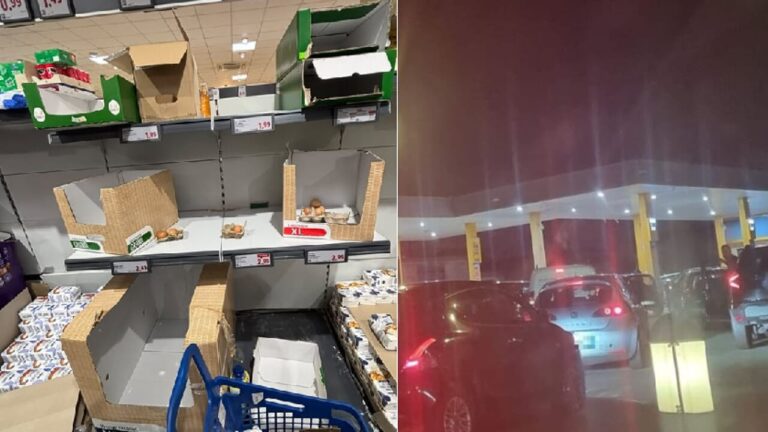
The protest grows like wildfire. For some days, hauliers and farmers have been demonstrating in various cities of Puglia against the increase in the cost of fuel and the drop in the price of oil, with mobilizations and road blocks at motorway toll booths, on ring roads and along other main roads. The workers of the former Ilva in Taranto are also protesting, because they oppose the closure of the plant: since Monday 12 October, when they blocked the entrance to the Eni refinery in Taranto in protest, three southern regions – Puglia, Basilicata and Calabria – have had to deal with fuel shortages.
The blocks of the Ilva dispute, therefore, are intertwined with those of protest against the high prices of petrol and diesel, and with those of the farmers. With direct consequences on the agri-food sector. Even for farmers, the reasons for the mobilization are essentially of an economic nature: at the basis there is the exponential growth in fuel costs and production costs. Olive growers are also worried about the crisis in the oil market.
Blockades in the Southern regions
The high cost of fuel has triggered the truck revolt: the hauliers are threatening to stop the country, while the government has decided to convene a discussion table for 27 October at the Ministry of Transport. Autonomous blocks have already been triggered in some regions of the South, such as in Puglia. Other demonstrations began on the initiative of autonomous committees and groups in Calabria and Sicily, but also in Campania and Basilicata.
Roads blocked and fuel ran out
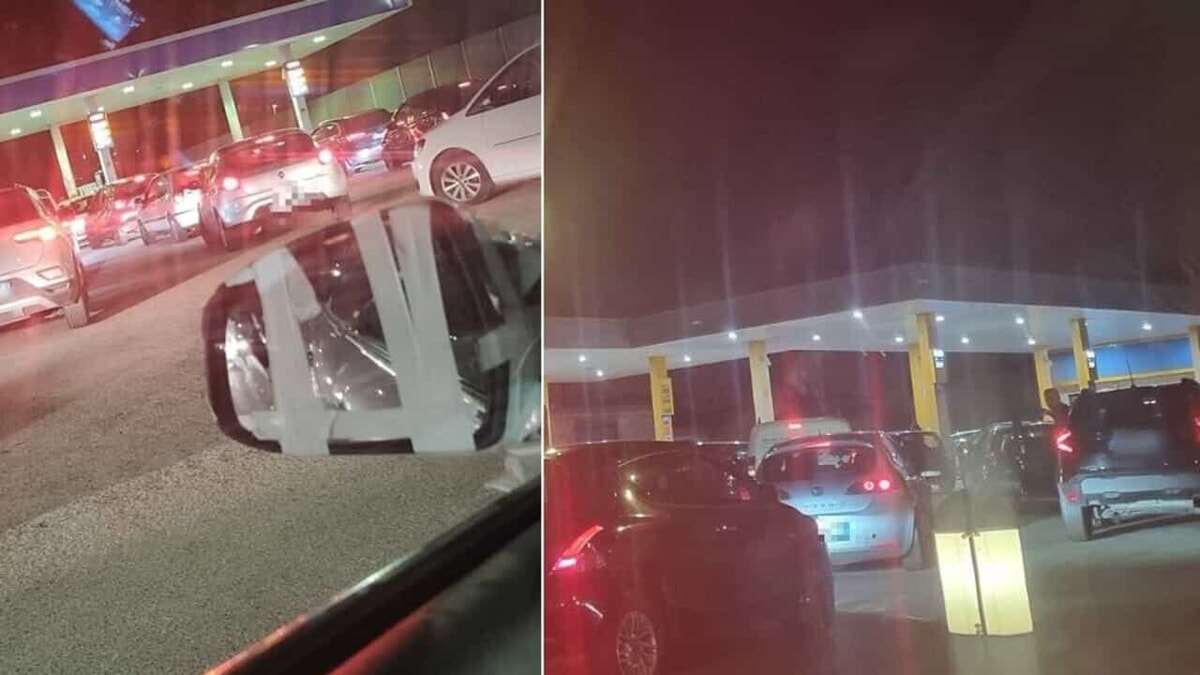
In Foggia, in particular, the protest has been going on since Sunday 11 October. Traffic is limited in many areas and there are several reports of fuel shortages at petrol stations, with long queues of cars lining up to fill up. The fear of a prolonged stoppage of supplies has pushed hundreds of Foggia motorists to go en masse to the pumps to fill up on supplies. City councilor Francesco Strippoli spoke of “attacks on petrol stations, almost all of which remained without a drop”.

Supermarket shelves without supplies
Not only that, because with the protests and empty truck tanks there are also the first supply difficulties for supermarkets, where some fresh products such as fruit and vegetables are starting to run out. In the municipality of San Severo (in the province of Foggia) empty shelves have been reported in supermarkets. Several mayors of the Gargano area, in the north-east of the province of Foggia, said that the same is happening in other countries and that “the situation is close to total collapse”.
View this post on Instagram
“Let’s block Italy”: what the government is doing
There is a real risk of a national stop against price increases at the pumps. The hauliers are threatening to “block Italy” to protest against the high cost of fuel and the failure to release the resources allocated in May to counter the increase in diesel prices. In the wake of spontaneous protests that have already started with autonomous blockades in Southern Italy, particularly in Puglia, and which from today will also extend to Calabria and then continue in the next few days in Sicily, the government has convened a round table for Tuesday 27 October at the Ministry of Transport. Meanwhile in Basilicata and Calabria there is alarm because fuel reserves are running out, with several petrol stations running dry and long queues to refuel.
“Spontaneous protests”
“They are spontaneous protests, not governed and not proclaimed by trade associations, which makes the picture even more disturbing because it means that we are moving in the context of the desperation of entrepreneurs”, said the president of Conftrasporto, Pasquale Russo. Linea Unatras (National Union of Freight Road Transport Associations) speaks of “a widespread malaise that is no longer sustainable on the part of companies”.
Dear fuel, over 14 thousand distributors do not go below 2.20 euros per litre: where you can really save
The acronyms have both called for government intervention: “We ask the government for an urgent ad horas convocation of the road haulage associations, otherwise we will have to resort to the evaluation of a national shutdown and the country will come to a standstill”, said Russo, while Unatras had warned: “If it does not convene a meeting with the utmost urgency, it assumes the responsibility of consigning the sector to total paralysis”.
What the unions are asking for
According to the unions, “further allocations” are needed to stem the continuous rise in the price of diesel which has seen “an increase of more than 50 cents per liter since the beginning of the war”, recalls the president of Conftrasporto. In Puglia and Calabria the emergency is exacerbated by the logistical crisis affecting the distribution network also due to the blockade of the Taranto refinery, linked to the former Ilva strike.
“The Meloni government must intervene immediately on the fuel emergency, which has now extended to the entire South”, was the request from the Calabria Democratic Party. While the president of Confindustria Puglia, Nicola Delle Donne, warns that “many companies risk stopping due to lack of fuel, from transport to infrastructure and construction”.
The situation in Calabria
The lorry protest against high fuel prices proclaimed by Fedralog, the regional logistics federation, has officially started in Calabria too, and will continue until Tuesday 20 October. The trucks involved positioned themselves on the sides of the roads without implementing real blocks, at the moment, under the control of the police. However, there will be no shortage of traffic disruptions due to the narrowing of the road.
There are around fifteen garrisons identified in the Calabrian territory, including those present in the Lamezia Terme airport area, in the port of Gioia Tauro and in the Cosenza area near the A2 junctions. The protest, among other things, adds to the demonstrations that have been ongoing for days and organized by farmers.
The mobilization in Sicily
In Sicily, however, the truck strike began in the last few hours. The trucks will remain parked in the yards and the semi-trailers loaded with goods will not be collected from the ships in the Sicilian ports. For five days, from today to Tuesday 20 October, an important part of the island’s transport system decided to stop to protest against high fuel prices. The committee of Sicilian hauliers, led by Salvatore Bella, proclaimed the closure until midnight on the 20th.
How is it going in Campania and Basilicata
The truckers’ protest against high fuel prices on the motorway arteries in the provinces of Caserta and Naples began at midnight and is still ongoing. In particular, heavy vehicles are under surveillance near the Nola toll booth on the A30 Caserta-Salerno motorway, and the Caianello toll booth on the A1 Milan-Naples motorway. The checkpoints, however, are leaving a gap to allow other vehicles to pass, but are creating traffic disruption. Other vehicles are under surveillance in Caserta Sud. The traffic police are monitoring the situation.
Protests have also taken place in Basilicata, where around one hundred trucks have been blocking heavy traffic since night along the Ionian state road 106, at the junction with Fondovalle dell’Agri, in Scanzano Jonico, in the Matera area. The mobilization, which is also destined to continue until October 20th, involves various strategic junctions of the regional road system. The protests were organized in particular at the intersections between the state road 106 and the state road 598 Val d’Agri, in Scanzano Jonico, and between the Ionica and the state road 653 Sinnica, in the area between Rotondella and Policoro.
The block concerns trucks and articulated vehicles, while the transit of private cars, buses, school buses and emergency vehicles is guaranteed 24 hours a day. Other garrisons are reported in the Vulture Melfese, along the Bradanica and on the Noce valley floor.
The problems for medical care
The ongoing protests also risk blocking medical assistance, especially for local care. The alarm was raised by Dauno Morlino, provincial secretary of Fimmg, the Italian federation of general practitioners in Foggia: “Hundreds of family doctors, emergency medical doctors and 118 health emergency doctors guarantee local care every day, moving with their own means to reach the stations, the practices and, above all, the homes of the most fragile patients. If the fuel shortage persists, the assistance is at risk”.
At the same time, the doctors’ federation is keen to clarify its position both towards the protesting citizens and towards those responsible for public management: “Our closeness goes to the numerous demonstrators involved. Instead, the institutions are asked to protect local assistance, guaranteeing doctors and healthcare workers the possibility of replenishing their own vehicles”, concluded Morlino.