

Far from structural reform of the system, as was heard from many quarters in the last electoral campaign, perhaps with greater flexibility to anticipate leaving work. The financial resources available are few, and not today: there is no point in beating around the bush. And so, all things considered, in 2026 retiring before the age of 67, the age threshold from which the door to the old age allowance begins to open up, becomes much more complicated.
The reason is simple: neither quota 103 nor the women’s option, the two main channels for early retirement provided by INPS in recent years, no longer exist. The rules this year are a little stricter, therefore, and the concrete possibilities of early retirement are greatly reduced. For thousands of workers who are thinking of leaving work early, the new regulations require a rethink of their plans. Especially because there are few alternatives available.
The ordinary exit, but watch out for the moving windows
For those considering leaving work before the age of 67, a traditional channel remains in place, that of the ordinary early pension, introduced with the Fornero law and modified several times. This is an instrument that allows retirement with a minimum contribution of 42 years and 10 months for men and 41 years and 10 months for women, regardless of age. In this case, however, the monthly check does not arrive immediately. Let’s take an example. For a woman who completed 41 years and 10 months of contributions in February this year, the pension will start in May, or later if she is a public sector worker.
This happens because the so-called “moving windows” come into play, a variable sliding period that must pass between the moment of maturation of the age and contribution requirements useful for the right to a pension and the effective date of the social security check. It is an expedient introduced by the legislator to contain pension expenditure: the payment of the benefit is postponed to a time subsequent to the one in which the requirements for obtaining the pension have accrued.
The raising of the threshold of 67 years as a result of the increase in life expectancy has been postponed by one year. Even if the requirements for the ordinary early pension in 2026 are confirmed, therefore, the payment does not start immediately upon reaching the contribution threshold. A sliding window of three months must be taken into account, which rises up to five for some categories of public employment.
Old age and thresholds
This year the rules also remain unchanged with regard to access to the old-age pension, the most widespread and usual channel for workers. Therefore, without the increase in the age threshold, the result of Istat estimates on life expectancy, even in 2026 everyone will need at least 67 years of age and 20 years of contributions actually paid. In this case there are no moving windows: it means that, once the required requirements have been reached, the allowance starts automatically from the first day of the month following the actual exit, without further waiting.
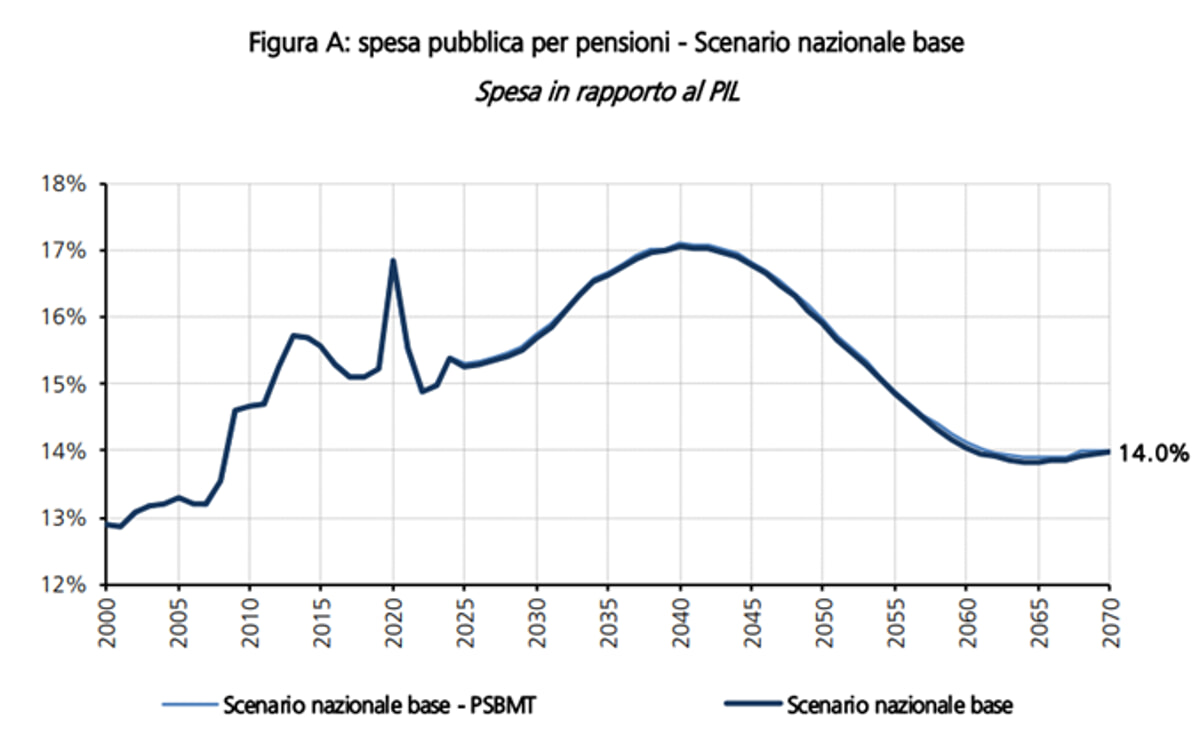
But then things will change. From 1 January 2027 an extra month will be needed. In 2028 the threshold will rise again, reaching 67 years and three months. The increase in age and contribution requirements for retirement could be a further three months in 2029 and another two months in 2031. These are estimates and forecasts contained in the 2025 report “Medium-long term trends in the pension and social-healthcare system”, developed by the State General Accounting Office, which is a department of the Ministry of Economy and Finance. “In any case, the adjustments actually applied will be those ascertained by Istat in the final balance”, specifies the report.
Even if this year the adjustment to life expectancy is suspended, and therefore there will be no automatic increases in age or contributions required, for workers who, despite meeting the age requirement, have discontinuous careers behind them, the bar of 20 years of effective contributions remains the main obstacle. Failure to reach the threshold opens the way to alternative forms of social security protection such as social security. However, it should be remembered that the payment is guaranteed to applicants in the case of incomes below the threshold of less than 7,002.97 euros, doubled to 14,005.94 euros if married.
The woman option flop
As mentioned at the beginning, the hypothesis of an early exit with a women’s option definitively exits the scene in 2026. The measure, one of the flexible tools most used by female workers to bring forward retirement, however survives for female workers who have fulfilled the requirements by 31 December 2024. In this case, the application presented in subsequent years remains valid under the same conditions. At least 35 years of contributions are required. The allowance is calculated entirely using the contributory method and a consequent reduction in the amount.
The measure was a flop. In 2025, according to INPS monitoring of retirement flows, 2,147 female workers left work with the female option, with a decrease of 40.5% compared to the 3,612 recorded in the previous year. Over 1,800 pensions with a women’s option were paid by the age of 63. The data is affected by the restrictions on access to the measure introduced in recent years.
The social Ape remains
Among the early exit routes, the social Ape remains in force. Until 31 December 2026, workers in difficulty – such as the unemployed, caregivers or disabled – with at least 63 years and 5 months of age and with 30 years of contributions can request the activation of this “bridge” instrument to accompany the old-age pension. The contribution threshold rises to 36 years for some categories of strenuous activities.
The difficult condition at the time of applying for a pension must then be considered, such as unemployment, caregiving or strenuous activity. For workers who have carried out strenuous tasks for half their career or for 7 years (out of the last 10), forms of early retirement remain in place, also in 2026. In any case, you need at least 61 years and 7 months of age and 35 years of paid contributions. Those affected by this instrument are in particular night workers who carry out shifts from midnight to 5 am, “chain line” workers and drivers of public transport, i.e. vehicles used for public transport with a capacity of no less than nine seats.
A further early retirement channel is reserved for the category of so-called early workers. Anyone who started working before the age of 19, paying at least 12 months of actual contributions at the time, can leave work with 41 years of contributions regardless of age.