

It’s called the Arctic Sentry, read as NATO’s “wall” in the Arctic. For Secretary General Mark Rutte, this is not a choice, but an existential necessity: ensuring a “safe and free” Arctic from the growing shadows of Moscow and Beijing. Not everyone, however, sees the operation as a purely defensive move. Detractors believe it is yet another exercise in rebranding the Alliance to appease Donald Trump’s United States over the Greenland issue.
Great fanfare but very little substance
With Trump’s return to the White House and his repeated threats to aim for the Danish island, NATO seems to want to offer Washington a guarantee of total control over the area of the far north, locking down European loyalty to the American line in order to keep the transatlantic axis firm.
The new mission, however, does not stand out for its freshness. Despite Rutte’s proclamations, the feeling is that the Alliance is recycling strategies already seen, limiting itself to giving a catchy name to a defensive posture that has already been a reality for years. The mission, in fact, had already been agreed by Rutte and Trump last month in Davos, Switzerland, with the aim of strengthening NATO’s position in the Arctic by bringing together the activities of the 32 member countries under a single umbrella. That is, gathering forces to monitor and, if necessary, stop what Atlantic officials have called an aggressive Russia and a growing Chinese presence. All to appease Trump’s aims.
❝In the face of Russia’s increased military activity and China’s growing interest in the High North, it was crucial that we do more. Which is why we have launched Arctic Sentry❞
— @SecGenNATO on NATO’s new military activity Arctic Sentry pic.twitter.com/m75LDcHzBg
— NATO (@NATO) February 11, 2026
At first the operation ended up in the meat grinder of the political crisis between Washington and Brussels, especially after the sending of a few European military forces to the Arctic island. But after several threats of a commercial and diplomatic nature, the crisis currently seems to have subsided. The Supreme Allied Commander in Europe, American General Alexus Grynkewich, has finally received the green light from Washington. “Arctic Sentry – he commented on February 11 – underlines the Alliance’s commitment to safeguarding its members and maintaining stability in one of the most strategically significant and environmentally difficult areas in the world”.
Greenland will not be the focus of operations
At first, what the various countries were already planning independently, both in terms of exercises and use of assets, will simply be brought together under the NATO umbrella. In fact, under the banner of the “Arctic Sentinel”, historic maneuvers and new national programs will converge: from the Arctic Endurance led by Denmark, focused on multi-domain scenarios, to the La Fayette operation by France, designed to test the speed of projection of forces from the Atlantic ports towards the ice, up to the Norwegian Cold Response, which already sees the arrival of troops from various allied countries. Denmark, for its part, promises a “substantial contribution” to the operation and says it is fully satisfied. The model adopted follows the trajectories already marked by the Alliance in deterrence operations in the Baltic Sea and Eastern Europe.
Rebranding operations, then. Because the mission aims to transform a series of periodic exercises into an integrated and permanent presence. In this way, NATO can claim a defensive “wall” in the Arctic region without having to immediately invest billions in new platforms, making the most of the assets already deployed by Copenhagen, Oslo and Paris. And Greenland won’t even be at the center of operations.
The 33 Russian military maneuvers in the Arctic in 365 days
The Arctic represents a strategic gateway to the North Atlantic and hosts crucial hubs for trade, transportation and communication links between North America and Europe. Rutte clearly indicated the two catalysts of the acceleration on Arctic security: Moscow and Beijing.
Let’s start with the country led by Putin. Russia considers the Arctic vital to its economic and strategic survival and, through this lens, one must identify the push for Russian militarization in the region, which has grown exponentially in the last year alone. In fact, the reopening of Soviet bases and the deployment of missile systems are no longer seen as defensive acts, but as a direct threat to the Alliance’s flanks.
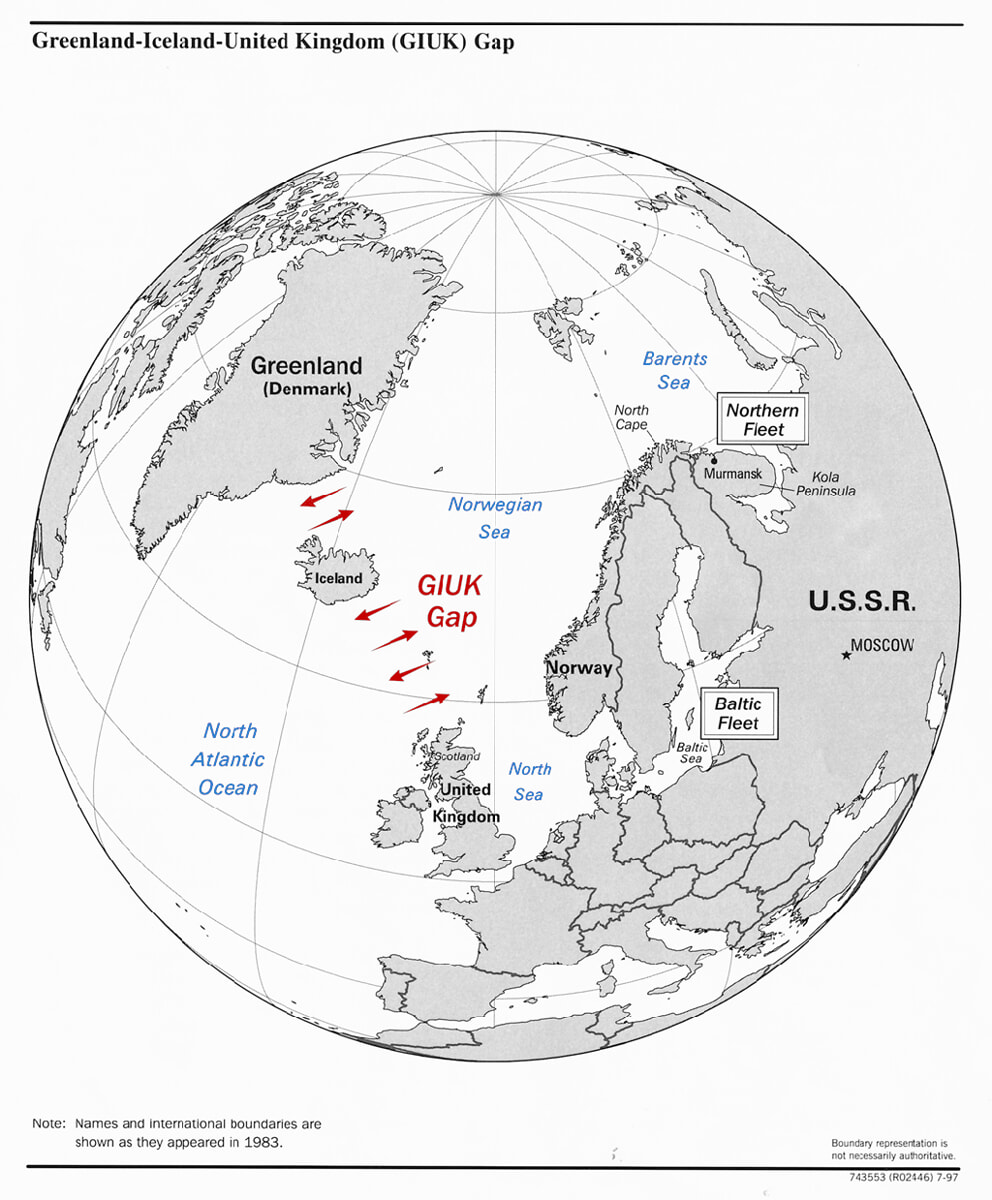
Since the beginning of January 2025, Russia has conducted at least 33 military maneuvers in the Arctic, about half of them training exercises, according to the Center for Strategic and International Studies (CSIS), a Washington-based think tank. The beating heart of the Russian threat lies on the Kola Peninsula. Here, thanks to the Atlantic currents that keep the port of Murmansk, on the Barents Sea, ice-free all year round, the Russian Northern Fleet has deployed nuclear-powered submarines equipped with atomic warheads. Moscow protects these strategic assets with coastal and air patrols.
But the obsession of NATO officials has a precise name: GIUK Gap, the maritime corridor between Greenland, Iceland and the United Kingdom, which can be crossed by Russian nuclear submarines to access the Atlantic and easily reach the American and European coasts. In addition to the nuclear threat, Alliance officials denounce an underground war of sabotage of communications cables and pipelines and smuggling of sanctioned oil, a disruptive activity aimed at destabilizing global markets and connections. Greenland certainly remains in the background, through which the shortest route for a Russian or Chinese missile attack against the United States passes.
China’s ambition: from the first Ukrainian icebreaker to the nuclear-powered one
Beijing, despite not having coasts washed by the Arctic Ocean, defined itself as a “quasi-Arctic” power in 2018. Chinese interest in sea routes (the Polar Silk Road) and in Greenland’s mineral resources are the real factor that pushed NATO to intervene and close ranks with this new strategy.
The Chinese Navy does not yet patrol these waters on a regular basis, but its commercial ships are now a stable presence. And here the alarm goes off, because the boundary between the civil and military sectors is thinning under the leadership of Xi Jinping. The construction of research bases, energy cooperation in the oil and gas sector and even joint military patrols with Russia in areas close to Alaska clearly speak to Beijing’s ambitions. Ambitions that have taken the form of a new nuclear-powered icebreaker, presented last December as a conceptual prototype by the State Research Institute 708. Officially it is a “multi-purpose” cargo ship and for tourism, practically it is the vessel capable of crushing sheets of ice up to 2.5 meters thick so as to strengthen the military presence in the Arctic. The place of birth already says a lot. The ship comes from the China State Shipbuilding Corp shipyards, the same ones that gave birth to the Fujian, Beijing’s third aircraft carrier, which entered service at the end of last year with advanced military technologies.
Chinese ambitions in the Arctic date back decades. The first step was taken with Ukraine’s purchase of its first icebreaker, the Xue Long (“Snow Dragon”), in 1993. In 2004, China opened its first permanent Arctic research station in Svalbard, followed by another in Iceland in 2018. In September 2025, the container ship Istanbul Bridge completed the voyage from Ningbo to Felixstowe inaugurating the “China-Europe Arctic Express”, the first fast container route between China and Europe via the Arctic.
Russia has the highest number of icebreakers
Icebreakers prove to be fundamental tools for power projection in polar areas, because they allow access to frozen territories and maintain a continuous presence. Data from the International Institute for Strategic Studies (IISS) outline a worrying reality: despite NATO’s efforts, Russia maintains an overwhelming numerical primacy, while China is accelerating its rise with unprecedented industrial speed.
As of 2022, Russia boasted 57 icebreakers and Arctic patrol vessels. By 2026, Moscow plans to further consolidate this lead with the entry into service of new Arktika-class nuclear units, such as the Chukotka.
Also in 2022, NATO had 47 units, a number which however hides a pitfall: a large part of the US and Canadian fleet is obsolete, with ships exceeding 40 years of service. The entry of Helsinki and Stockholm into the Alliance, after the war in Ukraine, provided a breath of fresh air. Something changes in the two-year period 2024-2026. To fill the gap, the US, Canada and Finland have launched the Ice Pact, a monumental plan to build up to 90 new icebreakers over the next ten years, thanks to billions of dollars in investments.
And then there is China, which is continuing its rise. If in 2022 the People’s Republic had two icebreakers, it now has double that number. Beijing is already testing nuclear-powered prototypes and has demonstrated it can deploy up to five ships simultaneously near Alaska, marking the transition from “observer” to “protagonist” in the region. Steps that cannot be ignored by NATO.