

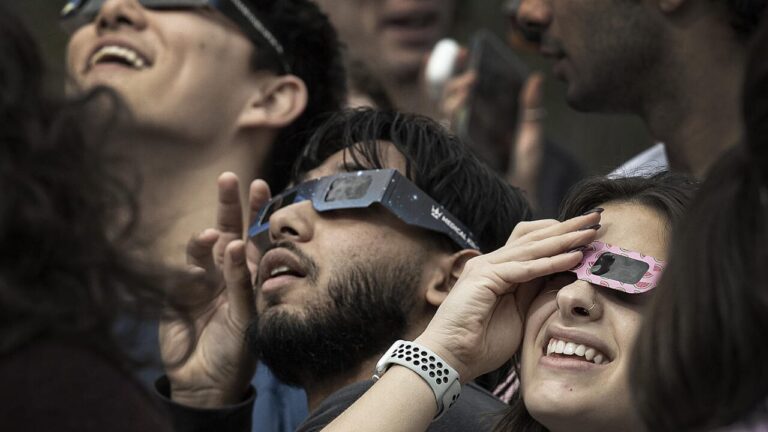
On August 12th there will be the first total solar eclipse in Europe since 1999, but in Italy we will have to settle for a partial eclipse which will also not be easy to see. The advice for those who want to try to observe it is however to prepare in advance: first by purchasing specific glasses (no, normal sunglasses are not enough) and secondly by choosing an observation place from which you can actually see the setting sun (we’ll get to that shortly). In the meantime, let’s start with some contextual information.
A total solar eclipse occurs when the apparent dimensions of the Moon and Sun are perfectly equal in the sky, allowing the lunar disk to completely mask the solar disk. This phenomenon requires our satellite to be near the perigee, i.e. in the phase of maximum proximity to the Earth along its orbit. This is exactly what will happen on August 12: the Moon will be approximately 367,000 km from us, just 3,000 km away from the point of closest approach reached two days earlier.
How to see the eclipse of August 12th in Italy: times
The total dark band will cross Spain, Iceland and Greenland. As mentioned above, in Italy the eclipse will be partial and the phenomenon will be visible in the late afternoon, roughly around the time of sunset. A circumstance that will make it difficult to find an adequate observation point. The start of the eclipse is expected around 7.27pm and 7.38pm depending on the city, while the maximum peak will be reached between 7.56pm and 8.22pm when the sun will have almost disappeared behind the mountains, especially in the Center and South where sunset occurs a few minutes before.
Here are the exact and distinct times city by city:
| City | Start | Peak | Blackout |
| Milan | 7.27pm | 8.20pm | 92.3% |
| Turin | 7.28pm | 8.21pm | 93.3% |
| Rome | 7.32pm | 8.11pm | 69.1% |
| Naples | 7.33pm | 8.02pm | 45.9% |
| Palermo | 7.37pm | 8.02pm | 38.9% |
The phenomenon will be observable more in the North, especially in the Po Valley, less in the South. According to the specialized site ‘Time and date’ in Milan, Genoa, Bologna and Turin the darkening will be greater than 90%, while in Rome and Naples it will be 69.12% and 45.84% respectively.
How to see the eclipse?
The Media Inaf website of the national astrophysics institute explains that the favored regions “are the northern and western ones: Piedmont, Valle d’Aosta, Liguria, Lombardy, Emilia-Romagna, Tuscany and Sardinia”. There are three phases: the beginning of the eclipse (just before 7.30 pm), an intermediate phase around 7.50 pm, and then the peak at 8.20 pm. INAF has also prepared maps showing the visibility of the sun during the eclipse on August 12.
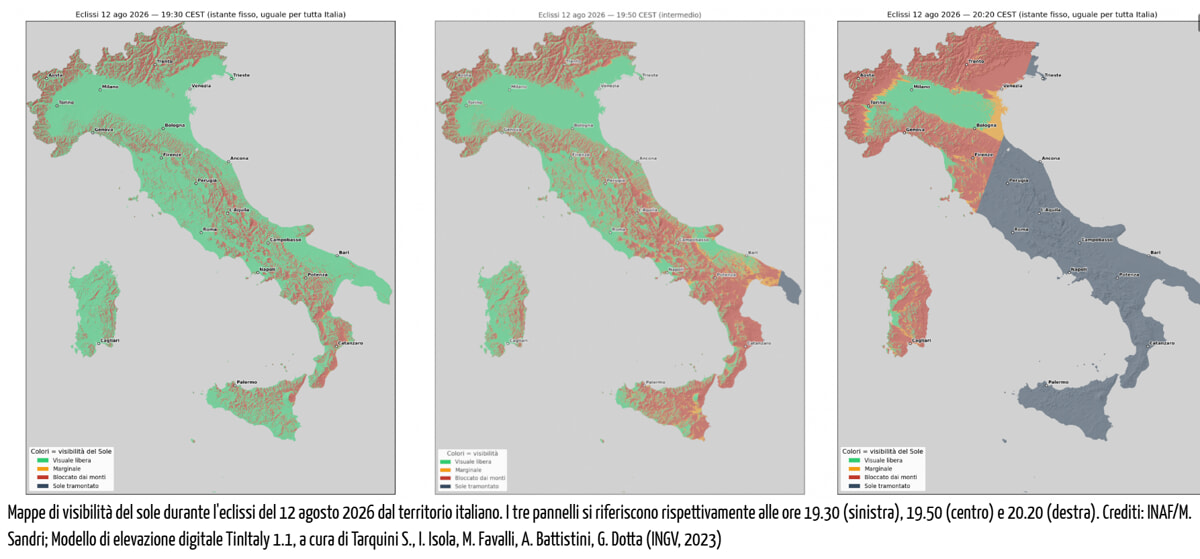
The fact that the sun is setting complicates the plans. We must therefore make sure, perhaps by doing an inspection the previous day, that in the indicated time frame the sun is actually visible from the point where we want to observe it. All it takes is a hill, a building, a forest or a mountain to the west to ruin everything. Since the sun’s rays arrive almost horizontal at that time, a high mountain located in the west “casts a very long shadow” for tens of kilometers towards the east, hiding the sun long before it touches the real horizon line.
To see the eclipse you therefore need a “low and free” western horizon, that is, the possibility of looking towards the west without anything in front (such as the sea shore facing west, a large grainy plain or the top of a mountain).
The regions where the eclipse will be seen best:
- Liguria (especially Western Liguria/Ventimiglia): darkening around 94-95%.
- Piedmont and Valle d’Aosta: darkening between 93% and 95%.
- Lombardy (especially the western provinces): darkening between 91% and 93%.
- Sardinia (especially the north-west area, Asinara/Alghero): it is the area of Italy geographically closest to the trajectory of totality that passes through the Balearics and Spain.
- Tuscany and Emilia-Romagna: darkening still high.
Buy specific glasses
Since this is a partial eclipse, the sun will never be completely hidden by the Moon. Looking at the solar disk with the naked eye – even for just a few seconds – causes irreversible damage to the retina (solar retinopathy) without feeling immediate pain. The Ministry of Health recommends using only eclipse glasses certified according to the ISO 12312-2 standard. Any other means must be avoided. And therefore it is not sufficient to wear normal sunglasses (even if overlapping), x-ray films, smoked glass, CDs or improvised photographic filters. They do not guarantee any protection from ultraviolet and infrared rays. In this case, do-it-yourself remedies are a danger. Our sight is worth more than an eclipse.