

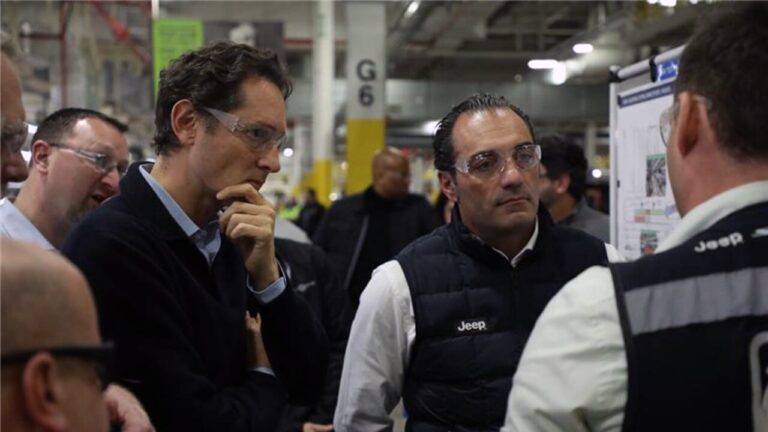
On the occasion of Investor Day 2026, Stellantis presented FaSTLAne 2030, the new 60 billion euro strategic plan with which the group aims to accelerate growth and profitability over the next five years. The plan, illustrated by CEO Antonio Filosa and opened by President John Elkann, marks a turn towards industrial realism, investment discipline and operational efficiency, after a difficult phase and while pressure from Chinese manufacturers is growing.
Stellantis’ new “fast track” is built on six pillars: more selective management of the brand portfolio, investments in global platforms and technologies, strategic partnerships, optimization of production, greater focus on execution and strengthening local teams. The declared objective is to put the customer at the centre, focusing on more accessible models, faster development times and greater industrial flexibility.
U-turn on electric
Between now and 2030, the group expects more than 60 new launches and 50 significant updates. The engine strategy abandons the “all-in” approach to electrics and focuses on freedom of choice: 29 electric vehicles, 15 plug-in hybrids or range extenders, 24 full hybrids and 39 thermal or mild hybrid models.
The four global brands on which Stellantis will focus most of its efforts are Jeep, Ram, Peugeot and Fiat. However, 70% of investments intended for products and brands will go not only to these brands, but also to Pro One, the commercial vehicle division. Chrysler, Dodge, Citroën, Opel and Alfa Romeo will instead have a more regional role, while DS and Lancia will be managed by Citroën and Fiat respectively as specialized brands.
The 2CV returns, Fiat roars with the Grizzly
On the product front, the expected innovations include the Fiat Grizzly family, the return of the electric Citroën 2CV and new Jeep models, including the Recon. For Maserati, Stellantis confirms its intention to strengthen the brand with two new E-segment models; a more detailed roadmap will be presented in Modena in December 2026.
The technological heart of the plan will be the new STLA One platform, expected in 2027. It will be a modular platform for segments B, C and D, designed to reduce complexity and achieve a cost efficiency of 20%. Stellantis aims to use it for more than 30 models and to converge half of global volumes on three main platforms by 2030.
Cars made in half the time
A central role will also be entrusted to artificial intelligence, already applied in over 120 operational areas. The group aims to reduce vehicle development cycles from around 40 to 24 months, thus approaching the speed of Asian manufacturers. STLA Brain, STLA SmartCockpit and STLA AutoDrive will also debut in 2027, while the collaboration with Wayve provides for a door-to-door hands-free assisted driving system in North America from 2028.
What happens in Italy? The role of Pomigliano
If the bulk of the money (60%) will fly to North America to push large SUVs and Pick-ups, Europe will play a fundamental game on convenience. Stellantis aims to grow revenues by 15% in the old continent. As? Producing a new generation of E-Cars, affordable electric city cars. The good news for Italy is that the production of these cars will take place in Europe, starting from the historic Pomigliano d’Arco plant.
On a financial level, the group aims to increase revenues from 154 billion in 2025 to 190 billion in 2030, with an adjusted operating margin of 7%. The goal is to return to positive industrial cash flow in 2027 and reach $6 billion in 2030. The program also calls for $6 billion in annual cost reductions by 2028 compared to the 2025 baseline.