

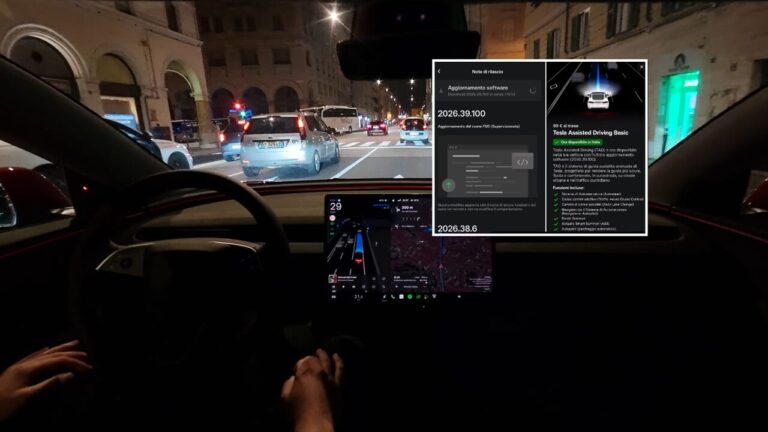
A Tesla capable of crossing the city, tackling a roundabout, stopping at intersections and changing lanes without the driver having to intervene on the steering wheel and pedals. This is what Tesla assisted driving (Tad) promises, the assisted driving system developed by Elon Musk’s car company which has also obtained the green light in Italy. But be careful: it doesn’t mean that it will be possible to get into the car, indicate a destination and concentrate on other things while the car drives itself. However, let’s try to explain the story well.
The Ministry of Infrastructure and Transport announced on November 20 the authorization to use the system on Italian roads. The measure comes after the Motorization, on November 19, recognized the provisional approval issued by the Dutch Rdw authority. Italy thus joins the other European countries that have already allowed the use of the technology, without waiting for an authorization automatically valid throughout the European Union. The usage limits have already been lifted and cars already enabled for autonomous driving are already circulating on Italian roads.
FIRST KILOMETERS with Tesla Assisted Driving in Italy! 🇮🇹 While Italian Tesla owners are still waiting for the update, the geofence has already been lifted, allowing me to experience Italian streets with TAD for the very first time! I headed to Trieste, just across the 🇸🇮 Slovenian border, where I put the system to a proper test. Already in the first hour, I encountered plenty of interesting situations, so be sure to check out my first impressions video, coming very soon to my YouTube channel! @Tesla @teslaeurope @elonmusk @SawyerMerritt @wholemars @TeslaOwnersIT @TeslaClubItaly @FSD_Italy
— Jan Skočaj (@JSkocaj) November 21, 2026
However, it must be specified that in reality it is assisted driving and not entirely autonomous. The innovation concerns above all the car’s ability to deal with more complex driving situations compared to traditional lane keeping and automatic speed regulation systems. The TAD is in fact the European evolution of the technology marketed in the United States under the name “supervised” Full self-driving. The differences depend on the European approval standards, the characteristics of the software and the conditions imposed to allow its use.
The driver remains responsible
When TAD is active, the car uses external cameras and an artificial intelligence system to interpret what is happening on the road. A neural network, trained on large amounts of driving data, processes the images and determines how to intervene on the steering, accelerator and brakes. Concretely, according to Tesla, the car can follow the route set on the navigator, change lanes, overcome obstacles, make right and left turns, cross intersections, go around roundabouts and enter and exit the highway. It can also adapt speed to traffic conditions and recognize the presence of cars, motorcycles, bicycles and other road users.
The fundamental difference compared to a fully autonomous car, however, concerns the role of those who sit behind the wheel. The driver must constantly observe the road, be ready to regain control and remains responsible for the movement of the vehicle. This means that you can temporarily leave your hands off the steering wheel, in the conditions allowed by the system, but do not divert your attention from driving. Internal cameras ensure that the driver is looking at the road and can intervene immediately. Warnings are issued in the event of distraction; if these are repeatedly ignored, the software may deactivate itself and temporarily suspend access to the feature.
No, Mad Max mode will not be active
Those who have tried the system also confirm other discrepancies, and the most concrete concerns speed. In the European version, Tesla had to modify the mechanism that allows you to set a speed higher than the limit detected by the car. Previously, the configurable compensation could be up to 50%: on a road with a 50 km/h limit, the system could therefore be set up to 75 km/h. The new version approved by the Dutch authority reduces this maximum margin to 10%. Furthermore, the parameter is automatically reset to zero every time the car is started. Furthermore, above 130 km/h the driver must keep his hands on the steering wheel.
Furthermore, in the United States the FSD system offers the driver various driving modes – including aggressive “Mad Max fashions”designed to carry out rapid insertions and decisive maneuvers at complex intersections – in Europe the software is distributed in a single configuration characterized by maximum pragmatism and prudence.
“The car does not try to instantly reach the set maximum speed as the basic Autopilot would, but adapts the pace to the road context, modulating the acceleration in an extremely progressive and comfortable way” explains those who have tried it.
In other words, the European TAD is not simply the American Full Self-Driving translated into Italian. It is a version adapted to a different regulatory framework, with constraints on speed settings and driver surveillance. For Italian owners, meanwhile, Tesla has provided a specific activation procedure conditional on signing a subscription of 99 euros per month, VAT included, equivalent to 1,188 euros for twelve consecutive months. The system will be distributed through a remote software update, without necessarily taking the car to the workshop.
For those who will be available
Not all Teslas currently on the road will necessarily be able to use it. The European homologation and the updates approved by the RDW concern cars equipped with hardware 4.0 or later. To activate the TAD, the owner will have to access the car’s settings, accept the conditions of use, watch a mandatory video tutorial and pass a short quiz on how the technology works.