

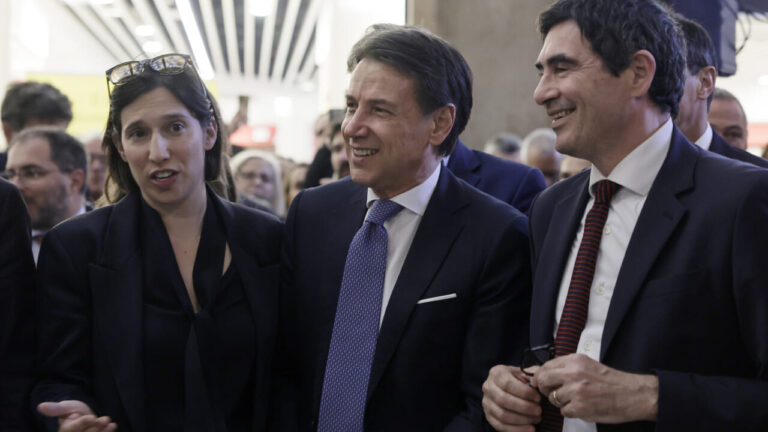
If Avs and Pd are thinking of a tax on the assets of the “super rich”, the M5s relaunches with a tax on financial investments, promising however to safeguard the portfolios of “small savers”. Speaking at the Green party in Rome, Conte said he was against hitting “net worth” because “there are also company shares” and “we cannot depress growth and productivity today”.
Saying “no to assets” does not, however, mean “saying no to taxation, to a levy on the super rich” clarified the M5s leader who therefore put “financial speculation” in his sights, i.e. “high-frequency financial transactions” and “large financial riches that should instead be injected into what I call the real economy. There we can take something – he explained – to finance this fund that cuts taxes, work and taxes for businesses”.
#Property, Conte: “I don’t agree. The Oxfam proposal gets votes because one reads those great patrimonial riches, but they are built on net worth, which also includes company shares, there’s everything. We cannot depress growth and productivity” https://t.co/yN2r90iS56
— Politikos (@politikosit) November 15, 2026
The idea of targeting financial investments is not new in the broad field, so much so that even Elly Schlein, only last summer, underlined that “financial income is taxed at 26%”, while “workers are taxed at over 40%”, thus supporting the need to rebalance the tax burden.
The 1% stamp duty on the securities account
Now the proposal is back in vogue. In an interview with Corriere della Sera, M5s vice-president Mario Turco underlined the need to “tax large financial wealth more, progressively increasing the current tax of 0.2% up to 1%, without affecting small savers, current accounts, deposits and social security”. Furthermore, the M5s proposes “a tax on large profits from high-frequency financial speculation”. According to Turco, these are “permanent measures that are simpler to apply and more effective than a one-off capital measure”.
Who is excluded (and what will be the exemption threshold?)
In a nutshell, the idea of the M5s is not to tighten taxation (today at 26%) on the so-called capital gain, i.e. on the profits made, but to increase the stamp duty on financial products (today equal to 0.2%) regardless of whether the investment is making a profit or a loss. Let’s take a concrete example. Anyone who invests 1 million euros today pays 2,000 euros every year just to hold those securities, while the 26% tax on profits is triggered only when the investment is liquidated (assuming there is a profit). By raising the tax on securities to 1%, that same investor would pay 10 thousand euros to the tax authorities every year.
Turco assured that pension funds will not be affected and liquidity in current and deposit accounts will not be affected. Although it cannot be ruled out, it is also unlikely that the increase in stamp duty will affect those who invest in government bonds. So who should worry? From what can be deduced from the little information available, those who invest in individual shares, ETFs and other instruments such as mutual funds and company bonds could pay. According to the M5s vice president, the tax will be progressive and will not affect “small savers”. It remains to be understood, and it is certainly not a detail, what the possible exemption threshold will be.
In fact, the idea of the 5 Star Movement is to tighten a wealth tax that already exists today. Then there is a contradiction to highlight. Giuseppe Conte motivates his opposition to the net wealth plan by stating that “company shares are also included”, but the M5s proposal would still affect investments in the stock market and therefore also “company shares”.
Trading in the spotlight
The other idea mooted by Turco is to introduce a specific levy on the profits generated by trading. The tax on high-frequency financial transactions already exists today (it is the so-called Tobin tax), but according to the M5s it is necessary to intervene “on the large profits of financial speculation”. In short, we are talking about a specific levy on the earnings generated by transactions classified as trading, but not on the individual order. Even on this side, however, the details remain to be defined.
The tax cut fund
According to the M5s, the revenue from the new taxes will have to be used to finance “a tax cut fund on work and businesses”. “We have two proposals and let’s compare ourselves with yours too”, said Conte speaking at the Green Party. “However, we are all convinced that we must generate resources to allow serious interventions to recover purchasing power, the real wages that have collapsed for the weakest sections of the population, otherwise we will not be progressive. Either we will offer the country a serious fight against inequalities and fairness or we will not be progressive”.