

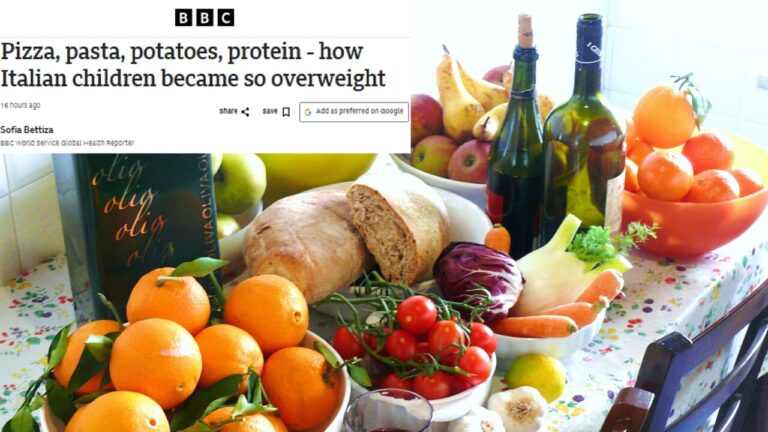
The eating habits of Italian families are apparently “attacking” the Mediterranean diet through the “five Ps”. At least, according to a report from BBC which starts from Naples to tell the story of a country in which children and adolescents increasingly eat high-calorie foods and industrial products, while vegetables, legumes and whole grains take up little space. The title of the investigation is representative and shows the “five Ps” in the dock: “Pizza, pasta, potatoes, proteins: how Italian children became so overweight”.
The modern Italian diet of the “five Ps” according to the BBC
The opinion reported by BBC is clear: “The traditional Mediterranean diet has been lost. Only 10 percent of Italians follow it”. Among the experts interviewed is Valter Longo, director of the Longevity Institute at the University of Southern California. Longo summarizes the change with the “five Ps”: pizza, pasta, potatoes, proteins and bread.
The problems come from frequency, portions and pairings with very fatty or ultra-processed foods. The report describes shelves full of snacks and places offering pizzas covered in chips, frankfurters, cheeses and sauces: preparations far from the model based on vegetables, fruit, legumes, olive oil, whole grains, fish and moderate consumption of meat described in the Mediterranean diet famous throughout the world and recognized by UNESCO.
Italian data confirms: in 2023, 10.9 percent of 8 and 9 year old children did not have breakfast every day, 66.9 percent consumed a mid-morning snack considered excessive and 24.6 percent drank sugary or carbonated drinks daily. 25.9 percent ate fruit or vegetables less than once a day, while 37 percent consumed legumes less than once a week.
The case of the boy who weighs 170 kg
The heart of the story of BBC It is Ponticelli, a neighborhood on the eastern outskirts of Naples, indicated in the report as one of the world’s epicenters of childhood obesity. It is written about the case of the 17-year-old boy who weighs 170 kilos, Salvatore: he struggles to walk, cannot tie his shoes independently and is followed to the evangelical hospital Villa Betania in Ponticelli, where doctors treat the most serious cases.
According to the report, his weight initially makes stomach reduction surgery too risky. Doctors then prescribe a GLP-1 receptor agonist drug with the aim of promoting preliminary weight loss: pathologies and complications that in the past were observed mainly in adults thus came to the attention of doctors already during adolescence.
What the data says
The OKkio alla Salute 2023 survey, coordinated by the Higher Institute of Health, finds that in Campania 24.6 percent of 8 and 9 year old children are overweight, 12.6 percent have obesity and a further 6 percent have severe obesity. Summing the categories, 43.2 percent of Campania children therefore live with excess weight. The ISS estimates that, applying this prevalence to the entire regional population between 6 and 11 years of age, there would be around 137 thousand children who are overweight or obese.
Overall, in 2023, 19 percent of Italian 8- and 9-year-old children were overweight and 9.8 percent had obesity, including 2.6 percent with severe obesity. Overall, this is 28.8 percent of the sample. The World Health Organization numbers appear higher because they use different thresholds. In the 2022-2024 cycle, applying the WHO curves, approximately 37 percent of eight-year-old Italian children are overweight, including obesity, and 18 percent have obesity. Italy thus remains among the European countries with the highest prevalence, together with Cyprus and Greece.
For decades, Italy has been considered a model of healthy eating. The Mediterranean diet, rich in vegetables, legumes, olive oil, whole grains and fish, became famous after US physiologist Ancel Keys and his wife, biochemist Margaret Keys, studied communities in southern Italy in the 1950s and linked their habits to extraordinarily low rates of heart disease. Their research transformed a regional way of eating into one of the best-known diets in the world; a model for healthy living. But, according to the research of BBCthe Italy that inspired those studies no longer exists.