

From Ceccano (FR)
State road 156 does not help you dream, even if you call it with the less anonymous name of via dei Monti Lepini, long and straight and gray of barracks and disused factories that flow to the right and left as in a chemical hunger video game and sleepless nights. It is an artery that from Frosinone reaches up to Latina and brings to the asphalt a long series of disillusions and failures, of noon coffers emptied to make holes in the rock and then cover them.
This land, with the Fiat of Cassino abandoned by the French shooting stars, of industrialist now seems to have only the memories. It is not entirely true, because something is there, and resists, and tries to invent something innovative, of profit, also overcoming the myopia of a political ruling class that for years has refused to see the mountain of ice on the horizon. The impact was there and so it is.
Now you have to imagine a future and a trace is precisely along the state road 156, on the outskirts of Ceccano, the Ciociara town that had its moment of glory with the bartender Bastiano by Nino Manfredi and the very song of 1958: “Fusse ca fusse la vota bona”. Here is one of the regeneration structures of the exhausted oils of Itelyum, a space reminiscent of certain military barracks, where everything is ordered and essential, with the covered parking that welcomes the cars of managers, white collars, chemicals, engineers and specialized workers and then, beyond the administrative offices, the plants and workshops of a leading company in the recycling of industrial waste.
It is an important example of circular economy. It is a citadel of tanks and tubular connections. It is here that Marco Codognola, CEO of the entire group, tells you the project he is trying to give birth. It is not a dream. It is the feat of recovering rare lands from permanent magnets. It can be done, but the bureaucratic authorizations are needed, which depend on the Mase, the Ministry of the Environment, and a regulatory framework that is not too short -sighted.
The last time you saw yourself in the North, on the banks of the ADDA, walking inside a plant in Casirate, in the province of Bergamo, for the disposal of industrial water. It is a collection point for Lombardy, Emilia, Veneto and the strength is the last “washing” tank, what they call “the child”, almost a living organism that costs millions of euros and that sees the bacteria protagonists. They are the brushes and feed on waters metals, transforming them, this after a series of stations began to purify them. The bacteria tell, they experience and learn year after year to clean better.
In the end you think that the Mother Earth from the monsters that undermine her will not be the millennial utopia of those who want to stop the world or move the time back, with an ethics backwards and pauperist, but science, technology and, in some way, the same capitalism, bad for Antonomasia. Brushing bacteria are children of all this. Codognola tells the “Terre Rare” project. “The next step is not only to regenerate oils or solvents. It is to work on what will be even more precious tomorrow than oil: rare lands”. He says it in front of a champion table. Small metal cylinders, shiny and heavy. Take them in hand and seem nothing special. In reality they contain elements such as neodymium, dyspose, praseodimio. Without them there would be no wind turbines, electric motors, smartphones, magnetic resonances.
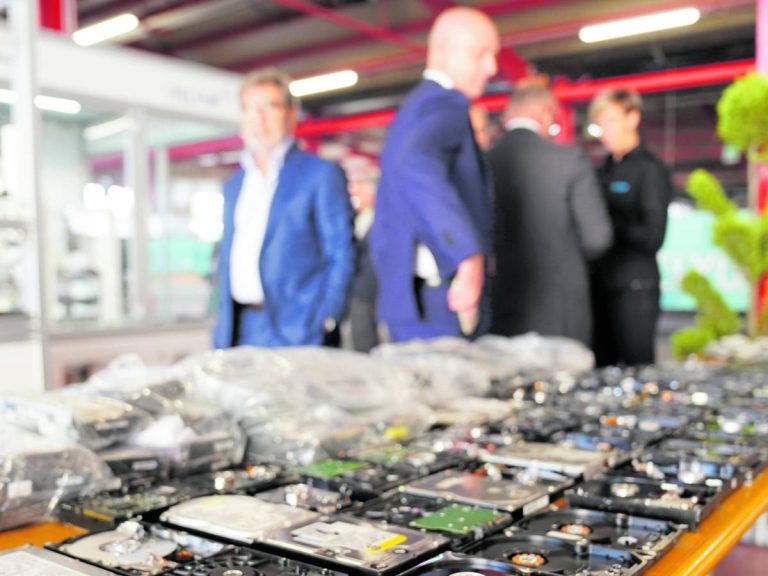
“These are permanent magnets and find them in electric engines, in the speakers, in hybrid cars. The problem is that today 90% of the rare lands are extracted and refined in China. If China decides to close the taps tomorrow, the whole world industry stops”. Here is the bet. “We are studying a process to recover them at the end of life” he continues. “We disassemble the magnets, pulverize them, separate metals with chemical and physical processes, and we obtain raw material with the same purity as that extracted from the mines. It is a circular economy applied to the most strategic technologies”. I ask him if he is complicated. Sighs. “It is complicated yes, but not impossible. It requires dedicated systems, safety procedures, chemical and metallurgical skills. But if we succeed, we can drastically reduce dependence on abroad and create a European recycling chain of the rare lands”. In the workshops, an engineer shows a jar with a gray-dark powder. “This” says “is neo -nodimio recovered by magnets of old hard disk”. You look at it and it seems to you ash, instead it is technological gold. Codognola nods. “Today we throw them off, or worse we ship them to landfills thousands of kilometers from here. Tomorrow we could recover and put them back on the market. It is a project that we would like to develop right here, in Ceccano, as an extension of the existing plants. A European pole for the recycling of critical metals”. Outside, the Statale 156 continues to run between empty sheds and closed workshops. Inside, there is talk of a challenge that concerns the industrial future of whole continents. “It is not just business,” he comments. “These are industrial sovereignty, because without strategic raw materials a country is not free to produce. And we, instead of digging mines, can dig in our technological landfills”.
Europe is thinking about it, as always with its distant times. There is no strategy on “rare earth”. In France there is a company that has moved on projects similar to those of Itelyum, for the rest there is no hurry. The central problem is how to make the recycling of rare lands sustainable, from the point of view of costs. The question is always the same: who pays? The answer is in the disposal of the oil. In Italy the exhausting lubricating oil is not a refusal left to chance. There is an organized, silent and widespread machine, which starts long before the collection: in the price of each liter of new oil there is already a small environmental contribution. Manufacturers and importers pay it, and serves to pay those who withdraw it, who transports it, who regenerates it. Thus the workshop does not spend a penny to dispose of it and the system can transform it into new oil, reducing imports and pollution. It is a closed cycle circular economy: those who produce the recovery, those who recycle the raw material, and the system feed themselves.
The rare lands project can arise with the same logic. Today permanent magnets end up in waste, but they could be collected and regenerated with a similar system: an environmental contribution on each electric motor, each turbine, each device that contains them. At the end of their cycle, specialized teams would dismantle them and plants such as that of Itelyum would extract neodymium, dyspose, praseodimio with the same purity as mining. It would be industrial insurance: to guarantee Europe strategic raw materials without depending on distant mines and unstable geopolitical. The doubt is that this process starts with another tax. There are not too many? Codognola admits it. “The tax is there, but in this case it makes sense. It is not particularly heavy and guarantees you a certain response to the question of the rare lands”. It is far -sighted. It is western. It is the attempt not to submit to America or, worse, to China.
You don’t know what the world will be like in twenty years.
You don’t even know what will be in Ciociaria after Fiat. You don’t know if the ancient intelligence of bacteria will save us. But one thing is certain: we must not be afraid of waste. It is the old history of diamonds, manure and even flowers.