

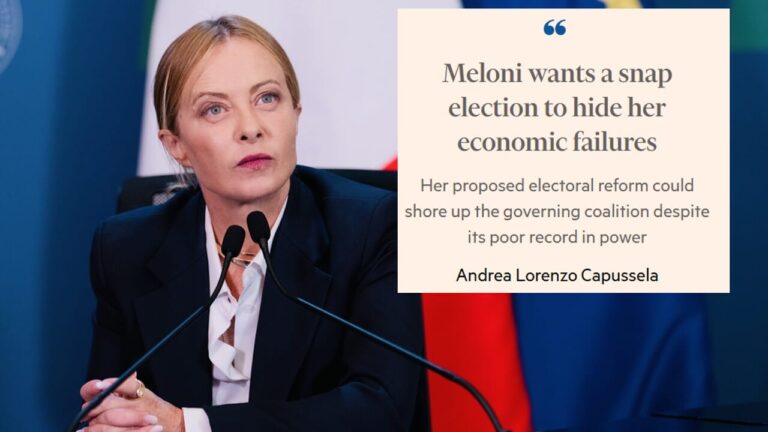
“Meloni wants early voting to hide his economic failures.” The Financial Times he doesn’t mince words. In a very harsh comment signed by Andrea Lorenzo Capussela of the London School of Economics published on August 24, the British financial newspaper links the reform of the electoral law to the possibility that Giorgia Meloni decides to take Italy to the polls already at the beginning of 2027. The thesis is that the Prime Minister today has much more to sell on the political and international level than on the economic one.
And some of the problems listed by the British newspaper are reflected in the numbers of the European Commission, OECD and Istat, providing a picture in which the government’s main success, employment, coexists with almost stagnant growth, wages still behind, industry in difficulty and a public debt destined to rise further.
The growth that doesn’t come
The first problem is the one that has accompanied Italy for decades and that the Meloni government has so far failed to resolve: low growth. In 2025, Italian GDP increased by just 0.5 percent. For 2026 the European Commission still expects +0.5%, against 1.1% for the entire European Union and 0.9% for the Eurozone. In 2027 it would rise to just 0.6 percent.
There is therefore no recession. The problem is rather a fundamental stagnation, made even more evident by the fact that investments continue to be heavily supported by the Pnrr. The European Commission itself underlines that in 2026 the investments financed by the Recovery Fund will continue to keep part of the growth going.
Opinion: The Italian prime minister’s electoral reform could shore up the governing coalition despite its poor record in power. https://t.co/9bwqZAz0yd pic.twitter.com/2TPaDpzzNt
— Financial Times (@FT) August 24, 2026
And this is where the accusation is concentrated Financial Times: Meloni would have chosen to manage the slow Italian economic decline rather than try to reverse it, giving up the more difficult reforms necessary to increase productivity and size of companies.
Wages have not yet recovered the lost ground
The second failure concerns payroll. Italy was one of the advanced countries where the explosion of inflation left the deepest wounds on real wages.
According to the OECD, at the end of 2025 real wages had not yet recovered the levels prior to the price surge: real contractual wages were still 8.8% lower than in January 2021. In June 2026, according to Istat, hourly contractual wages grew by 2.4% on an annual basis; in July, however, inflation was still at 2.9%. The recovery of purchasing power therefore remains incomplete and vulnerable to the new surge in energy prices.
This is above all the political problem: having more employed people does not automatically mean having richer families, if a substantial part of the new jobs is concentrated in sectors with low productivity and lower wages. And this is precisely what the OECD reports, recalling that an important part of the increase in employment occurred in tourism, consumer services and construction.
The silent crisis of the industry
Then there is manufacturing. The OECD recalls that Italian industrial production went through more than two years of widespread declines, before stabilizing in the second half of 2025. Istat records a substantially stable manufacturing turnover for 2025 (-0.1%).
And the recovery remains fragile. In June 2026, industrial production decreased by 1% compared to May and by 0.6% compared to the same month in 2025. The second quarter overall was positive (+0.4%), but not enough to talk about a real restart. Behind there are international factors – from German weakness to tariffs, up to the energy shock – over which Palazzo Chigi obviously has limited control. But the structural problem of Italian competitiveness remains unsolved.
Productivity, the problem that Meloni has not solved
Probably the important indictment concerns Italian labor productivity which has grown very little since the mid-1990s and has essentially stagnated since 2010. It is therefore not a problem born with Meloni. But the Financial Times he accuses the government of not having done enough to break this mechanism.
The OECD identifies some of the same critical issues: too many small and micro businesses struggling to grow, low investment in innovation, difficulty accessing capital, bureaucracy and fiscal and regulatory costs that discourage companies from becoming bigger. The organization invites Italy to encourage dimensional growth of companies, research, innovation and managerialisation.
The Financial Times it goes further and accuses Meloni of having favored micro-enterprises and self-employed workers, also resorting to tax and construction amnesties and interventions that weaken the institutions necessary for competition and business growth.
The debt is back towards 140% of GDP
Finally there is the great stone guest of the Italian economy: the public debt. In 2025 it was equal to 137.1 percent of GDP. According to the European Commission’s forecasts, it will rise to 138.5% in 2026 and 139.2% in 2027.
It is not correct to attribute the entire increase to the choices of the current government. Brussels explains that the deferred financial effect of the building bonuses of previous years weighs significantly, as well as the difference between interest costs and nominal growth of the economy. But one politically inconvenient fact remains: after four years of Meloni’s government, the debt/GDP ratio has not fallen.
On the deficit, the government can claim a result: it fell from 3.4% of GDP in 2024 to 3.1% in 2025 and the Commission forecasts 2.9% in 2026, bringing Italy back below the European threshold of 3%.
The success of the government: work and public finances
However, there is a piece of the picture that prevents us from simply talking about a failing economy. It’s the job market. As of June 2026, the employment rate was 62.9%, while unemployment was 5.7%. Compared to June 2025, employed people had increased by 131 thousand units.
This is the true paradox of the Italian economy: more employment and relatively tidier public finances, but little growth, weak productivity, wages that are struggling to recover and rising debt.
And it is on this ground that the Financial Times builds his political provocation. According to the British newspaper, Meloni would be interested in voting before these issues become even more evident and before the investment boost guaranteed by the PNRR runs out.