

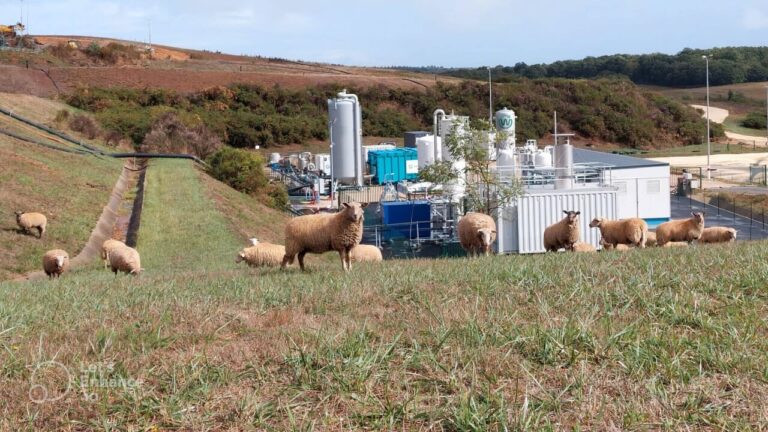
There is an energy resource hidden in Italian landfills. It is produced spontaneously, even many years after the waste has been buried, but it is not always exploited. It is biogas generated by the decomposition of organic matter, a mixture that mainly contains methane and carbon dioxide. A gas which, if appropriately treated, can become biomethane and replace that of fossil origin used in homes and industries.
Waga Energy, a French company specialized in the recovery of landfill gas, is focusing on this possibility and has announced the construction of its first two plants in Italy. They will both be located in Tuscany, in the provinces of Arezzo and Livorno, and will have a total production capacity of 121 gigawatt hours (GWh) of biomethane per year, equivalent to 121 million kilowatt hours of energy. A contribution that is still limited compared to the national gas requirement, but which opens up an interesting prospect: recovering energy from waste already deposited in landfills, without having to extract new resources from the subsoil.
Two Tuscan landfills will produce gas for the national network
The first plant will be built in the Podere Rota landfill, in Terranuova Bracciolini, in the province of Arezzo, through a collaboration with Centro Servizi Ambiente Impianti (CSAI), a company owned by the multiutility Iren through Valdarno Ambiente. The landfill is already in the post-management phase: despite the completion of the deliveries, the accumulated waste continues to decompose and produce gas. The new plant will be able to recover it and transform it into biomethane, with an expected production of up to 29 GWh per year. According to company estimates, it will avoid emissions equivalent to approximately 5,900 tonnes of CO₂ each year.
The second project is larger and concerns the Scapigliato plant hub, in Rosignano Marittimo, in the province of Livorno, which treats and disposes of waste with a capacity of more than 300 thousand tons per year. In this case the plant will have a production capacity of 92 GWh of biomethane per year, with an estimated reduction in emissions of 15,500 tonnes of CO₂ equivalent. It is expected to come into operation in 2027. The contract, awarded through a public tender in 2025, requires Waga Energy to finance, build and operate the plant for an initial period of ten years.
Overall, the two projects could avoid emissions of approximately 21,400 tonnes of CO₂ equivalent each year, according to calculations communicated by the company. These are estimates based on a methodology that also considers an improvement in gas capture in landfills.
Waste gas reaches our homes
The technology developed by Waga Energy is called Wagabox and allows us to solve one of the main problems of landfill biogas: its variable composition, which prevents it from being injected directly into the gas network. The process involves two steps. In the first, carbon dioxide and other unwanted components are removed through filter membranes. In the second, a cryogenic distillation system separates methane from nitrogen and oxygen. The result is a purified gas that can meet the technical requirements necessary for injection into the network. Once injected, biomethane can be used for the same purposes as fossil natural gas.
Of course, biogas recovery does not eliminate the environmental impacts of landfills and does not represent an alternative to waste reduction, reuse and recycling. However, it can help limit emissions associated with existing sites and exploit a resource that would otherwise risk being lost.
Who pays for the systems and how much the business is worth
Waga Energy’s economic model requires the company itself to finance, build, own and manage the plants, sharing the revenues obtained from the sale of biomethane with landfill managers. This allows local operators to obtain additional income without directly supporting the industrial investment and related operational risks. Founded in 2015 in Grenoble by three engineers from the Air Liquide group, Waga Energy is now present in seven countries, has over 300 employees and recorded revenues of 59.6 million euros in 2025. The two Tuscan shipyards therefore represent the first step in an expansion strategy in the Italian market.