

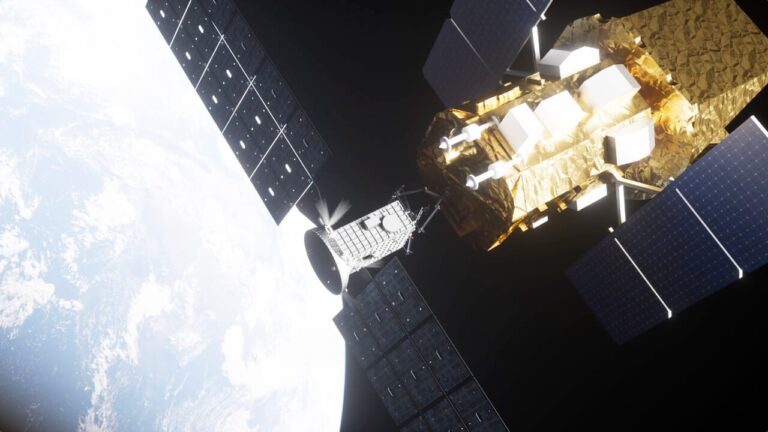
The American space agency had sent a probe into space to save a space telescope that was slowly falling to Earth but now engineers find themselves having to save their space tow truck.
The mission to recover the Neil Gehrels Swift Observatory, one of NASA’s most important space telescopes for studying the most violent phenomena in the Universe, is a real movie story. Launched in 2004, Swift specifically observes gamma-ray bursts, extremely energetic cosmic explosions that can last from a few milliseconds to several minutes. After more than twenty years in space, however, the telescope has to deal with a much more earthly problem: its orbit is lowering.
Because Swift risks falling to Earth
Swift travels in low Earth orbit and does not have a propulsion system capable of independently returning it higher. Over the years, the thin atmosphere present even at those altitudes has progressively slowed down the satellite, causing a slow loss of altitude. The risk is that the phenomenon will accelerate until Swift re-enters the atmosphere, putting an end to a scientific mission that continues to produce data considered precious by astronomers.
To gain more years of activity, NASA therefore decided to attempt an unusual operation: send another vehicle into space, reach Swift, dock it and push it towards a higher orbit.
The task, worth approximately 30 million dollars, was entrusted to the American company Katalyst Space Technologies which built a vehicle for the operation called Link.
The satellite that was supposed to save Swift goes out of control
Link was launched on July 3, 2026. Shortly after arriving in space, however, something went wrong. The vehicle began to rotate uncontrollably on multiple axes. Two of the three “reaction wheels”, devices used by satellites to control their orientation without consuming propellant, have become inoperable due to problems with the electrical system. Even the small thrusters intended for attitude control were not fully operational.
At one point Link was rotating at about 9 degrees per second. A movement rapid enough to complicate communications with Earth and, above all, to make any attempt to approach Swift impossible. The probe built to save a telescope that was in danger of falling towards Earth was therefore, in turn, in difficulty.
How engineers are trying to save her
The solution identified by the technicians was to use in an unconventional way one of the thrusters installed on Link, normally used to slowly modify the orbit of a satellite. Instead, engineers used them to counteract the rotation of the vehicle.
The maneuver worked. The rotation speed was first reduced to below 4 degrees per second and subsequently down to approximately 1.47 degrees per second. An important result also because, according to NASA, to obtain this reduction Link consumed less than 100 grams of propellant. Almost all the fuel needed for the main mission therefore remains available.
Now engineers are preparing new buoyancy control software. The goal is to allow Link to fly and orient himself even without being able to normally rely on all the systems foreseen by the original project.
The mission to save Swift may still succeed
If the new system works, Link will have to perform a series of maneuvers to reach Swift’s orbit. At that point the most delicate phase of the entire operation will probably begin. The vehicle will have to approach the telescope, observe it closely and then attempt to lock onto it. Once the capture is complete, Link will use his thrusters to raise the altitude of Swift’s orbit.
The technical problem inevitably slowed down the program. The approach to the telescope, initially scheduled earlier, has been moved approximately towards the end of August 2026. The mission, however, is not considered lost.
If the operation succeeded it would also have an importance that goes beyond Swift’s fate. In fact, it would demonstrate that satellites and telescopes without autonomous propulsion systems can be reached and “rescued” by other vehicles once in space. Some kind of orbital tow truck.