

The new quota 100 proposed by the government? The joke is around the corner: whoever uses it to leave work early will have a cut of almost 5 thousand euros gross per year. 4,989 euros gross per year, to be precise. The simulation is from the social security policies service of the Uil union (Italian labor union), which verified the negative economic effects of a possible pension flexibility measure that would allow people to leave work starting from 64 years of age, subjecting it to the recalculation of the entire pension with the contributory system. But let’s go in order.
The fund for the new quota 100
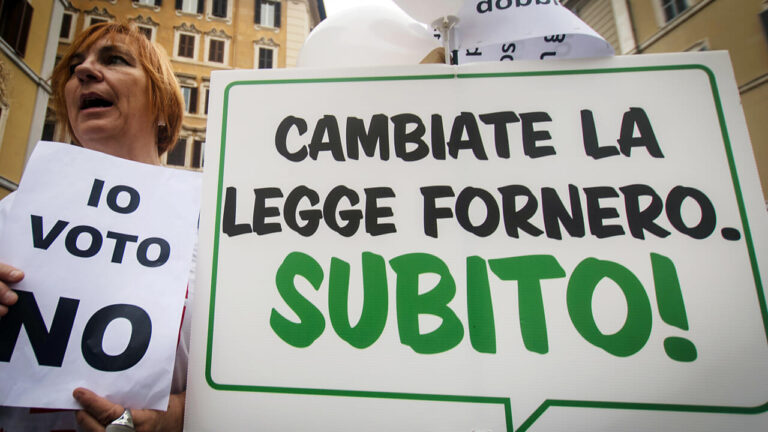
On the subject of pensions, the latest budget law included a fund “for support in leaving the job market” of 850 million euros per year for the three-year period 2027-2029. This is the measure which, according to the League, is intended to help overcome the Fornero law on pensions: it should finance people leaving work at 64. The fund is “intended to finance interventions, to be adopted – we read in the text – with subsequent legislative provision, aimed at regulating support measures for exiting the labor market, also with reference to specific individuals in difficulty and with possible measures regarding social safety nets”.
The League’s idea would be a new version of quota 100, also allowing people to leave work at 64, but only if they have 36 years of work behind them. Today this possibility already exists, but in general it is reserved for those who started paying contributions from 1 January 1996 and fall entirely within the contributory system. Now Matteo Salvini’s party aims to extend the measure to those who started working before 1996, but on one condition: accepting the recalculation of the contribution of the allowance. But leaving your job three years early would result in the application of a lower transformation coefficient. It means losing a lot of money.
Elsa Fornero, the Turin professor who is the author of the pension reform that the centre-right (especially the League) has been contesting for years, defined it as “a brazen and deceptive measure, yet another short-term idea by a gentleman chasing votes, financed with a new tax paid by pensioners”.
How much do you lose?
Let’s move on to the concrete figures. In detail, the social security policies service of the Uil union has verified how much an employee can lose by agreeing to leave work earlier than the possibility of continuing the activity until reaching the age foreseen for ordinary old-age retirement. The simulation examined the case of a worker who, at the age of 64, had completed 36 years of contributions, with a final gross annual salary of 35 thousand euros.
The comparison is between two different hypotheses: retirement at 64 years of age, with the entirely contributory recalculation of the allowance, and retirement at 67 years and 6 months, the age taken as a reference for the simulation of ordinary old age retirement, with the continuation of working activity for a further 3 years and 6 months and the maintenance of the mixed calculation system.
A lower check of 16.38%
Based on the simulations carried out, the fully contributory pension at 64 years of age would be equal to 25,477 euros gross per year, while the pension calculated with the mixed system at 67 years and six months would reach 30,466 euros gross per year. The difference between the two pension payments is therefore equal to 4,989 euros gross per year, corresponding to approximately 384 euros gross per month, considering the thirteen monthly payments. In percentage terms, the worker who decides to bring forward her retirement to 64 years of age would receive a benefit 16.38% lower than that which she would obtain by continuing to work for a further three years and six months, until she reaches 67 years and six months of age.
Uil’s comment
Santo Biondo, confederal secretary of the Uil, commented: “The possibility of choosing when to end one’s working life responds to a real need, especially after long careers and in the presence of onerous working conditions. However, this choice must be accompanied by the guarantee of adequate pension treatment. The case examined highlights how the choice to bring retirement forward by three years and six months compared to the ordinary exit would lead to a lower pension treatment of around 5 thousand euros gross per year. A significant economic difference destined to persist over time and which would risk having a concrete impact on the quality of life and the ability to meet economic needs in old age”.
Who would be penalized
The confederal secretary argues: “Flexibility subordinated to fully contributory recalculation therefore risks being concretely accessible especially to those who can afford to receive a lower allowance than that which would accrue by continuing to work. Those who have received low wages, have had a discontinuous career or have greater family burdens – remarked Biondo – could instead be forced to continue working, even when they would need to leave their jobs. Our assessment must therefore concern not only the formal freedom to bring early retirement, but also the economic conditions that make this possibility actually exercisable. Thirty-six years of contribution already represent a significant work commitment, which deserves to be recognized and valued”.
And again, he continues in his analysis: “A possible intervention that made early access to retirement conditional on the achievement of certain economic thresholds would also risk predominantly favoring workers with medium-high salaries and continuous careers, leaving without an answer those who have had discontinuous professional paths and low salaries. A condition that particularly affects many women, also due to the interruptions in work activities linked to care work and the difficulties of reconciling family and professional life”.
Santo Biondo concludes: “For these reasons, we believe it is necessary to open a discussion with the government on structural pension flexibility, which recognizes the value of contributory careers, safeguards the adequacy of the allowances and takes into account the different working conditions. Specific protections are needed for demanding and demanding activities, greater recognition of care work and concrete solutions for those who have had discontinuous careers. Pension flexibility cannot only be a possibility provided for by law, but must represent a concretely exercisable right, regardless of economic conditions of the worker”.