

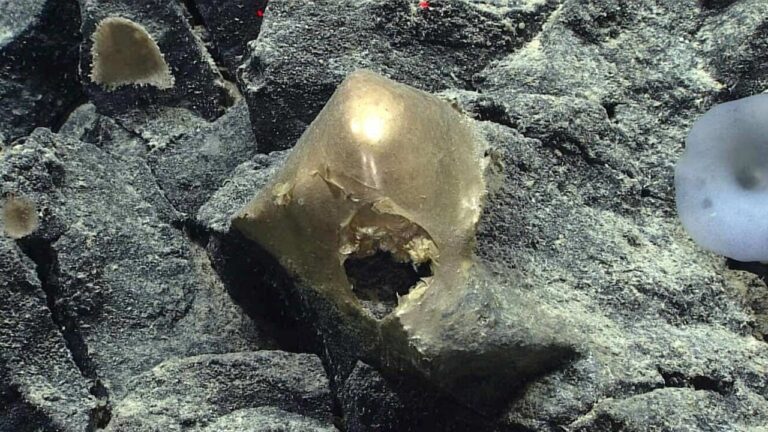
No, it was not an egg of extraterrestrial origin nor evidence of an unknown prehistoric creature. After two years of research, investigations and much speculation, scientists have finally solved the mystery of the “golden sphere” found in 2023 at 3 thousand meters deep in the Gulf of Alaska.
The golden sphere
Through an advanced analysis combining genetics and marine biology, researchers from NOAA (National Oceanic and Atmospheric Administration) and the Smithsonian have finally confirmed the nature of the object, which initially attracted public attention, sparking theories and hypotheses. Instead, as confirmed by experts, they are tissue remains of a giant sea anemone, Relicanthus daphneae.
The 2023 sighting, which occurred during an ocean exploration, left the crew members of the Seascape Alaska 5 speechless: “It looks like the beginning of a horror film. Or an episode of the X-Files.” The discovery dates back to an exploration mission conducted by the remote-controlled underwater vehicle Deep Discoverer, launched from the oceanographic vessel Okeanos Explorer. As the images show, the object taken at a depth of 3,250 meters appeared as a shiny and rounded mass, with a strange opening in the frontal area.
DNA analysis
“It is common for scientists to find organisms that they do not immediately recognize – NOAA clarified in a note -. In most cases, these mysteries are solved quickly thanks to comparison and sharing of knowledge between members of the scientific community. However, some discoveries turn into real enigmas, as in the case of the golden sphere”.
To figure out what it was, the team collected the sphere using a suction sampler and sent it to the Smithsonian national museum of natural history for further examination and study. The identification was a very complex undertaking, lasting two years. “It turned into a special case – the experts underlined – which required the commitment of several people. It was a complex mystery that required morphological, genetic, deep marine biology and bioinformatics skills to be solved”.
Mystery solved
The first DNA analysis, the so-called barcoding, did not give results due to the presence of DNA from other microscopic organisms present on the sample. A more in-depth examination confirmed the presence of animal DNA and revealed a large presence of genetic material belonging to a giant deep-sea anemone. Sequencing of the mitochondrial genomes of both samples confirmed their almost total genetic identicality to the Relicanthus daphneae genome.
“Mystery solved: it is not an egg, a sponge or the remains of an alien, but a relic of a sea anemone. Thanks to advanced techniques such as DNA sequencing – explained William Mowitt, interim director of NOAA Ocean Exploration -, we are able to solve an ever-increasing number of enigmas like this. This is why we continue to explore: to reveal the secrets of the abyss and better understand how the ocean and its resources can promote economic growth, strengthen our national security and preserve our planet.”