

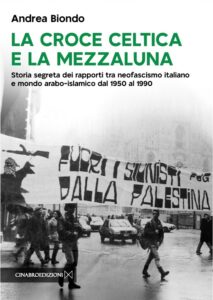
There are pages of Italian history that seem destined to remain in the shadows. Not for lack of charm, on the contrary: because they are too uncomfortable, too difficult to pigeonhole into the consolidated narratives that still shape public memory today (and which often find confirmation in current political events, where the different sides appear happily inserted into artfully constructed stereotypes). The Celtic cross and crescentnew volume of the series Politikón Of Cinabro Editionswritten by Andrea Biondo, falls exactly in this gray area. And it does so with the ambition – rare and precious – of bringing to light a complex, stratified, even surprising story: that of the relationship between Italian neo-fascism and the Arab-Islamic world between 1950 and 1990.
An apparent paradox, of course. For decades, in mainstreamwe preferred to cultivate the idea of a closed, identitarian Italian right, impervious to the winds of the world. Biondo instead shows a very different picture: that of a milieu politician who, despite a thousand contradictions, developed interlocutions and sympathies towards the Middle Eastern liberation movements precisely in the years in which the Left looked with romantic eyes at the kibbutz Israelis. A reversal of perspective that shocks the contemporary reader, accustomed to paradigms that today seem granite but which, in the Cold War, were anything but.
The book – 334 pages full of ideas – reconstructs with rigor and narrative rhythm a mosaic that crosses the entire Afro-Asian chessboard: from Nasser’s Egypt to Gaddafi’s Libya, from the Lebanon of the refugee camps to the Palestine of the fedayeen, up to the Afghanistan of the mujahideen, where there was no shortage of young militants from the Italian neo-fascist area, attracted by the myth of anti-imperialism and the suggestion of a “third alternative force in both Washington and Moscow.
Biondo, a communication expert who has been studying the history of the radical right of the Years of Lead for years, does not indulge in nostalgia or demonization: he observes, reconstructs and lets the protagonists speak. What emerges is a world crossed by fractures and internal divisions, from the ferment of the Italian Social Movement to the movementist galaxies that revolved around it, up to the extremism of the NAR, which were also touched by the idea that in the Arab world a decisive game was being played against the hegemony of the superpowers.
The result is a work that fills a historiographical void and offers, at the same time, a new key to understanding the political culture of a part of Italian neo-fascism in the second half of the twentieth century. A “secret” story, as the subtitle says and, for this very reason, to be rediscovered. The Celtic cross and crescent it’s not just a book: it’s an invitation to reconsider categories that are too often taken for granted. And to recognize that political realities, even the most uncomfortable and radical ones, never live only on stereotyped patterns.