

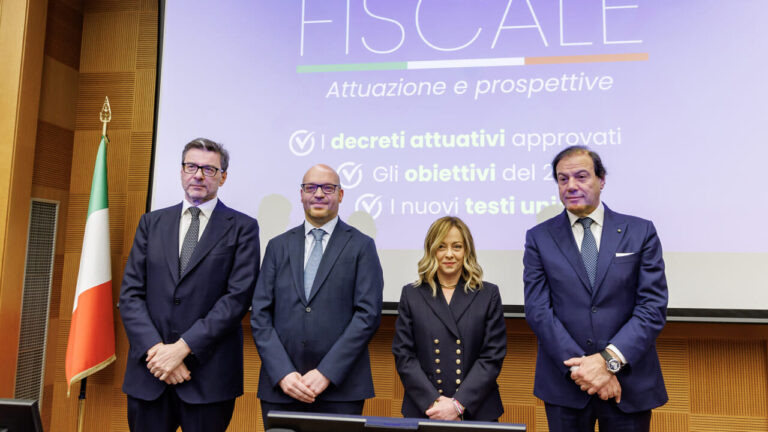
A new cut in personal income tax to reduce taxes on the middle class. The government is once again focusing on reducing personal income tax, with the aim of extending the 33% rate up to 60 thousand euros. Deputy Minister of Economy Maurizio Leo confirmed his desire to include the measure in the next budget law. But with one condition: find the necessary resources.
The intervention would cost around 2.7 billion euros per year and could guarantee savings of up to 1,000 euros per taxpayer. The number of beneficiaries, however, will also depend on the choices made on higher incomes. The result is that taxpayers subject to the same IRPEF rate of 43% may have a different effective tax burden, depending on the benefits used and the applicable limits. And with the new reform it will be necessary to establish whether to maintain the discount in full even for those who earn more than 60 thousand euros.
New Irpef 2027: how rates and brackets change
The 2026 Budget Law has already reduced the rate applied to the portion of income between 28 thousand and 50 thousand euros from 35% to 33%, guaranteeing a maximum saving of 440 euros per year. The next step, in the government’s intentions, is to move the limit of the second bracket from 50 thousand to 60 thousand euros. The share of income affected would thus go from the current taxation of 43% to 33%, with a reduction of ten percentage points.
| Taxable income | Rate 2026 | Hypothesis 2027 |
| Up to 28,000 euros | 23% | 23% |
| From 28,000 to 50,000 euros | 33% | 33% |
| From 50,000 to 60,000 euros | 43% | 33% |
| Over 60,000 euros | 43% | 43% |
How much you save with the Irpef cut: examples by income
The theoretical benefit increases by 100 euros for every thousand euros of taxable income between 50 thousand and 60 thousand euros. The maximum saving therefore reaches one thousand euros per year.
| Annual taxable income | Annual income tax savings |
| 30,000 euros | 0 euros |
| 40,000 euros | 0 euros |
| 50,000 euros | 0 euros |
| 52,000 euros | 200 euros |
| 55,000 euros | 500 euros |
| 58,000 euros | 800 euros |
| 60,000 euros | 1,000 euros |
| 70,000 euros | 1,000 euros |
| 100,000 euros | 1,000 euros |
For those who declare 55 thousand euros, the benefit would therefore be 500 euros per year. At 60 thousand euros it would reach a thousand euros, equivalent to approximately 83 euros per month over twelve months. Even those who earn more than 60 thousand euros would theoretically benefit from the cut, because the discount still applies to the portion of income between 50 thousand and 60 thousand euros. But the government could introduce corrections to limit the advantage of richer taxpayers.
The cut in tax bonuses for those exceeding 75 thousand euros
To understand how much you really pay in Irpef you must also consider the deduction system. The ceiling depends on income and the number of tax-dependent children. For incomes above 75 thousand and up to 100 thousand euros the starting point is 14 thousand euros. Over 100 thousand euros, the basic amount drops to 8 thousand euros. These sums are multiplied by a family coefficient.
There are over 1,100 euros of cumulative bonuses and discounts for bills: who can get them
The limit concerns, among others, costs for education, veterinary expenses and construction bonuses relating to work carried out from 2025. There are some exclusions: health expenses regulated by article 15, paragraph 1, letter c) and subsidized investments in start-ups and innovative SMEs are not included in the limit. Furthermore, certain expenses related to mortgages and insurance taken out by 2024 are excluded, as are the installments of building works paid by 31 December of the same year.
Out of approximately 42.84 million taxpayers, those with incomes above 75 thousand euros are approximately 1.43 million, equal to 3.3% of the total. The audience narrows further as income increases: around 492 thousand taxpayers exceed 120 thousand euros and just over 149 thousand declare over 200 thousand euros.
The government’s decision: will the Irpef discount also reach higher incomes?
This is one of the issues that will accompany the preparation of the 2027 budget. The extension of the 33% rate up to 60 thousand euros would produce, without further interventions, a maximum theoretical benefit of one thousand euros even for those with much higher incomes. The government will have to decide whether to leave this advantage unchanged or provide new forms of limitation for some income groups.
Deputy Minister Maurizio Leo, speaking at the end of September on the possible intervention, had expressed a preference for a system without further roofs: “I am for simple things and therefore I would not put roofs”. However, he had recalled the need to verify the financial coverage and left the final decision to the political level.
One possibility to evaluate would be to intervene on the deductions, as already done with the 2026 budget. But the current cut of 440 euros could not be considered automatically sufficient to neutralize the new theoretical advantage of one thousand euros. Furthermore, the availability of benefits to be reduced varies considerably from one taxpayer to another.