

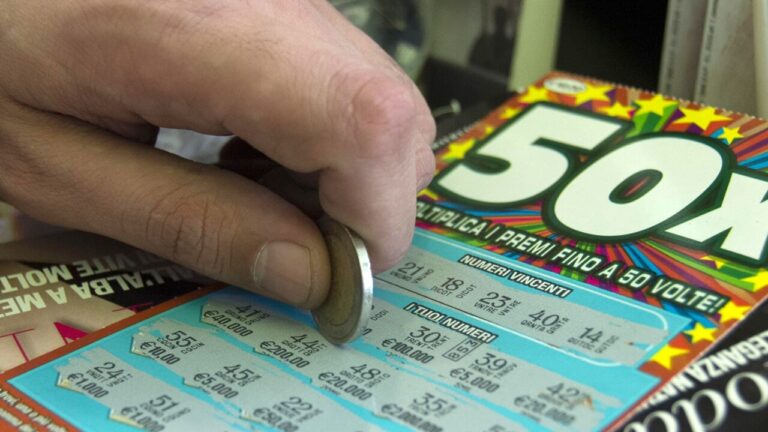
Taking a well-known passage from the Italian song as a model, we could decline it like this: “Where there was a coupon thrown away, now there is… a health data”. It is the reference to the startup project Bias and Gamesthe first reality of this type to intercept early signs of compulsiveness, potentially linked to the Gap, pathological gambling, through the automated analysis of tickets scratch and win which were trashed by the players.
The chance discovery in separate waste collection
All this happens using a patented, innovative and highly technological method. But the idea was born by chance, as Andrea Azzarello, data analyst, founder and CEO of the startup explains: “One day I wanted to check the contents of a column for the separate collection of scratch cards, believing that I could find some winnings.”
The result obtained? It was definitely surprising. As Azzarello further admits: “Among the first 6 winning coupons intercepted, 5 showed the same type of error, presenting a repeated pattern. I therefore understood that behind that gesture there was a recurring behavioral pattern”.
Present at the latest edition of Maker Faire Romethe annual event dedicated to innovation, technology and creativity, where he presented his project, so far the “Bias and Games” team has analyzed over 52 thousand scratch cards thrown into the bin by players, identifying over 2,000 human reading errors and 380 unclaimed winnings.
Thus the data collected “speak” to each other
Through data analysis and their clustering, i.e. the technique focused on the automatic grouping of similar elements to create clusters (groups) where the elements in each group are as similar as possible to each other and as different as possible from the elements of the other groups, a correlation emerged between such errors and compulsive behaviors.
The working group therefore found that as spending on scratch cards increases, the error rate on the part of the player also increases. Then, when the coupons are purchased in bulk attached to each other, the error rate exceeds 5 percent: a very high figure. In deepening its analyses, “Bias and Games” found that behaviors are repeated and can be read and interpreted because they remain crystallized inside the tickets.
All the signs of gambling addiction
“We have identified recurring patterns that allow us to recognize coupons scratched by the same person, even among hundreds”, explains the work team. And again: “When we brought the coupons back from the tobacconists, they managed to reconnect them to the player who had scratched them. In fact, an automatic and repetitive gesture changes into a signal that makes it possible to open the door to a space of dialogue, awareness and the possibility of rebirth.”
The startup has therefore patented a method which, combining computer vision, or the field ofartificial intelligence which allows information to be obtained from images and videos, AI and behavioral analysis, achieves a triple objective: automatically reading, classifying and interpreting discarded scratch cards, associating qualitative and quantitative data with them.
In 2021, even before founding “Bias and Games”, Azzarello was received by the Observatory for combating the spread of gambling and the phenomenon of serious addiction, provided for by the 2015 Stability Law and established at the Ministry of Health. The Observatory has therefore created an awareness campaign against gambling-related addictions, establishing a national toll-free telephone (800.558822), anonymous and free, active from Monday to Friday from 10:00 to 16:00.
Help to free oneself from slavery
In our country there are one and a half million pathological gamblers, an underestimated number, and only a few thousand resort to treatment centers distributed throughout the national territory. According to the latest annual report to Parliament on the phenomenon of drug addiction in Italy, this condition is particularly growing among young people. As well as, it still illustrates the relationshiponline gaming is increasing, plus 8 percent.
The fever from gambling it knows no crisis. And the State, from the games, it makes money: The resulting revenue is crucial for the budget. The numbers of the last one dossier by Libera are impressive. For each player, seven other people are involved: his family members, who in total amount to 20 million 400 thousand people, equal to 40 percent of the Italian population. Translated: in Italy 4 out of 10 citizens are victims of “passive gambling”.
The result is an estimated loss of 7.6 percentage points in quality of life, both for the player and his family members. From the “Azzardomafie” report It then emerges that in 2024 alone, revenues from legal gaming reached 157 billion and 453 million euros with a +6.59 percent compared to 2023.