

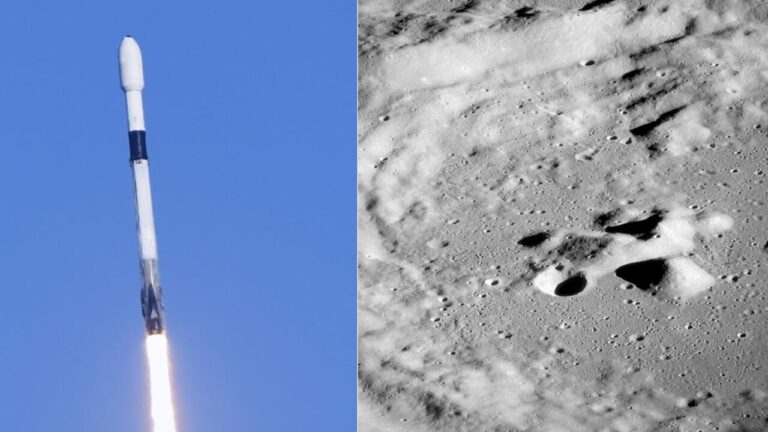
The second stage of SpaceX’s Falcon 9 rocket is believed to have crash-landed on the moon while traveling at a speed of 8,690 km/h. The object, the size of a school bus and weighing four tons, is part of the carrier of a Falcon 9 launched in January 2025 for a Firefly Aerospace mission.
Typically the components of these rockets, known as stages, would re-enter Earth’s atmosphere, but due to the high thrust needed for the lunar mission, the stage did not re-enter and remained in orbit as space junk. It was then pushed towards the moon by the combined action of gravity and solar activity.
NASA forecasts
According to astronomers’ calculations, the rocket should have crashed into the moon at 8.35 am (Italian time), but at the moment of impact no one was able to see it or really confirm it with telescopes. The predicted crash area (the Einstein crater) is located right on the visible edge of the lunar disk, a position that is very difficult to observe from the ground.
NASA predicts that the impact generated a dust cloud and should have created a new crater about 18 meters wide and 4 meters deep. Space agency spokesperson Jimi Russell assured that “the impact does not pose a danger to Earth and NASA scientists plan to collect lunar data on the event and refine techniques for tracking objects in space.”
Space debris impacts on the moon are rare, but there are precedents. As the Guardian reports, a Chinese rocket stage crashed into the moon in March 2022 after completing a lunar test mission, while in 2009 NASA intentionally crashed a rocket stage into the moon to study the cloud of lunar material kicked up by the impact.