

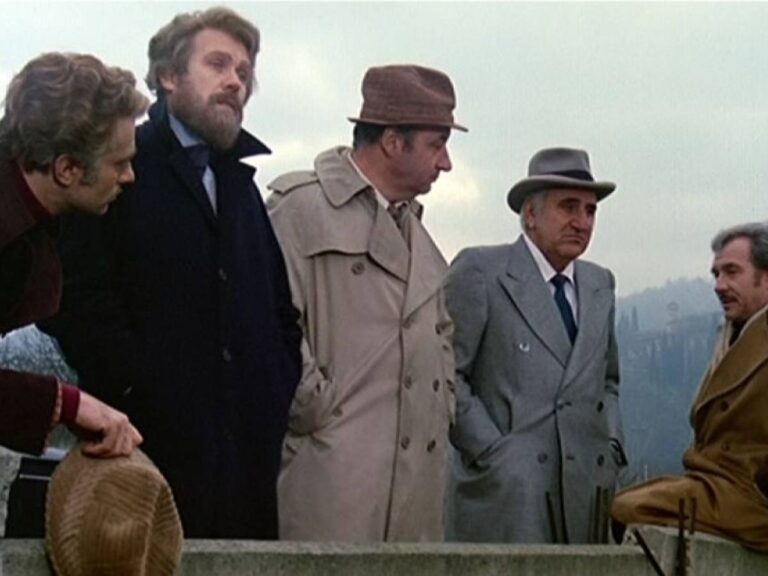
A quintet of historical friends, middle age looming over their heads, an indissoluble desire to stay together and laugh without ever taking themselves seriously. Because the only thing that matters in life is laughing. Even in those moments when it seems impossible, even when everything seems to be going wrong. This might be the somewhat rough summary of what Mario Monicelli he left us with his “My Friends”a film released in Italian cinemas fifty years agoin the golden year 1975. Florence it is the setting for a bittersweet story, which enhances the value of friendship and brings it to the altar of the deepest feelings. Because in the bond that holds together the events of Count Raffaello Mascetti (Ugo Tognazzi), the architect Rambaldo Melandri (Gastone Moschin), the journalist Giorgio Perozzi (Philippe Noiret), the bartender Guido Necchi (first Del Prete and then Montagnani), and the professor Alfeo Sassaroli (Adolfo Celi) the secret of happiness is hidden. Because friendship preserves that sincere love that expects nothing in return. We are together, yes, but when we feel like it.
A language that has entered everyone’s lives
On the banks of the Arno, the Tuscan maestro Monicelli arrives to replace the deceased Pietro Germi, to direct a masterpiece destined to enter the Olympus of Italian cinematography and the heart of Italian culture. This film changed paradigms and introduced neologisms that we still use in common language. The “gypsy“, a trip without destination, without obligations and without time order. The “super shit“, a twist of words useful for confusing the interlocutor. Not to mention the best possible definition of “genius” which, as everyone knows, is: imagination, intuition and speed of execution.
Then there are the iconic scenes. Unforgettable was the “bon voyage” slap to all the faces of those who leaned out of the window of the departing regional train. A diversion, a balm to soothe the pain of love, a prank that only very complicit friends can carry out. Not to mention the telephone courtship of Sassaroli’s wife or the petty charade to the detriment of poor “Righi”, convinced that he had joined a gang of criminals intent on fighting their rivals from Marseille. And let’s not go any further, out of respect for those who have not yet managed to view this unmissable title.
United we win
But, ultimately, what is the message that “Amici Miei” wants to leave us? That together we are stronger. When the flood of the Arno devours Florence, recalling the tragedy of November 4, 1966 in the second chapter of the trilogy, the five companions observe from Piazzale Michelangelo the city bent by the cruel waters that have swallowed up everything, including hopes. “And what do we do now?” they question themselves disarmed. “Water skiing” exclaims Perozzi. And we can smile again about tomorrow with confidence.
No one is left behind, a friend in difficulty always helps himself, as he reminds us the collection for Mascettidone in secret because the count is the proud type. He, when he was really rich and before squandering a billion-dollar fortune, went around with a Marsican bear on a leash. Finally, as the last intense scene reminds us, even if the pain of a disappearance hurts, we must find the strength to react, and laugh again even with our faces streaked with tears. After all, life is also this and death is part of our existence.
What do we have left of Amici Miei
Fifty years later, does an Italy like the one narrated by “Amici Miei” still exist? Everything has changed, personal relationships have changed.
Technology has brought people closer together, but it has also pushed them further apart, reducing the opportunities for meeting in person. The analog world was more physical and real. But let’s not lose hope, sincere friends still exist. And laughing is still as good as half a century ago.