

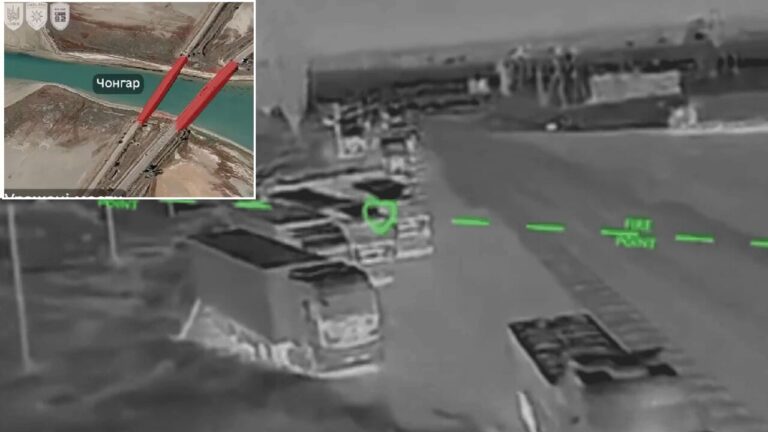
Ukraine is targeting Crimea in an attempt to cut off and destroy the Russian logistics network supplying the occupied territories. The effects of the raids are already tangible, even in Russia. The Kiev army claimed responsibility for a large night attack, between 10 and 11 June, which hit the Armiansk bridge, in the northern part of the occupied peninsula, which also affected a column of Russian vehicles loaded with fuel and ammunition.
The bombing of the Armiansk bridge: 50 trucks on fire
The operation would have knocked out the bridge and paralyzed a logistical route considered central to the supply of Russian troops. The Kyiv Independent reports that 50 military vehicles came under fire, it is not clear how many of these were destroyed. In any case, the affected waypoint is of strategic importance.
Armiansk is located on the Perekop Isthmus, one of the land passages connecting Crimea to the rest of the occupied territories. The raid is part of a broader campaign of attacks: in the previous days, other connections had also been hit, including the Chonhar bridge, one of the main road routes between occupied Crimea and the Kherson region. Satellite images published by Skhemyan investigative project by Radio Liberty, showed dark signs compatible with previous attacks on Chonhar and the presence of a pontoon crossing.
Authorities loyal to Moscow in the occupied Kherson region admitted damage to multiple bridges along the route to Crimea, including those in the Perekop-Armiansk area, although without confirming the military toll indicated by Kyiv.
The Kerch bridge, which connects Crimea to Russia through the homonymous strait, remains the most important passage still active: this is the access network from the north, used by the Russians to move fuel, ammunition and vehicles towards the southern front, in particular towards the Zaporizhzhia area. It had already been attacked by the Ukrainians in 2022.
But the Ukrainian attacks are moving further and further away from the front line and causing disruption to supply chains even on Russian territory: in the same hours as the raids in Crimea, Kiev hit oil and petrochemical sites, such as the Tatneft Taneco and Taif-Nk refineries in Tatarstan and the Tolyattikauchuk plant in the Samara region. And over 1,000 kilometers away from the front, a “Flamingo”, a low-cost cruise missile designed by the Ukrainians, was also used for the first time. Videos show the damage suffered by an electronic components factory for drones in Cheboksary, a city on the Volga river, capital of Chuvashia.
The effects of the raids in Crimea: what Ukraine wants to achieve
Kyiv’s stated objective is to progressively isolate Crimea. Robert “Madyar” Brovdi, commander of the Ukrainian Unmanned Systems Forces, told Reuters that Ukraine aims to cut links between the peninsula and Russia. According to his reconstruction, drone attacks have already reduced military traffic along the so-called “Novorossiya” highway, a corridor used by the Russians through the occupied territories of southern Ukraine, by more than two thirds.
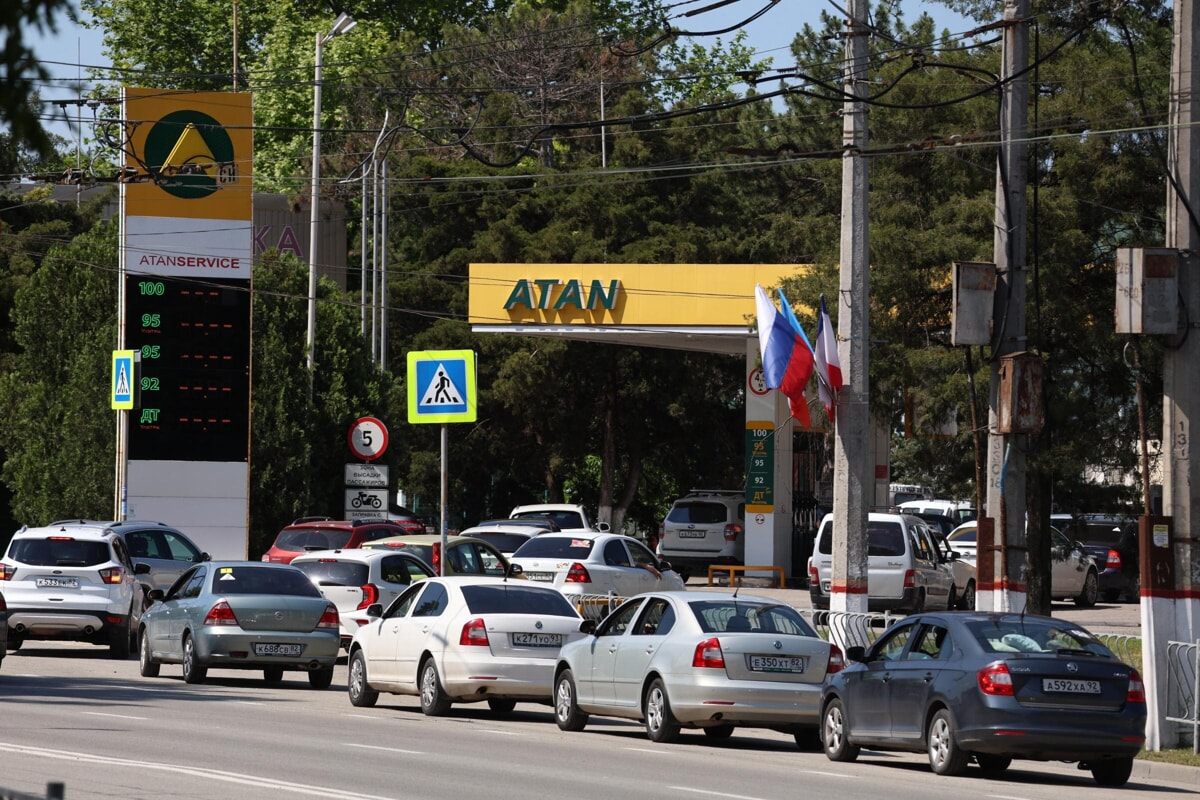
The effects, however, can also be seen in Russia. Reuters collected testimonies from Sevastopol and Yevpatoriya: petrol stations without petrol, queues at plants still functioning and rationing. Associated Press describes the situation as the worst fuel crisis in Crimea since the 2014 Russian annexation. The Kremlin has acknowledged the existence of supply problems, promising corrective measures.
Sevastopol’s pro-Russian governor, Mikhail Razvozhaev, said the distribution of rationed gasoline was delayed because trucks could not reach the city after attacks on supply routes. Ap reports that in late May authorities limited sales to 20 liters of fuel per week per vehicle owner via coupons, which quickly sold out, while some motorists waited hours to refuel.