


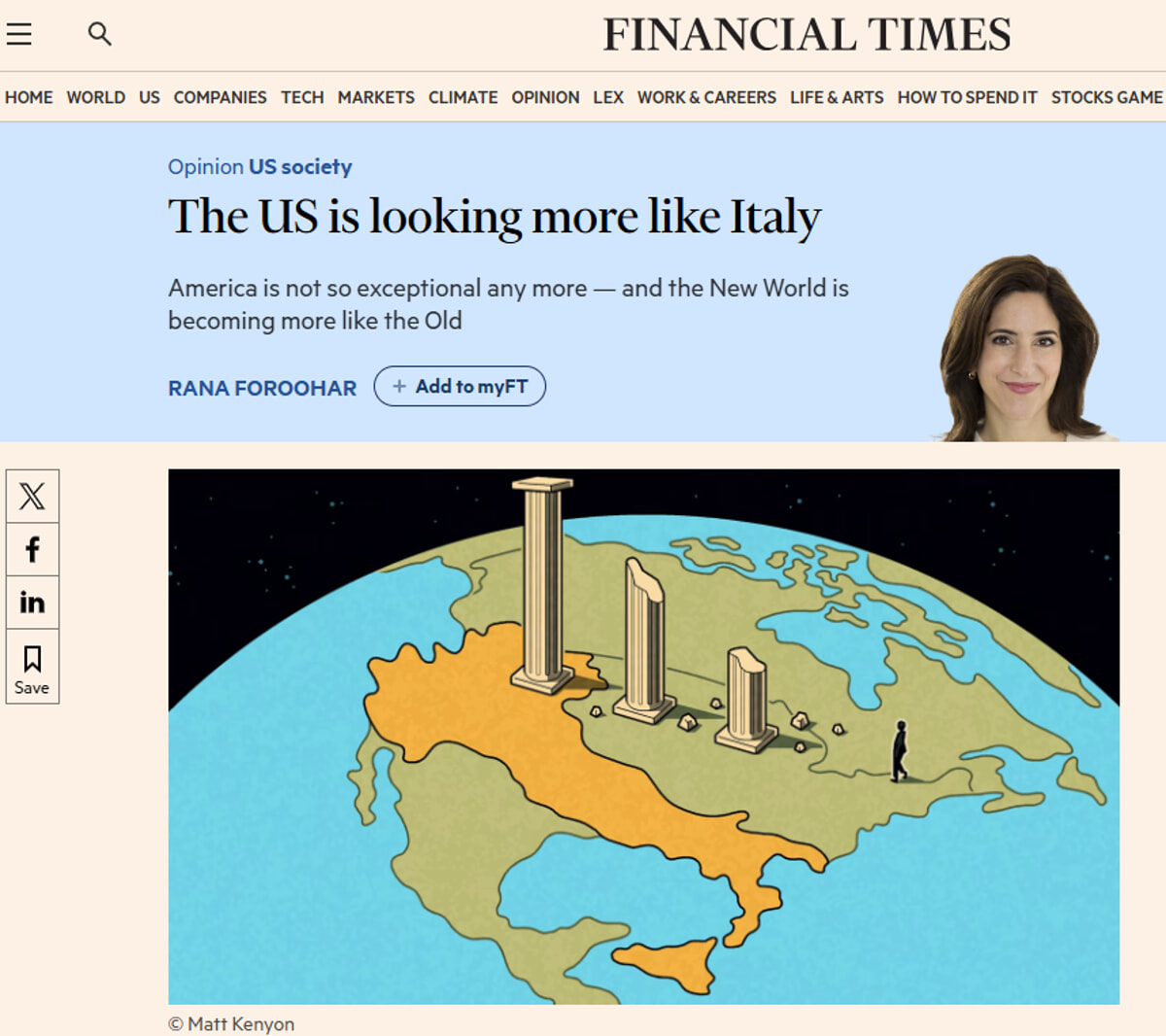
The title chosen by Financial Times is provocative, but the reasoning of journalist Rana Foroohar goes beyond the usual stereotype of Italy spread abroad as a politically unstable country with weak growth. The point is another: some “very Italian” staples are also appearing in the United States.
Because according to the Financial Times the USA is becoming like Italy
“While overt corruption in the United States and Italy is perhaps not as bad as in many other border markets, both countries are actively easing controls to combat it,” Foroohar writes. The United States and Italy do not have the same level of perceived corruption, although the main index sees it as relatively high among the most developed countries: the USA obtains 64 points out of 100 and Italy 53. Washington therefore remains clearly ahead, but the American figure is the lowest ever recorded in the index while the Transparency International organization reports a deterioration over time. Italy, in turn, loses one point compared to the previous year.
Regarding Italy, Transparency International criticized the position on the criminalization of abuse of office within the European anti-corruption legislation. it is on this retreat of controls that the Financial Times builds the first analogy. But it is not just corruption that unites the countries of Giorgia Meloni and Donald Trump.
“Economic cynicism” and populism
The second analogy identified by Foroohar is political: populism that grows together with distrust towards institutions and what he defines as “economic cynicism”. The journalist also links this phenomenon to economic difficulties: the feeling of a part of the population is that the rules of the system no longer allow them to improve their condition.
The loss of trust is then connected to economic cynicism: the belief that studying, working and respecting the rules no longer necessarily guarantees the possibility of reaching the living standards obtained by previous generations. The economic system does not reward work by allowing one to improve one’s position.
The problem of young people who cannot find work
But it is above all the third point, that of work, that is comparable through data. “The American job market is starting to resemble the Italian one in one crucial way: older workers hold onto the best jobs, while young people struggle to find decent ones,” writes Foroohar. The latest numbers from the US Bureau of Labor Statistics actually show a marked gap. As of September 2026, the unemployment rate among 20- to 24-year-olds in the United States is 8%, while among those over 55 it drops to 2.6%.
In Italy, the Italian youth unemployment rate rose to 20.3% as of August 2026. In the same month, overall employment remained essentially stable at 24 million and 352 thousand, but Istat reports that employment increases among those aged at least 50 and decreases among 25-34 year olds and 35-49 year olds. Furthermore, compared with August 2025, employed people grow by 291 thousand units, but decrease among 15-24 year olds.
Istat has also recently photographed the longer-term trend: between 2021 and 2026 the growth in the Italian employment rate affected all age groups except the youngest and was particularly strong between 50 and 64 years old, with an increase of 7.8 percentage points. The Institute also indicates demographic aging and pension reforms among the reasons.
The paradox: today Italy is doing better than the comparison suggests
“Italy is now experiencing a more favorable moment, characterized by solid data on exports and employment”, writes Foroohar. The most recent numbers from Istat at least partially support this observation. In August, Italian employed people were 291 thousand more than a year earlier. The increase is mainly due to permanent employees, who increased by 370 thousand units, while fixed-term employees decreased by 157 thousand.
There are also positive signs regarding exports. In the first eight months of 2026, Italian exports to non-EU countries grew by 5.8% compared to the same period of 2025. In August the annual growth was 16.1% and, a particularly significant figure in comparison with Washington, Italian exports to the United States increased by 31.1% on an annual basis.
However, growth remains limited: in the second quarter of 2026, GDP increased by 0.2% compared to the previous three months and by 1% compared to a year earlier, with growth achieved for the whole of 2026 of 0.8%.
“America has only just begun to understand what happens when an empire collapses”
“America is just beginning to understand what happens when an empire collapses under the weight of its own dysfunctional political economy,” Foroohar’s assessment. But while the United States would begin to resemble the old image of Italy, the Italy of 2026 simultaneously shows some better indicators than its recent past.
And this is perhaps the real reversal contained in the title of Financial Times: It is not only Italy that is observed through the American model. Now it is America which, according to one of the main international economic newspapers, risks being read through the Italian model.