

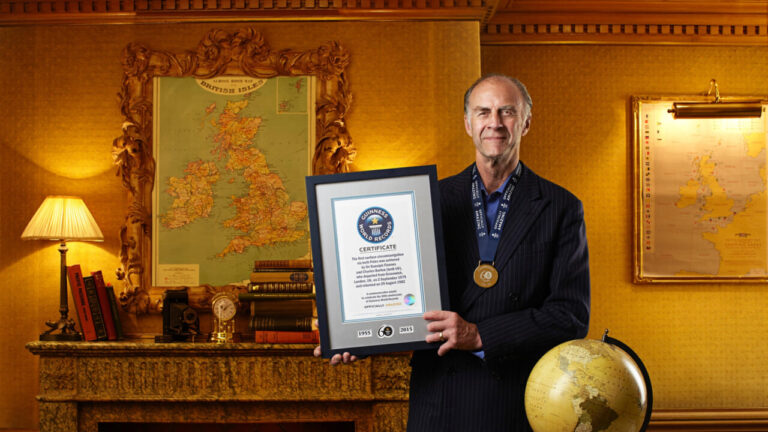
The famous writer and explorer Ranulph Fiennes, record holder for the first surface circumnavigation across both poles, had not been heard from for about two years. In 2024 he did not show up at a gala evening in his honor and since then his fate has remained shrouded in mystery. At least until the first months of 2026, when a disconcerting truth came to light: according to what was revealed by several British newspapers, Fiennes would have been illegitimately deprived of his liberty after his wife, Louise Millington-Cotes, had him admitted to several nursing homes under a false name.
The “imposed” hospitalization
The woman also allegedly imposed strict conditions on the methods of assistance to be provided to the writer, now 82 years old. It would have been precisely these strange indications that revealed what had happened to Fiennes. The owner of a nursing home in Wales has reportedly written to the Office of the Public Guardian (Opg), the British body that deals with cases involving people who lack the mental capacity to make autonomous decisions due to illness, disability or advanced age. In the report, which was then also sent to the police, the owner of the facility expressed concern for the writer’s well-being and condition, placing emphasis on the unusual medical provisions imposed by Mrs. Millington-Cotes.
The wife’s instructions
The woman did not allow visits and refused to reveal to anyone where her husband was hospitalized. The concerns were mainly about his unusual drug therapy and the validity of a “do not resuscitate” document presented by his wife, which asked health personnel not to initiate cardiopulmonary resuscitation or other invasive care in the event of cardiac arrest. Earlier this year, authorities found that Fiennes was “unlawfully deprived of his liberty because his wife acted without ensuring that the required legal protocols were respected.” According to investigators, the former explorer “is subjected to continuous supervision and control and is not free to leave, nor is he able to give his consent to care, treatment and accommodation”.
The writer’s wife, who was granted lasting power of attorney in 2024, was required to ensure a Deprivation of Liberty Safeguarding Order (DoLS) was in place – a legal safeguard that protects vulnerable people who are unable to give consent to restrictive treatment. In these cases the assessment must be carried out by two professionals not involved in the patient’s care, and the person being cared for must have a designated representative, such as a relative or friend.
The identity to be kept secret
According to what was reported by the owner of the clinic in Wales who brought the case to light, Mrs Millington-Cotes would have done everything to hide her husband’s true identity: “He told me that he was a former member of the SAS (the British army’s special forces corps) whose life could be in danger from extremists”. Furthermore, he required him to wear a hat, sunglasses and gloves to avoid being recognized during walks with his assistant. The woman also said that in the previous facility the staff had tried to kill him. According to the English media, some of the writer’s friends, who had already expressed doubts about his safety, are considering the possibility of legally challenging his guardianship to take it away from his wife.
Legendary feats
Fiennes, considered Britain’s greatest explorer, married Millington-Cotes, 23 years his junior, in 2005, a year after his first wife, Virginia ‘Ginny’ Fiennes, died of cancer in 2004. In the 1980s he became the first person to reach both the North and South Poles on foot during the pioneering Transglobe expedition, and became the first person ever to completely cross Antarctica on foot. In May 2009, at the age of 65, he reached the summit of Mount Everest.
Health problems
He has had several health problems over the years, including a heart attack in 2003 that forced him to undergo emergency bypass surgery. In 2019 he was diagnosed with Parkinson’s disease, with Fiennes having spoken publicly about the difficulty of living with this pathology: “I think it is different from person to person. There are sudden attacks of dizziness and when they occur you have to be careful, otherwise you risk fainting and hurting yourself. Swimming in cold water is the best cure I have experienced for the symptoms of Parkinson’s”. On 23 October 2024 he did not show up at the gala evening of the Royal Geographical Society, organizational in his honor, raising the first questions. Instead, he appeared in a short pre-recorded video and that is considered his last public appearance.