

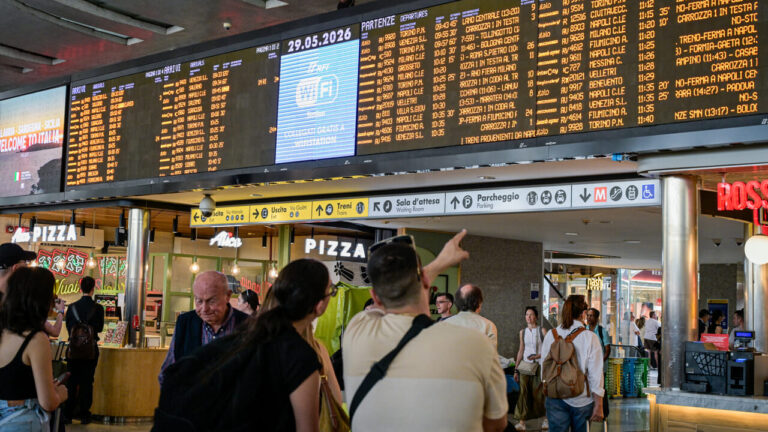
The CGIL has proclaimed a 24-hour national general strike for Friday 20 November. The protest will affect all public and private workers in numerous sectors, from schools to healthcare, including transport and public offices, with possible repercussions and inconveniences on the provision of services. Around one hundred demonstrations are planned throughout Italy, including marches, demonstrations and rallies.
Who’s stopping? The mobilization called by the CGIL will involve all working categories, both public and private, including contracted activities and support services. The abstention has been proclaimed for the entire working day, with methods that may vary based on the sector and the provisions envisaged for the individual categories. Among the sectors affected are education, universities, research, healthcare, public administrations and transport. Possible consequences also for local authority offices and other activities aimed at citizens. In essential public services, indispensable services must in any case be ensured, as established by law 146 of 1990.
The reasons for the protest
At the center of the strike are the CGIL’s demands for a change in the government’s economic and social policies. The union calls for wage increases, renewals of collective agreements and interventions against inflation, with the aim of recovering the purchasing power of wages. On the social security front, the confederation calls for more adequate pension benefits, the full revaluation of the amounts and a stop to the increase in the retirement age. Other demands include a more progressive tax system and the restitution of sums stolen from workers and pensioners by the so-called “fiscal drag”, the fiscal drain caused by inflation.
The CGIL also calls for more funding for health, education and welfare, industrial policies to safeguard employment and measures against precarious work. Particular attention is paid to the new generations, with requests for greater accessibility to studies and housing. The union also calls for the strengthening of safety in the workplace, and there is a proposal to allocate more resources to public services rather than military spending.
Possible transport disruptions
The general strike could lead to slowdowns and reductions in transport services, with consequences for rail connections and urban mobility, depending on the membership and the methods applicable to individual companies. The mobilization of the CGIL will also be accompanied by a national agitation proclaimed by Cub Trasporti and Sgb Ferrovie, scheduled from 9pm on 20 November to 8pm on 21 November for the railway sector and rail freight transport, as reported by the Ministry of Infrastructure and Transport. For some local public transport companies the stop will instead concern November 21st.
In the sectors subject to the legislation on essential services, the minimum services required by law will remain operational. To find out about any cancellations, protected periods and changes in circulation, it will be necessary to consult the updates of the individual operators.
What happens at school
One of the main consequences of the day of protest could concern schools of all levels. The Ministry of Education and Merit, with a notice, communicated the proclamation of various trade union initiatives for the entire day of Friday 20 November. The agitation will affect the staff of the education and research sector, with possible repercussions on the normal activity of the institutes. Depending on membership, there may be changes to timetables, suspensions of lessons and difficulties in organizing school services. Families will therefore have to refer to the communications of the individual schools to find out any changes.
In the education sector the mobilization will not be limited to the CGIL. Various acronyms will take part in the protest initiatives, including USB public employment, Flc Cgil, Sisa, Sidl, Federazione Gilda unams, Clap and Confederazione Cobas. Sial Cobas is also involved, with the adhesion of Cub Confederazione, ASL Varese and Cub Sur, together with Sgb, Cib Unicobas, Unicobas school and university and Ssb. The proclamations will concern, according to the respective methods, the teaching, educational and administrative, technical and auxiliary staff (ATA).
Landini in Rome and other events
The strike will be accompanied by around one hundred initiatives throughout the national territory, with regional and provincial events. The main event is scheduled for Rome, where the concentration of participants is set for 9.30 in Piazza Vittorio Emanuele II. The general secretary of the CGIL, Maurizio Landini, will conclude the procession. In Milan the demonstrators will meet at 9am in Piazza Cadorna, with the intervention of Maria Grazia Gabrielli (director of the CGIL), while in Turin the departure is scheduled for 9.30am from Piazza XVIII December, in the presence of the CGIL trade unionist Luigi Giove. In Bologna the procession will start at 9.30 from Piazza dei Martiri and will reach Piazza del Nettuno, where Michele De Palma will speak.
In Florence the appointment is at 9.30 in Piazza Indipendenza, with Pino Gesmundo. The union initiatives will also affect numerous capitals in the rest of the peninsula. In Naples the meeting is scheduled for 9am in Piazza Mancini, with arrival in Piazza Matteotti. At the same time the processions will start in Bari, from Piazza Giovanni XXIII, and in Palermo, from Piazza Marina, where the conclusions will be held in Piazza Verdi with Serena Sorrentino. In Cagliari the regional event will begin at 9 in Piazza Giovanni XXIII, with the participation of Christian Ferrari.
In Perugia the concentration is set for 9am in Piazza Partigiani, while in Genoa the participants will gather at 9.30am near the maritime station. In Veneto, mobilizations are planned, among others, in Venice, Padua, Verona, Vicenza and Treviso. Further marches will take place in numerous Italian cities, with possible temporary changes to traffic along the affected routes.