


Walking, swimming, running or going to the gym? The possibilities are endless when it comes to moving and staying fit, and not all of them provide the same benefits for our health. Yet the secret to a long and quality life does not seem to be so much the choice of the best sporting discipline, but rather focusing on variety: mixing multiple types of physical activity is in fact the strategy that extends life the most, at least according to a study recently published in the journal BMJ Medicine.
Which sports do they do best? Walk
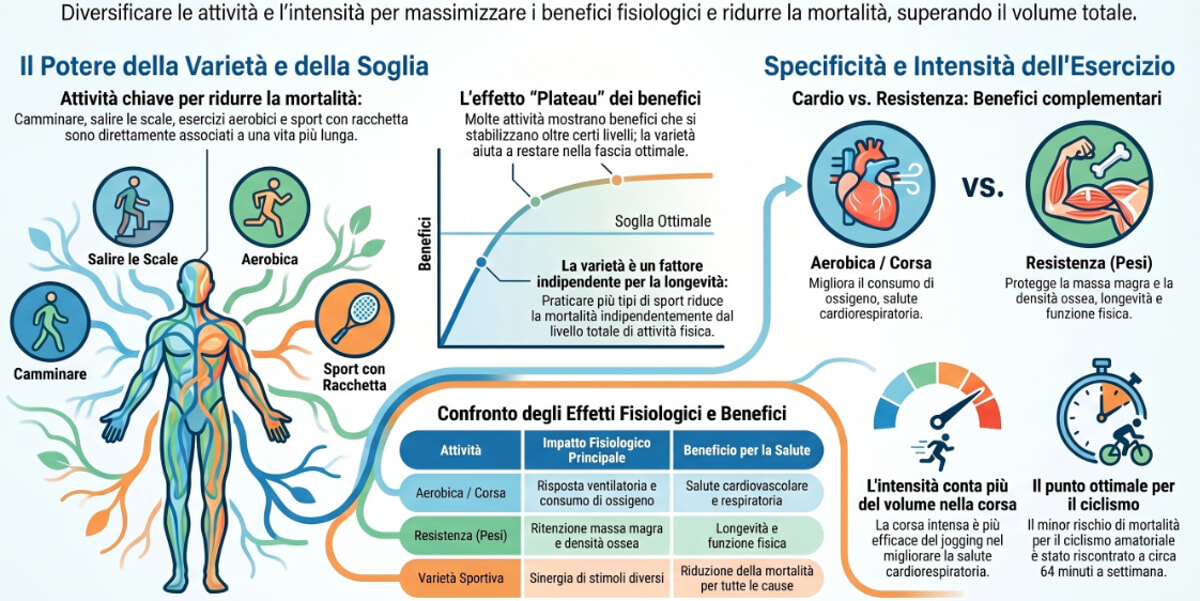
The research analyzed data from two large cohort studies, the Nurses’ Health Study and the Health Professionals Follow-Up Study, tracking 111,467 participants over more than three decades. The analysis focused on 13 different activities, including walking, running, cycling, swimming, tennis and weight lifting. Among the activities analysed, walking was found to be the most common and one of the most effective, with a 17% reduction in mortality risk for those who practice it most frequently.
Climbing stairs is good for you (almost as good as playing tennis)
Climbing stairs was also associated with a concrete benefit, reducing the risk by 10%. Other sports such as tennis and racquetball showed reductions of 15%, followed by rowing and bodyweight exercises with 14%. Running and weight training both saw a 13% decline. Swimming was the only activity that did not show a statistically significant correlation with the reduction in general mortality in this specific sample, while cycling showed a more limited benefit, equal to 4%.
A significant finding that emerged from the study concerns the relationship between the amount of exercise and the benefits obtained. The researchers found that the longevity benefits do not increase linearly to infinity, but tend to level off after reaching approximately 20 Met (Metabolic Equivalent of Task) hours per week. This suggests the existence of a limit beyond which the addition of further physical activity does not produce significant increases in health protection.
The most important rule: vary
However, variety has proven to be an independent protective factor: diversifying physical stimuli appears to stress the organism in complementary ways, reducing the incidence of chronic pathologies such as cancer or respiratory diseases by between 13% and 41% depending on the specific cause. A benefit that is reflected in greater longevity: participants who practiced the greatest variety of weekly exercise had a 19% lower risk of death from all causes compared to those who practiced only one type of exercise, even with the same total time dedicated to sport, with particularly evident benefits in the field of cardiovascular and respiratory health.
Although this is an observational research, which cannot establish a direct causal link, the size of the sample and the duration of follow-up make the results quite reliable, especially as indications for public health. “Overall – the authors of the study write in this regard – these data support the idea that long-term engagement in multiple types of physical activity can contribute to extending lifespan”.