

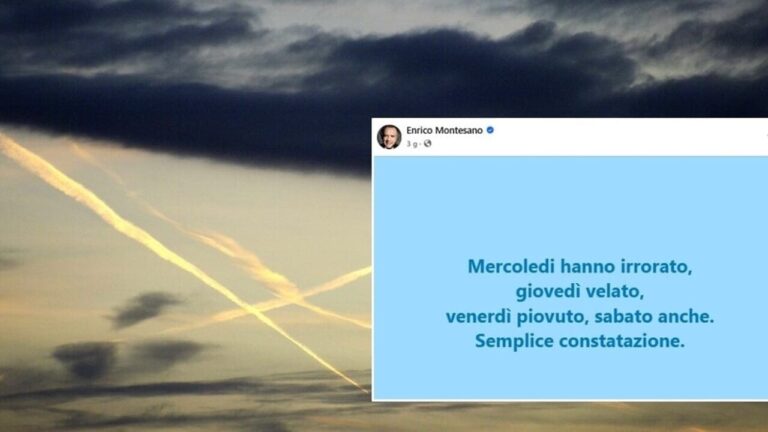
Among the various conspiracy theories, the one about the so-called “chemtrails” is undoubtedly one of the most popular. Many, in fact, are convinced that the white streaks left by the planes are part of a secret plan by occult powers to poison the population and influence the climate. The formation of contrails is first of all a physical-atmospheric phenomenon, but today we are trying to reduce them.
Over the years, science has disproved the conspiracy theory several times and now, also thanks to artificial intelligence, scientists are putting into practice a project to eliminate these trails, which at the same time denies, once again, all the fake news on the subject: Operation Blue Skies.
The conspiracy and the “chemtrails”
The debate on the alleged effects of chemtrails is always heated and relaunched even by illustrious people, mostly linked to worlds very far from science. Among these there is also the famous actor Enrico Montesano, who in recent days published a post on social media on the subject: “On Wednesday they sprayed, on Thursday it was cloudy, on Friday it rained, on Saturday too. Simple observation”. A message which, as happened in the past with similar posts, sparked comments from hundreds of users, including those who support the conspiracy thesis and those who do not. Let’s clarify: the phenomenon we observe in the skies is purely physical and those trails are not “chemical”.
Those thin white lines that follow the planes are actually contrails, also called contrails, which form like real clouds when water vapor condenses around the soot particles present in the exhaust gases of jets at high altitude. They contain no artificial poisons or other harmful substances, but they account for about a third of aviation’s total climate impact. As anticipated at the beginning of the article, their negative effect is linked to global warming.
Persistent contrails can reflect part of the solar radiation during the day, producing a cooling effect, but at the same time they hinder the dispersion of terrestrial infrared radiation into space. Overall, the average net effect is warming, especially for certain contrails and at night.
The algorithm denies fake news
The Blue Skies operation fits precisely into this context. As explained by Google, following initial research into AI mitigation of warming, partnerships have been formed across the entire aviation industry, working alongside airlines such as American Airlines, air navigation service providers such as Eurocontrol’s Muac, and flight planning software providers such as FlightKeys. The joint work made it possible to demonstrate that it is scientifically possible to avoid the formation of contrails, simply by making changes to flight plans and avoiding sensitive atmospheric regions.
However, the functioning of the system offers a very effective demonstration of how the normal contrails observed in the skies arise: their appearance strictly depends on the temperature and humidity conditions crossed by the aircraft. By changing altitude and leaving atmospheric regions favorable to the formation of ice crystals, the trail may become smaller or not form. In fact, by combining weather data, satellite images and predictive models, artificial intelligence signals pilots to move just a few hundred meters in altitude to fly in less humid areas. The result is that the trail does not form at all, whereas if there were deliberate chemicals the trail would appear at any height.
The test data
In the first experiments lasting six months, the American Airlines company modified the routes of seventy flights following the indications of the algorithm, obtaining a reduction in contrails equal to 54%. The only price paid was an extra 2% fuel consumption due to the change in altitude.
The ocean corridor
The project is now preparing for the next step, with the start of coordinated mitigation along an entire flight corridor. Operation Blue Skies is the world’s first state-backed trial to avoid contrails on the scale of an entire oceanic airspace. The program will take place for thirty months in the eastern half of the North Atlantic corridor, within the Shanwick airspace, an area which alone accounts for approximately 5% of global warming due to contrails. The program includes two operational phases lasting four months each. Each year around ten thousand flights from hundreds of cities will pass through Shanwick’s airspace during the test hours, and a small percentage of these planes will be diverted slightly to prevent contrails from forming.
The consortium and financing
To achieve this, a world-leading British consortium has been formed, bringing together Google, Nats, Contrails.org, Imperial College London, the University of Cambridge and the UK Met Office. The operation is co-funded by industry partners and the UK Department for Transport through the ATI programme, a partnership between the Aerospace Technology Institute, the Department for Business, Innovation, Science and Trade and Innovate UK. Not only that. To ensure maximum transparency, all government funding is awarded directly to academic, non-profit and aviation industry partners. Google UK is participating completely free of charge, contributing £1.4m worth of in-kind through AI research expertise, design time and high-performance computing infrastructure.
Operation Blue Skies was not created to disprove the theories on “chemtrails”, but indirectly ends up showing how the phenomenon observed daily in the skies can be explained through measurable physical parameters: temperature, humidity, altitude, engine exhaust and the formation of ice crystals. Conditions that today can be predicted with weather models and artificial intelligence and, in some cases, avoided by slightly changing the aircraft’s route or altitude.