

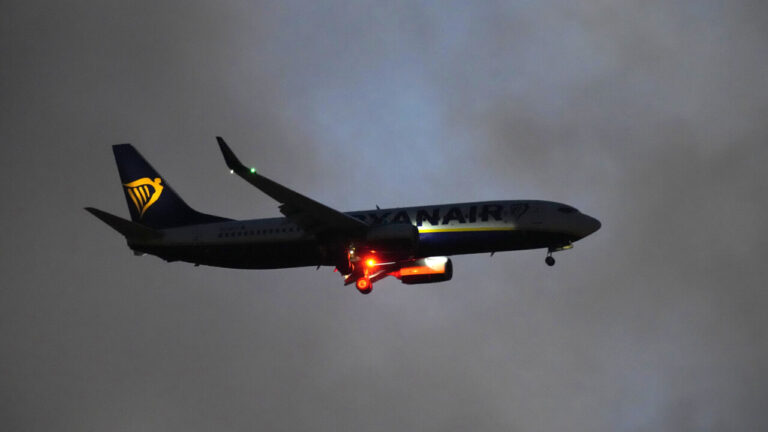
The extra fuel taken on board before departure was supposed to be used to deal with the storm. It wasn’t enough. After three landing attempts interrupted by strong winds, a Boeing 737 departing from Pisa arrived in Manchester with just 363 kilos of fuel in the tanks, against an expected final reserve of 1,101 kilos. There were 171 passengers and six crew members on board. The plane landed without damage or injuries, but for British investigators the accident on 3 October 2025 was a “serious accident”.
The three failed landing attempts and the diversion to Manchester
The sequence is reconstructed by a report from the Air Accidents Investigation Branch (Aaib), published on 24 September 2026. The Ryanair flight was headed to Glasgow Prestwick, Scotland. Storm Amy was passing over the region, and pilots had anticipated the possibility of delays or a diversion. Before take-off they had therefore chosen Manchester as an alternative airport, considering the weather conditions more favourable, and loaded additional fuel. In total, there were 11,500 kilos in the tanks: a higher quantity than initially foreseen in the flight plan.
The first problem came on the descent towards Prestwick. A few dozen meters from the runway, the plane received a “wind shear” warning: a sudden change in wind speed or direction, particularly dangerous during the approach. The pilots stopped the maneuver and regained altitude. After a short wait, during which another Boeing 737 managed to land, they made a second attempt. This time too the alarm went off and the crew had to abandon the landing.
The choice, at that point, was to head to Manchester. The diversion request, however, was rejected and the reasons were not explained to the pilots. The plane then headed for Edinburgh, where the wind was still strong but no recent episodes of wind shear had been reported by the landing planes. Even there, during the descent, a new alarm came. It was the third aborted landing attempt.
The remaining fuel no longer left much margin. The pilots assessed that trying again at Edinburgh was too risky: if the next attempt failed, they might not have enough fuel to reach another airport. They then broadcast a “Mayday” for fuel emergency and asked to proceed immediately to Manchester.
A decisive landing and a near tragedy
The Boeing landed in Manchester at 8.52pm British local time, with 363kg of fuel still on board. According to the AAIB, that quantity would hardly have been sufficient to abort even the last approach and make a new attempt.
To get an idea, the final fuel reserve must be equal to at least 1101 kilos of fuel, parts 30 minutes into the flight, while the Boeing had a third remaining, just 363 kilos. Also on the basis of this evidence, the English investigators spoke of a “serious episode”.
The investigation also examined the rejection of the first diversion request. The airport’s procedures stipulated that the airport operations control would decide whether to welcome an aircraft, verifying the availability of space on the ground. The request was however rejected after a communication according to which the operator in charge of ground handling could not receive the flight. On the same day, Manchester welcomed another 19 flights diverted due to the storm.