

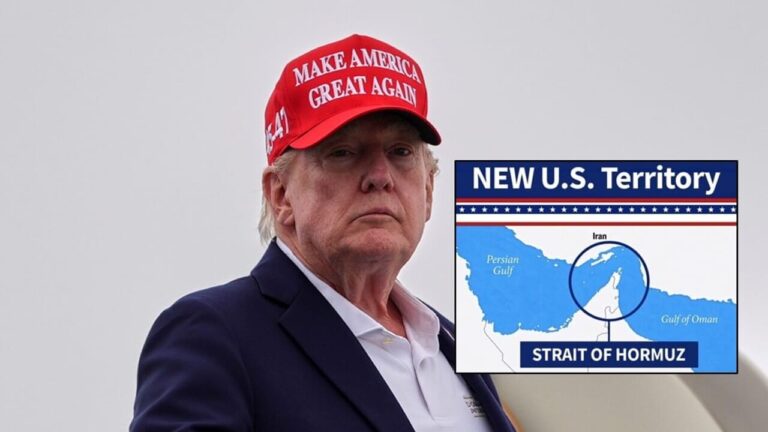
US President Donald Trump has announced an “economic war” of unprecedented scale against Iran and threatened “tremendous” consequences for any country that helps or does business with the Islamic Republic. “It will be an economic war comparable to D-Day,” Trump wrote in Truth. A week ago, Treasury Secretary Scott Bessent stated that the United States would impose unprecedented economic isolation on the country.
“Any country that allows its financial institutions, its businesses, its airports or its government agencies to provide any kind of life support to Iran will in turn face enormous economic consequences,” explains Trump on his social network Truth.
The Republican president’s statements represent an intensification of Washington’s pressure on Tehran, as the war approaches its sixth month with no diplomatic or military solution to the conflict in sight. Trump also faces renewed domestic political scrutiny over the war, with midterm elections due in November.
The context
After the Israeli-US attacks against Iran on February 28, Tehran responded with bombings against neighboring countries allied with Washington and blocked the Strait of Hormuz, a strategic route for the transport of hydrocarbons. The United States has in turn imposed a blockade on Iranian ports. Despite a recent decrease in hostilities, tensions in the region remain high: negotiations are at a standstill with Iran wanting to impose shipping tariffs for services provided to vessels in transit, a measure which is strongly opposed by the United States and some countries in the region.
The United Arab Emirates accused Iran on Tuesday of launching two ballistic missiles, which fell into the sea and were aimed at maritime traffic. Iran has denied firing missiles into the Gulf and “categorically” rejected the allegations. Immediately afterwards, the Emirati diplomacy announced the suspension, until further notice, of “commercial exchanges” and “financial transactions” with Iran. Tehran had already threatened Gulf countries that provide any type of support to the US army on Wednesday morning. “Any assistance or facilitation provided to the aggressor US army is equivalent to participation in American military operations,” said General Ali Abdollahi, head of the Armed Forces, in a statement released by the Mehr agency.
The consequences
The “economic apocalypse” announced by Trump appears to be a good bogeyman for allies, partners and certain swing states, but what will Iran’s strategic partners such as Pakistan, China and Russia do?
Meanwhile, the United States army is said to have created a secret maritime corridor in the Strait of Hormuz which allows approximately 10 million barrels of oil per day to be transported to international markets, half of the pre-war volumes. This was revealed by Axios, according to which the operation has been ongoing for several weeks: “between 15 and 20 oil tankers enter and exit the Strait every night through a southern canal near the coast of Oman” some officials reveal to the US site. The operation does not only concern loaded oil tankers leaving the Gulf. U.S. forces also allow empty ships to pass through Hormuz from the Arabian Sea, reach Persian Gulf ports to load crude oil, and then exit again through the same corridor.
A secret corridor for oil
The device is coordinated by a task force based in Fort Bragg, North Carolina, which together with Gulf partners prepares daily lists of ships authorized to pass. The tankers are grouped into separate time windows for entry and exit and travel through the southern canal following the directions of American forces, while Air Force fighter planes provide protection from possible Iranian attacks. According to Axios, the operation was made possible by a two-week military campaign by the US Central Command that degraded Iranian radar and maritime surveillance systems while Tehran retained limited monitoring capabilities through some reconstructed radars and Pasdaran fast boats.