

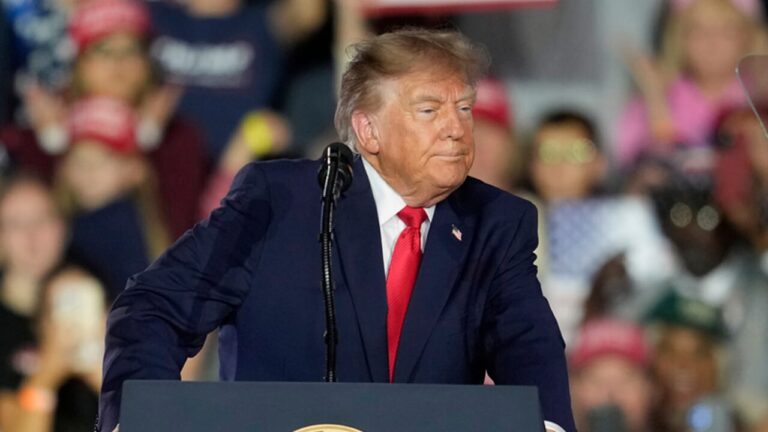
“Vote and do not allow democratic jihadists and communists to win.” With these words, American President Donald Trump launches his last appeal before the midterm elections. He chooses the stage of great occasions: the Lincoln Memorial and addresses the Americans directly: “These are the most important mid-term elections in our history. We cannot allow those who hate this country to win.”
Midterm elections: what they are
The midterm elections are called this because they take place exactly two years after the last presidential elections. We vote to renew the House of Representatives (all 435 members) and a third of the seats in the Senate (35 seats out of 100). Voting is also held to elect the governors of 36 out of 50 states and in many states there is also voting for local legislative assemblies, mayors and state referendum questions on different topics.
They are a fundamental test of Trump’s approval. If the president’s party loses its majority, the administration risks legislative gridlock, making it nearly impossible to pass new reforms, judicial appointments or financial budgets in the next two years of office.
Trump’s latest move
After dwelling at length on the infrastructural interventions carried out in Washington and at the White House, including the arch he wants to build and which “will be more beautiful than that of Triumph” in Paris, Trump listed his successes. “I kept my promises and even more”, he assured, placing the emphasis on immigration and tax cuts. “We stopped Iran from having a nuclear weapon. Our country is doing very well,” he added. And then the usual anxiety-inducing messages: “If the Democrats win, however, you will have a depression like in 1929. If the people who voted for me and who voted in the last elections went to vote even just a good part of them, we would win by a large margin. We will decide whether or not these extremists will be granted power. Either we will keep America strong, or we will give way.”
In recent weeks, Trump has gone for broke. He held 30 rallies in 32 days and now he too has to wait.
The knots
Various issues weigh on the vote. The high cost of living is a source of strong dissatisfaction among voters, who are ready to present the bill to the Republican Party and the White House. However, the vote is also influenced by the growing anger towards data centers and artificial intelligence, which Donald Trump instead portrays as an engine of growth and wealth for the country. Then there is the war in Iran chapter, which has never convinced most Americans.
The scenarios after the vote
Three possible scenarios. The first is the most common: the opposition wins a majority in at least one of the two chambers. It becomes difficult to approve new reforms because each text must be voted on by both houses of Parliament.
If the opposition gains control of both houses, it is called a “lame duck”. The opposition decides which laws to bring to the vote and can pass budgets that cut funding for the president’s central programs. Trump has a plan and he has said it clearly: he would use his veto power to block laws passed by Congress with an opposing majority.
However, if the president’s party manages to maintain or gain a majority in both the House and Senate, it has the green light for reforms.
The polls
The boom in early voting – almost 56 million Americans who voted before the polls opened – gives hope to the Democrats, who the latest polls show with a strong advantage. The conquest of the Chamber by the liberals is now almost taken for granted, and significant progress has also been made in the Senate.
According to the final findings of the New York Times-Siena, the Democratic candidates are ahead in all the races that will decide the balance of the Senate, from Texas, which they have not won since 1988, to Kansas, which they last conquered in 1932. Polling guru Nate Silver estimates that they have an 80% chance of winning the upper chamber and the idea of a “blue tsunami” is floating around. Caution, however, is a must in the face of polls which in the latest electoral rounds have proven to be untrue.
Among Republicans, however, tension is high. While they publicly display confidence, the behind-the-scenes showdown has already begun. And everyone places the responsibility for the expected defeat on the president who, with his war in Iran, has destroyed the chances of victory.
When you have the results
The first results of the midterm elections in the United States for the renewal of Congress are expected around 1 am in Italy on November 4, when the first polls will close. Others will arrive after 2 am, still others after 3 and continue until after dawn. The time of publication depends on the type of detection and the choice of American networks.
Poll closing times vary based on state laws and time slots. The first to close will be those in Georgia and South Carolina, at 7pm Eastern time (1am between Tuesday and Wednesday in Italy). At 7.30 pm (1.30 am in Italy) it will be the turn of North Carolina and Ohio. At 8pm (2am in Italy), the polls will close in Florida, Maine, New Hampshire and Pennsylvania. At 9pm (3am in Italy), Iowa, Kansas, Michigan and Texas, although in the latter state the polls in some areas will close an hour earlier.
In Alaska the polls will close when it is 7am on Wednesday morning in Italy, although in some areas the polls will close an hour earlier. Furthermore, the counting in Alaska will be much longer and more complex, because the state adopts a ranked choice voting system: the candidate with the lowest number of first preferences is eliminated and the votes on his ballots are redistributed based on the next preference indicated. The process continues until one candidate reaches a majority. In this case, the final results will be available fifteen days after the vote, i.e. on November 18th. In California and many other West Coast states the polls will remain open until the time corresponding to 5 in Italy. An hour later, 6 Italian, it will be Hawaii’s turn.
Live: US elections 2026, Trump at the test of the midterms: the live broadcast and the results of the House and Senate