

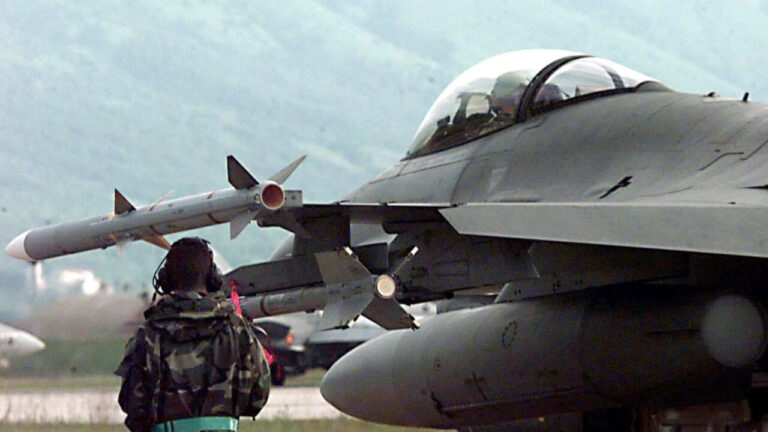
From Bulgaria to Greece and Romania, passing through Cyprus and Turkey, up to the American military installations present in Italy. The network of bases used by the United States in Europe is back in the spotlight following rumors that Tehran is considering possible attacks against US military targets on the continent if Donald Trump decides to further escalate the conflict and directly strike Iranian strategic infrastructure.
Not all installations, however, have the same level of exposure. What makes the difference is first of all the distance from Iran and, consequently, the range of the missiles at Tehran’s disposal. Iran has the largest arsenal of ballistic missiles in the Middle East, and several of its systems can reach targets up to about 2,000 kilometers away. A capability that makes military infrastructures in particular in the eastern Mediterranean and south-eastern Europe potentially vulnerable. However, it would be much more complicated to reach the main US bases on Italian territory.
The bases closest to Iran
Among the most exposed European outposts is the Bezmer air base in Bulgaria, one of the infrastructures also used by US forces and NATO and used to support air operations. In the eastern Mediterranean, Raf Akrotiri, the large British base located in Cyprus, takes on particular importance, used as a base for intelligence, reconnaissance and operations directed towards the Middle East.
Akrotiri itself has already become one of the most delicate points of the Western military presence in the region. Trump had criticized then-British Prime Minister Keir Starmer’s initial failure to give the United States the use of the base in the conflict. When London subsequently authorized Washington to use some of its installations in the region for “specific defensive purposes”, the American president considered the decision to be late. Shortly afterwards Akrotiri was targeted by a drone attack attributed to groups close to Iran.
The strategic infrastructure map also includes Souda Bay, on the Greek island of Crete, one of the main bases of the US Sixth Fleet in the Mediterranean. Even more important is Incirlik, Turkey, which has been one of the pillars of the US military presence in the area for decades.
Added to these is Deveselu, in Romania, where the Aegis Ashore system is installed. This is not a traditional air base, but a land component of NATO’s anti-missile defense: the SM-3 interceptors are designed specifically to detect and neutralize ballistic missiles also coming from the Middle East.
It is a very complex network of military airports, naval bases, logistics centers, intelligence facilities and anti-missile systems through which Washington can support its operations in the Mediterranean and the Middle East.
The missiles that Tehran could use
To threaten targets in south-eastern Europe, Iran has, at least on paper, various systems. Among these are ballistic missiles such as the Emad and the Sejjil, which are generally attributed ranges in the order of 2,000 kilometers. Added to these are long-range cruise missiles, such as the Paveh.
However, the 2,000 kilometer limit is particularly important. Tehran has in fact developed its missile program for decades, focusing above all on short and medium range launchers, sufficient to reach Israel, US bases in the Gulf and part of the eastern Mediterranean. Striking targets located deeper into the European continent would represent a significant leap. And this is where Italy comes in.
Sigonella, Aviano and Vicenza: how exposed are the bases in Italy
The main American infrastructures present in our country are located further from Iranian territory than the installations in the eastern Mediterranean. Sigonella, in Sicily, is one of the most important Western military hubs in the Mediterranean and is especially crucial for intelligence, surveillance and reconnaissance activities. Aviano, in Friuli-Venezia Giulia, represents one of the main points of support of the US Air Force in Europe, while a significant presence of the US army is concentrated in Vicenza.
Depending on the launch point used as a reference, these installations are approximately located at a distance between approximately 2,400 and 3,000 kilometers from northwestern Iran. Too much for the main Iranian missiles with a range of around 2,000 kilometres.
This does not mean that Italy is necessarily out of Tehran’s reach. In fact, the situation changes when considering the Khorramshahr, one of the families of Iranian ballistic missiles about whose real performance there is greater uncertainty. Some assessments believe that by reducing the weight of the warhead, certain versions can reach ranges in the order of 2,500 kilometers or even greater.
The difference, however, is substantial: while the Iranian ability to hit targets within a radius of approximately 2,000 kilometers is consolidated and supported by different operational systems, that of reaching installations located 2,500-3,000 kilometers away is much less documented. Furthermore, there is no reliable public information on the quantity of launchers actually available for missions at these distances, nor on their accuracy with operational war payloads.
For this reason, in the event of a further escalation between the United States and Iran, the American bases in the eastern Mediterranean and south-eastern Europe would represent, at least from a geographical point of view, the most directly exposed European objectives. Sigonella, Aviano and Vicenza would instead find themselves in a different risk range: not necessarily unattainable, but decidedly more difficult to hit with Iranian missile capabilities (at least according to what we know today).