
Europe is preparing to face the winter with natural gas stocks at the lowest levels since 2013. At the end of October, European Union stocks were just 75% full, well below the minimum threshold of 80% set at community level. A situation that risks making the continent more vulnerable to possible supply interruptions and prolonging tensions on the global gas market into 2027. The alarm was raised by the International Energy Agency which in its latest report photographs a market still affected by the war in the Middle East and by supply difficulties.
The origin of the failure to fill the storage facilities are undoubtedly the difficulties in LNG supply due to the closure of the Strait of Hormuz, which occurred after the outbreak of the conflict in the Middle East at the end of February 2026. The blockade of one of the main global energy routes has hindered European imports of liquefied natural gas, making it more difficult to replenish reserves.
Descalzi (Eni): “There is an ongoing war for the control of energy. Europe has done everything wrong, new leadership is needed”
The particularly low level of stocks at the end of the previous winter also complicated the situation. European traders were supposed to catch up during the warmer months, but many buyers preferred to postpone purchases, hoping for a further drop in prices which did not materialize. Between August and October the pace of filling European facilities accelerated, despite the Strait of Hormuz remaining largely closed during the summer. The recovery, however, was not enough to close the gap with previous years. According to IEA data, the overall volume of gas released into storage during the filling season was approximately 4% lower than the average of the last five years.
The risk of a cold winter
The problem does not only concern the quantity of gas already available in reserves. With stocks so low, Europe will have to rely more on LNG imports from the international market precisely in the months in which energy demand reaches its highest levels. This means greater exposure to global market fluctuations and possible problems along supply routes.
The situation, warns the International Energy Agency, “increases the region’s dependence on global LNG supplies to meet peak seasonal demand, and could make it particularly vulnerable if the upcoming winter turns out to be colder than expected, or in the event of technical problems or other supply disruptions.”
According to IEA estimates, if temperatures are particularly cold in the coming months, European gas reserves could fall below 10% by March 2027. But already with stocks below 30%, the speed with which gas can be withdrawn tends to decrease with problems that could have widespread repercussions.
Then in 2027 Europe will have to face the stop to Russian gas which will become fully operational. If in the first ten months of 2026, EU countries imported approximately 17.5 billion cubic meters of Russian LNG, equal to 15.3% of total liquefied gas imports. The stop on LNG will start from 1 January and from 30 September also for pipeline contracts.
The Italian case
Italy has 91% full storage, but remains exposed to energy increases linked to the scarcity of raw materials with consequences that could be serious for the bills of families and businesses, the cost of electricity, industrial production and, indirectly, consumer prices.
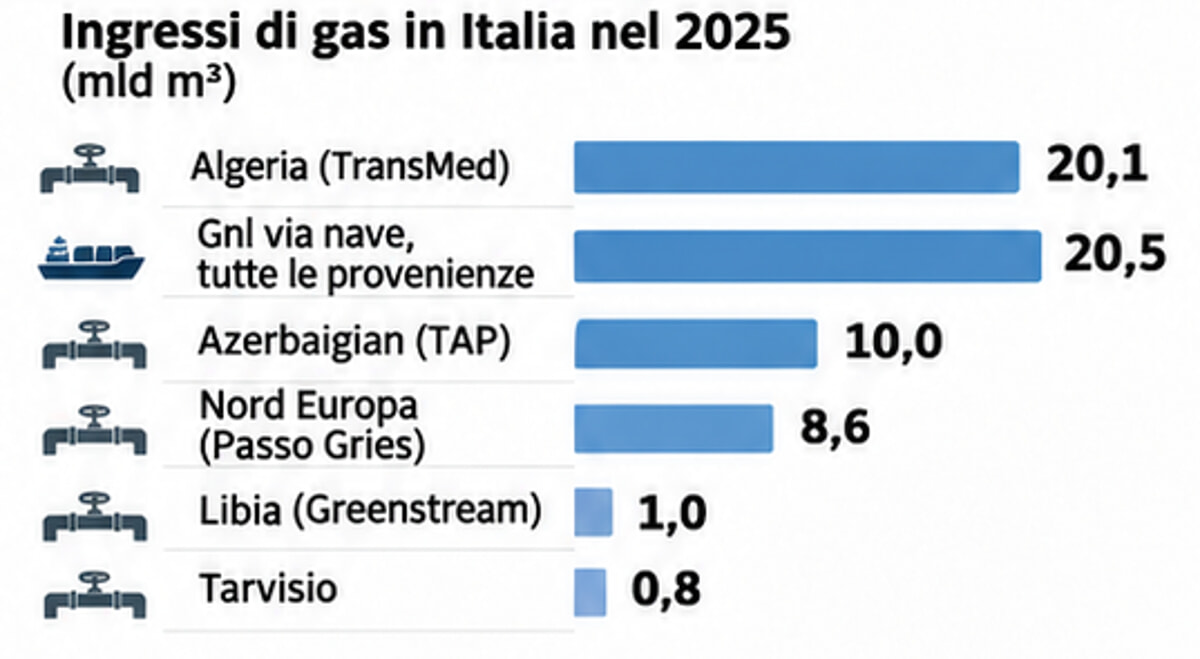
Having more reserves does not mean being protected from price increases since the price of gas is determined on interconnected markets, where demand from other countries also influences what Italians pay. Many manufacturing companies are particularly exposed: the production of ceramics, glass, chemicals, steel and paper is not sustainable with a gas price of 100 euros/MWh. But Italian families’ bills will also see rising prices: today the Arera update for October gas is expected, increased by 12% compared to September: we are talking about an expected increase of 9% for vulnerable customers and for offers indexed to the price of the raw material. The effects will be felt on the price of electricity, higher costs for production, processing and distribution, and therefore on the final prices of consumer goods.