

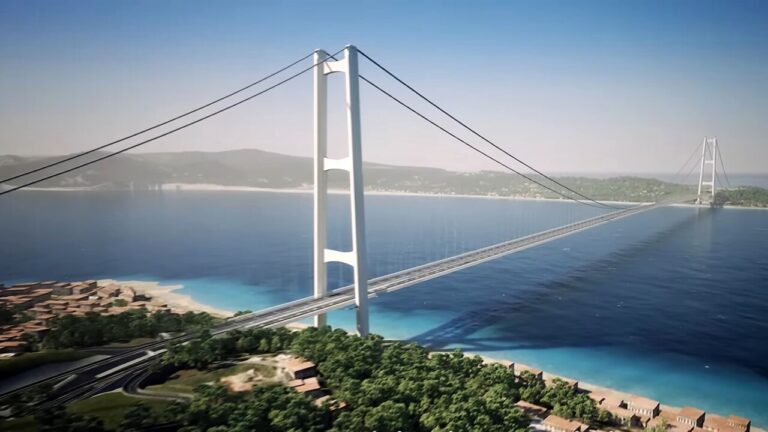
The Bridge over the Strait of Messina does not yet have a certain date for the opening of construction sites, but the hiring machine has already started. Between August and September 2026, Webuild published various job offers to be allocated to the Eurolink structure, a consortium headed by Pietro Salini’s company which will be responsible for building the Bridge. The dedicated recruitment campaign started in October 2025, when the group announced the start of the selections, speaking of “thousands” of jobs, especially between Sicily and Calabria. Now, the opportunities seem renewed, with the promise of a transfer with a view of the Strait of Messina.
When will work on the bridge begin? We don’t know
According to the latest updates from the Stretto di Messina company, by September the company would like to start the investigation together with the Ministry of Infrastructure for a new Cipess resolution to approve the definitive project. The previous one had been rejected by the Court of Auditors.
Only once the legitimacy approval has been obtained will the resolution become effective. The declared objective is to arrive “by the end of the year” at the start of the construction phase, with executive planning and anticipated works programme. The new timetable places the opening to traffic in 2034, after 7 and a half years of work. A year ago, MIT still expected the start of early works by the end of that year and the completion of the infrastructure in 2032.
The construction site is not there, hiring continues
In any case, between August 14 and September 9, 2026, Webuild published at least 21 job offers. Among these there are professional figures such as planning manager, IT manager, Rspp, finance and insurance manager, personnel administration manager, planner, buyer, construction site assistant, environmental, quality and safety inspectors, junior electrical and mechanical engineers, internal audit analyst, maritime civil engineer and compliance analyst.
For several figures, entry into the company is initially expected in Rome, with a subsequent transfer to the project headquarters, the Strait of Messina. After the Meloni government “resurrected” the old Bridge project in 2023, Webuild explained that the work would be “a catalyst for investments for Southern Italy. Over 100 thousand workers in total will be expected for its construction. An important figure in regions such as Sicily and Calabria where the employment rate remains below the national and European average”, we read in a brochure of the group.
Who will work on the Strait
The planning manager, for example, will initially be hired in Rome and “about a year after joining” will have to move permanently to the project headquarters, i.e. on the banks of the Strait of Messina. The task will be to build and update the work program, control times, resources, costs, subcontractors, risks and possible delays. You need between 10 and 15 years of experience and advanced knowledge of tools such as Primavera P6 and Ms project. The salary indicated is between 65,000 and 80,000 euros gross per year, including any additional and variable components.
The same scheme is envisaged for the Head of the Prevention and Protection Service (RSPP): first Rome and after about a year the permanent transfer to the project. He will have to deal with the safety of a construction site which, in the announcement, is already described through some of the more complex activities envisaged: excavations, underground works, works at heights, earthmoving and interference with traffic. At least eight years of experience in similar roles and long experience on large infrastructure construction sites are required. Also in this case, the range for the compensation is between 65,000 and 80,000 euros gross per year.
The engineer for maritime works can reach 100 thousand euros
The most economically relevant position among those currently published is that of maritime civil engineer. Eurolink is looking for a figure with a master’s degree in civil engineering, hydraulics with maritime or geotechnical specialisation, obtained for at least 13 years, and 10-15 years of experience in the maritime sector. He will have to coordinate and supervise the maritime engineering activities of the project, evaluate the solutions for the works at sea, address the technical critical issues, coordinate with designers and suppliers and carry out inspections in the areas affected by the temporary and definitive works.
This professional will also initially work in Rome and then be permanently assigned to the project site approximately one year after joining the company. The expected framework is the framework with the construction collective bargaining agreement and the range communicated by Webuild goes from 75,000 to 100,000 euros gross per year, including any complementary and variable components.
Job positions open for the Webuild Bridge: salaries
There are also other sought-after profiles: a personnel administration manager, already assigned to the project headquarters in Messina, who will have to manage recruitment, pay slips, contributions, contracts, secondments from consortium companies, foreign workers, visas and residence permits and relations with INPS, INAIL, Labor Inspectorate and Construction Fund. The role requires at least eight years of experience. Webuild indicates a gross salary of between 55 thousand and 65 thousand euros per year.
At the other extreme there is the compliance analyst, for whom one or two years of experience is enough. The work involves anti-corruption systems, compliance controls and privacy. The published salary is between 35 thousand and 44 thousand euros gross per year.
Not just graduates: Webuild is looking for miners, carpenters and excavator drivers
Webuild has also created a page dedicated to the Bridge in which it publishes job offers, even if the latest ones appear in the “work with us in Italy” section of the site. Five categories dedicated to workers appear: traditional excavation workers, workers for outdoor activities, construction machinery operators, workshop and plant maintenance workers and Tbm specialists, the large “moles” used for mechanized tunnel excavation. There are also two separate channels available for spontaneous applications, one for staff and one for workers.
For outdoor activities, the indicated salary amounts start from 10.57 euros gross per hour for the first level, rise to 11.88 euros for the second, 12.87 for the third and reach 13.63 euros gross per hour for the fourth level. Food is also provided and, for those who reside or are domiciled outside the province, accommodation, in addition to any further allowances provided for by collective agreements or working conditions.
For traditional excavation workers, the envisaged classification starts from the second level of the reference Ccnl: 11.88, 12.87 or 13.63 euros gross per hour, depending on the experience gained. Here too, food, accommodation and surcharges can be added.