

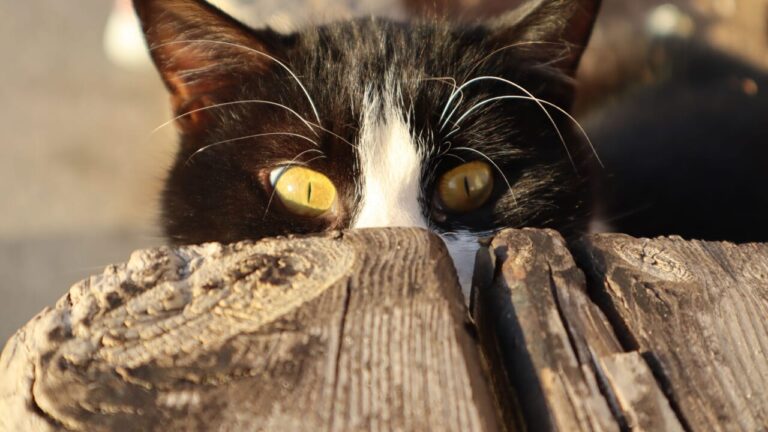
In young children, shyness and curiosity often go hand in hand: when they meet a stranger they are torn between the curiosity of a new face and the fear of an unknown individual. They are not the only ones: some cats also have a similar character. This was demonstrated by a group of Japanese researchers, who in a study published in Plos One has documented how some shy cats have an unexpected behavioral profile, characterized by a complex mix of fear and curiosity towards strangers.
Behavioral profiles
To arrive at these results, the team adapted psychological questionnaires traditionally used to assess personality in human newborns and applied them to domestic felines. As a rule, studies of animal personality use an assessment based on a monodimensional scale ranging from fearful to courageous, and which therefore does not allow the identification of composite behaviors such as human shyness. The use of questionnaires designed for our species made it possible to overcome the obstacle. By collecting the responses provided by over three hundred owners, scientists divided the animals into four distinct behavioral macro-categories: highly sociable, sociable, fearful and, finally, a specific group identified as shy.
While simply fearful cats tend to systematically avoid any unfamiliar contact or stimulus, the category of shy cats showed a high score both in the fear dimension and in the tendency to approach unknown people and objects. In practice, these specimens feel distrust and fear in front of strangers, but at the same time maintain a strong exploratory drive and a latent curiosity that pushes them to move towards novelty anyway, while maintaining a safe distance or hesitating before exposing themselves completely.
The evolutionary parallel
This behavioral dualism faithfully reflects the so-called infantile shyness, also observed in many scientific studies starting from nine months of age. In children, the reaction to an unknown face generates an internal conflict: the child feels anxious but cannot look away, oscillating between the desire to explore and the instinct of self-preservation. According to the researchers, the analogy demonstrates how psychological diversity in the animal world is much more complex than old stereotypes that describe felines as aloof or indifferent.
The statistical analysis conducted by the Kyoto group also highlighted that this particular form of complex shyness is not distributed randomly in the feline population. The data indicate a higher incidence in male subjects and in cats born in street or stray contexts, factors that could influence the development of emotional reactivity and the management of environmental stimuli during the early stages of growth.
Methodological limitations
Despite the relevance of the proposed interpretative model, the authors themselves urge caution. The research is based entirely on questionnaires self-compiled by the animal owners, a method that inevitably reflects human perception and the subjective interpretation of the animal’s behavior. Behavioral field observations will therefore be necessary to confirm the recorded dynamics.
Correctly understanding the nature of these behaviors – assure the Japanese researchers – is not a mere scientific curiosity, but would have important practical implications, in particular for the management of cats in shelters and domestic contexts. Interpreting an animal that hides or hesitates as simply frightened risks altering the way you relate to it. Instead, recognizing the existence of a component of repressed curiosity allows animals to be offered the right adaptation times, respecting the individuality of each specimen and improving the overall well-being of coexistence between humans and pets.