

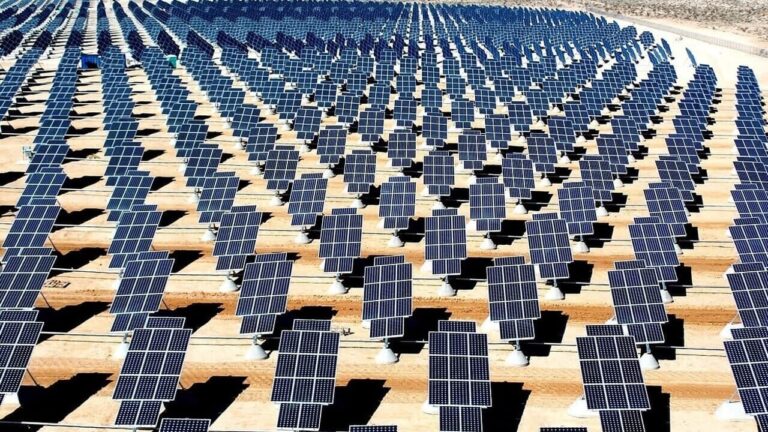
Produce clean energy and ensure services for its citizens. Two birds with one stone, one might say. Municipalities that host works such as photovoltaic fields and wind farms on their territory can in fact enjoy advantages that would otherwise be excluded from the coffers of a small community. The benefits activated range from school buses with seats for people with disabilities to cycle paths, from the strengthening of welfare to projects to reduce the waste tax (Tari).
The range of compensations, as they are called, is very vast and depends on the individual negotiations entered into at the services conference and at the municipal level with the energy operators. But the price of renewables can be very high for a local reality: land “lost” to make space for the panels, compromises at a landscape level, the identity of a territory handed over to the Italian and European pursuit of clean energy. And most of the time a municipal administration can do little to oppose it.
Operators: what the legislation says
By 2030, our country expects to count on just over 80 GW (gigawatts) of installed power through photovoltaic fields. An ambitious objective, but dictated by a European regulation (2018/1999). Italy has sent the integrated national plan for energy and climate to Brussels with its objectives to be achieved. To ground these goals, together with the Regions, suitable areas have been established in which to build the necessary infrastructures.
The bureaucratic procedure to follow is regulated by legislative decree 190/2024 and by corrective decree 178/2025. When an energy operator, such as Enel, Edison or Erg, intends to build a plant, the authorization process varies based on the type of infrastructure and the installed power. If these are “free activity” interventions, such as photovoltaic solar systems with a power of less than 5 MW installed on the ground, it is not necessary to request permits, authorizations or give communications to the Municipality.
However, there are different obligations imposed on the works that fall within the Simplified Qualification Procedure (Pas). These are works such as photovoltaic systems with a power of less than 10 MW, but different from those regulated by free activity. In this case, the operator must present various documents to the Municipality, such as the declaration of legitimate availability of the land (ownership, rental or surface right). In the case of interventions that exceed the power threshold of 1 MW then the operator must still provide the Municipality with a territorial compensation program “not less than 1 percent and not more than 3 percent of the economic value of the expected production during the useful life of the plant”. These compensations cannot be monetary, but works with environmental or landscape value.
The last circumstance concerns infrastructures subject to the single authorization of regional and state competence. Among the foreseen cases, the Regions follow the bureaucratic process of photovoltaic systems with a power equal to or greater than 1 MW and up to 300 MW, while the central State deals with those with a power greater than 300 MW. Also in this case the operator must present numerous documents and the authorization process moves to the services conference where the compensation for the Municipality is also established, within a limit of no less than 1 percent and no more than 4 percent of the economic value of the expected production during the useful life of the plant.
The Erg group, owned by the Garrone family, makes explicit reference to it in its financial statements. In its report dated 31 December 2025, the giant under the item “Costs for services and other operating costs” reports 11.9 million euros in royalties and surface rights. A “cleaner” figure returns to the note “Other receivables and current assets” which records portions of deferred charges equal to 46.1 million euros. Of these, the budget clarifies, a part (11 million) mainly refers to fees towards municipalities, surface rights and insurance premiums.
The “renewable” municipalities
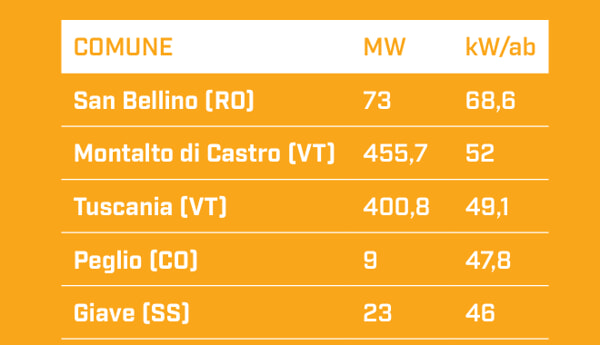
In Italy there are several realities that have an average of kilowatts per inhabitant that is out of scale compared to the national context. These are “renewable municipalities”, as Legambiente has called them for years in one of its reports. Triumphing in the top 10 drawn up for photovoltaic solar is San Bellino (Rovigo) with 68.6 kilowatts per inhabitant. The Municipalities of Canaro (Rovigo) and Peglio (Como) also find a place in the special ranking. The rest of the positions are occupied by bodies from the Centre, South and Sardinia. And the province of Viterbo, as we will see, has a very high average.
As for wind power, here too the Centre-South has no rivals. Monteferrante, in the province of Chieti, occupies first place with 773.9 kilowatts per inhabitant, just 119 in 2025, and surpasses the other municipalities. If the installed power is taken into account, the municipality of Melfi (Potenza) dominates the others thanks to its 271.2 MW. The top five also include Bisaccia (Avellino) with 250.2 MW, Ascoli Satriano (Foggia) with 230.1 MW, Troia (Foggia) with 225.8 and Foiano di Val Fortore (Benevento) 223.4 MW.
The case of Montalto di Castro
As documented by the resolution of the Lazio Region 171 of 2023, 78 percent of all renewable energy plants in the region are present in the province of Viterbo. Montalto di Castro, a town of not even 9 thousand inhabitants, recorded an installed power of 455.7 MW in 2025. A recent development that has sparked quite a bit of controversy.
“Our community is substantially divided. On the one hand there are environmentalists who are against it. On the other there are supporters of clean energy who are in favour, also due to the employment and financial implications”, the mayor Emanuela Socciarelli told DossierToday.it. In 2026, the number of photovoltaic parks in operation, under construction and authorized reached 57. A situation that is no longer manageable, according to Mayor Socciarelli. His administration in fact opposed the decree of the Ministry of the Environment which declared the environmental compatibility of the “Montalto Pescia” maxi-photovoltaic plant of more than 65 MW. And the Lazio Regional Administrative Court accepted the body’s appeal, recognizing its claims regarding landscape protection.
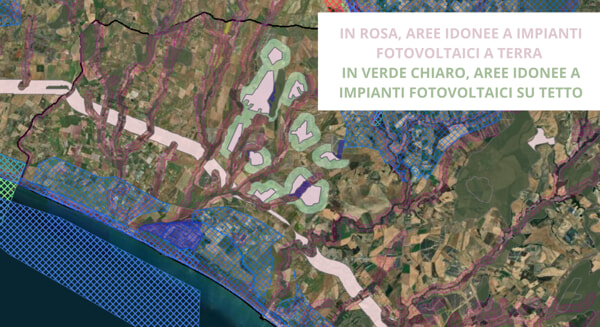
“With this sentence, a firm point has been made on how large renewable energy plants must be managed in our territory – underlines the mayor -. The TAR has established two principles. The first is that there are no automatic mechanisms, defining a ‘suitable’ area does not mean signing a blank bill of exchange. The State has the duty to evaluate each project on a case-by-case basis. The second is the obligation to provide reasons. The Ministry of the Environment ignored the alarm of the Ministry of Culture, which indicated that our area was now saturated with panels and wind turbines, without explaining why that impact on the landscape was not a problem”, summarizes Socciarelli.
The mayor of Montalto di Castro has no illusions about the consequences of the sentence: “It does not definitively decree the saturation of the territory and does not impose an absolute ban. The Ministry of the Environment could approve the project again.” But from today things will be more complicated: “It will no longer be possible to use the excuse of ‘suitable areas’, if he wants to proceed he will be obliged to explain why the superintendency’s fears on the environmental and visual load would be unfounded”.
The victory for the administration remains, but it is only one of the fronts on which it is fighting. Another battle is that of “Burden sharing”, or sharing of responsibilities. “It is a principle contemplated by European directives and Italian laws and establishes that the national objective of 80 GW must be divided between the Regions”. The Municipality “does not reject the energy transition”, clarifies the mayor, “but has demonstrated that it has already largely extinguished the share that would be due to dozens of other Municipalities in Lazio”. The Region is asked to implement the principle of Burden sharing in its regional law on suitable areas so that “Montalto di Castro is excluded from further ground installations, being classified as an unsuitable area”.
What are the compensations?
Over the years, thanks to compensations, the Municipality of Montalto has been able to make municipal buildings and the water network more efficient and build cycle paths. The administration is also building the municipal energy hub to produce energy and sell it online: the proceeds will finance the institution’s electricity costs. Furthermore, on 12 August 2026, the Municipality renegotiated the agreement agreed with the company Solar energy fourteen srl which had submitted a request for the construction of a plant.
In the agreement signed by the parties on 22 July 2025, the company committed to financing compensatory works worth 507 thousand euros. The resources were used to provide the Municipality, among other things, with a 40-seater school bus also suitable for people with disabilities, plus companions and driver. The remaining advanced credit will be used for the energy efficiency of the “G. Rodari” school. The exact same intervention was financed by Shell in the municipal headquarters of San Bellino (Rovigo).
How much Italian oil is really worth: Giorgia Meloni’s plan – by Manlio Pistolesi
Cases like this are widespread throughout the country. In Foiano Val Fortore (Benevento), as Erg itself reported in a 2019 press release, the administration used royalties from renewable energy production plants in the area to support the municipal welfare system.
In Celle di San Vito (Foggia) the municipal council in 2024 approved an agreement with Edison for environmental compensation and rebalancing following the construction of wind farms in the municipal area, starting from the end of the nineties. These resources were used, as stated in a council resolution of June 2025, in cleaning rural and municipal roads and public green areas.
Dossier is the exclusive subscription investigative section of The Vermilion. If you want to support our journalistic work and subscribe, Click here.