

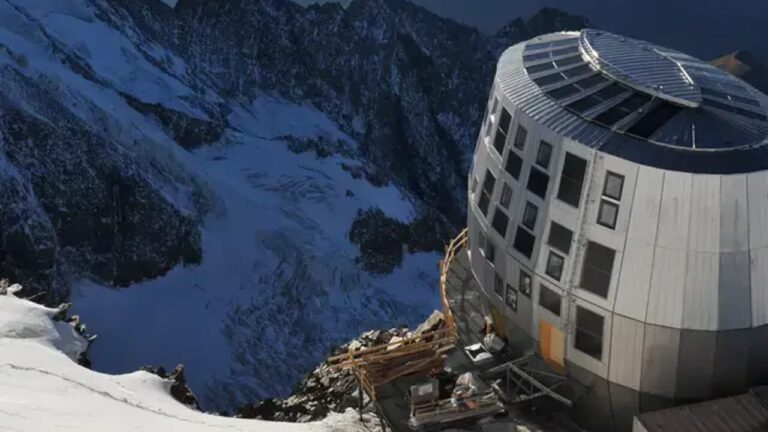
They remained at almost 3,800 meters above sea level, at the Goûter refuge, along the normal French route of Mont Blanc. When the time came to return to the valley, 32 climbers asked for a Sécurité civil or gendarmerie helicopter to pick them up free of charge. The answer was no. Not because they had been abandoned in an emergency situation, but because, according to the French mountain rescue service, the conditions to justify the use of public transport did not exist at that moment.
Eventually some got out on foot. The others were taken lower by a private helicopter from Chamonix Mont-Blanc Hélicoptères, but paying out of their own pocket. It was Jean-Marc Peillex, mayor of Saint-Gervais-les-Bains, the municipality in whose territory the Mont Blanc normal route falls, who turned the story into a national case. An administrator already known in France for his battles against climbers who face the mountain without taking warnings into account and who this time spoke openly of “irresponsible”.
It all starts in the previous days. The heat and drought had made the Aiguille du Goûter sector particularly unstable and especially the famous Goûter couloir, one of the most dangerous passages of the normal French route to Mont Blanc.
Significant stone throws had occurred on the gully. The impressive images had begun to circulate on social media and the municipality of Saint-Gervais itself published the video of a large collapse that occurred on August 11th. The guide companies of Saint-Gervais-Les Contamines and Chamonix had already decided to suspend ascents of Mont Blanc until conditions improved. Warnings had also come from Courmayeur and the high mountain office to take the risk of rock falls seriously.
Peillex therefore issued an order on 11 August ordering the closure of the Tête Rousse and Goûter refuges. The motivation was explicit: the heat waves and drought were favoring significant stone falls and continuing the ascent meant putting not only the climbers at risk, but potentially also the rescuers called to recover them.
However, there is an important detail in the reconstruction of the story: the 32 climbers were already at the Goûter refuge when the ordinance was issued. Peillex himself clarified this al Dauphiné Libéré. They had therefore not violated the provision by going up to an already closed refuge. However, they had tackled the mountain despite warnings that had been warning for days about the deterioration of conditions along the route.
The request: “Come and get us by helicopter”
On the morning of Wednesday 12 August the phone call arrives which infuriates the mayor. Antoine Rattin, manager of the Goûter refuge, and his assistant Mathis Fuchs explain that the 32 climbers present in the structure believe they are stuck and ask to be recovered by a Sécurité civil or gendarmerie helicopter, without incurring the cost of the flight.
At that point Peillex consulted with the commander of the Pghm, the Peloton de gendarmerie de high mountains, that is, one of the French structures specialized in high mountain rescue. The assessment is decisive: that morning the conditions of the couloir had returned relatively calm and, according to the authorities, there was no immediate danger situation such as to require a public rescue operation. Therefore, technically, they were not people who were injured or in imminent danger of their lives needing to be evacuated.
The mayor thus decides not to treat the request as free assistance. “The irresponsible must pay for the risks they take” It is at that point that Peillex turns the episode into a political battle.
According to the mayor, the decision should represent a precedent for changing the way mountain rescues are managed in France: public transport, he claims, should be reserved for those who actually find themselves in an emergency situation, while those who knowingly take avoidable risks should bear the economic consequences.
Peillex maintains that for too long the principle of the mountain as a “space of freedom” and that of guaranteed rescue for all have ended up removing responsibility from some hikers and mountaineers. His proposal is that those who abuse aid or take unnecessary risks should pay.