

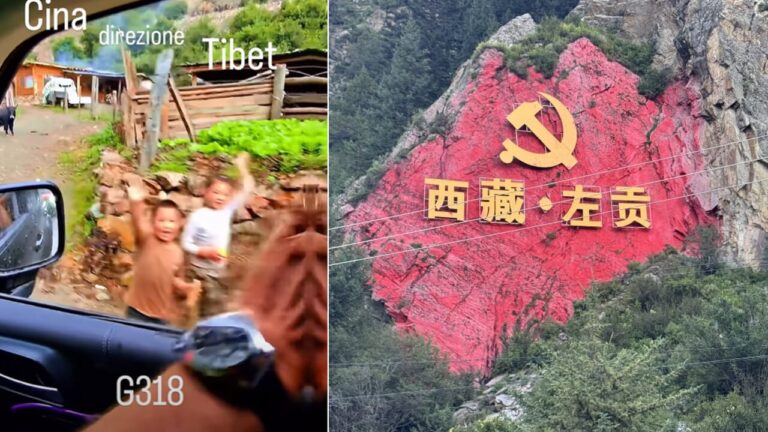
“Returned to Italy. In a free country, where freedom of thought, of speech… and of dirtying the license plate still exists without SWAT intervening”. The long story published on social media by Fabio Borroni, an Italian tourist returning from a trip to China which took him from Chengdu, Sichuan, to Lhasa along the G318, one of the most spectacular and challenging roads in Asia, begins with a joke.
A journey made up of off-road vehicles, mountains and plateaus which, according to his testimony, also turned into a close encounter with the Chinese surveillance system and with the particular restrictions imposed on foreigners visiting Tibet.
The most surprising part comes when Borroni says that the group was effectively blocked in the hotel after a video shot during some evolutions with the off-road vehicles was spread on Chinese social networks. To restart, he claims, they would have been asked to record an apology video. The situation, again according to the story, was resolved only after the intervention of the Italian Embassy in Beijing.
The Chinese driving license and the journey to Lhasa
The group arrives in Chengdu and, Borroni says, on the second day they show up at the motor vehicle offices to obtain a Chinese license that allows them to drive. “Our driving license and the international one there are worth as much as a two of cups with trumps in clubs,” he jokes.
The substance is correct. China allows foreigners present for short periods to apply for a Provisional driving permit by presenting, among other documents, a passport and foreign driving license with a translation into Chinese. The Chinese government specifies that for short stays the permit can be valid for up to three months.
Having obtained the documents, the group takes the G318 towards Lhasa and begins to include some off-road detours. The cars get covered in mud. It is at that point, according to Borroni, that the first phone call arrives. “Our Tibetan guide receives a phone call from the police. The reason? They invite us to wash the license plates because they are difficult to read”, he says. For Borroni it is the first sign of how much their movements are observed.
“Cameras Everywhere”
The issue of surveillance is very different. Borroni says he saw cameras everywhere “roads, rest areas, buses, shops” and claims that even the radios used by the crews had been set to a pre-established frequency that could be listened to by the police.
That surveillance in China is very extensive, however, is a widely documented fact. The US State Department explicitly warns travelers that foreigners in China may be monitored by security forces and that surveillance may include hotels, cars, telephones and internet use. An updated 2026 UK government note also describes technical surveillance via CCTV as extremely widespread in the country. And Tibet constitutes an even more particular case. Foreigners cannot visit the Tibet Autonomous Region independently as they would a normal tourist destination, but must contact an accredited agency, which arranges for them to obtain the Tibet travel permit.
Furthermore, all routes must be previously authorized. It is in this context that Borroni also says that he was unable to take a boat on Lake Basum because the excursion was not included in the authorized program. “It’s as if a Chinese tourist came to Lake Como and we banned him from getting on the boat,” he comments.
The video published on “Chinese TikTok”
The story changes pace after another off-road excursion. The group stops in a muddy meadow before returning to the main road. Two crews begin to do some evolutions with the cars. Some local boys participate in the scene, get on the vehicles and film everything and publish on the “Chinese TikTok”, Douyin, the ByteDance platform intended for the domestic market.
About half a day passes and, again according to the testimony, a new phone call arrives to the guide. This time the situation would be much more serious. The group of Italians remains detained in the hotel and forced to make an official apology video to the Chinese government. The group records a first version explaining that they did not know about the ban. It’s not good. According to the story, the authorities suggest what to say. “In the fifth video they practically ask us to confess to crimes we never committed”, I say. At that point one of the crews contacted the Italian Embassy in Beijing. According to Borroni, the consular officials examined the case, viewed the video and spoke with the authorities and the guide, ultimately managing to resolve the situation.
View this post on Instagram
The post sparked a lot of reactions. One of the most complex is that of Maurizio Hu, an Italian-Chinese entrepreneur and startupper known on the web for his informative content regarding the economy, geopolitics and technological innovation of China. “Not all groups of foreigners who visit Tibet are subjected to the same level of scrutiny,” he explains. His hypothesis is that checks may become more stringent when authorities consider some visitors potentially more sensitive. Hu cites, as a possible explanation, the fear of activities linked to organizations close to the Tibetan cause, foreign journalists or intelligence activities.
The delicate balance of Tibet
Borroni says that the inhabitants he met during the journey were “very cordial and friendly”, but that it was enough to mention their living conditions for the face to fade and silence to fall. “The inhabitants of the places crossed by the tours – observes Hu – know perfectly well that foreigners tend to ask questions on politically sensitive topics. And they may choose not to answer simply to avoid any risk or involvement”.
The general fact remains: freedom of expression on politically sensitive topics in China is subject to strong restrictions and Tibet is one of the areas on which the authorities are paying the greatest attention. Topics regarding political opposition, protests and other issues considered sensitive are subjected to censorship and surveillance.