

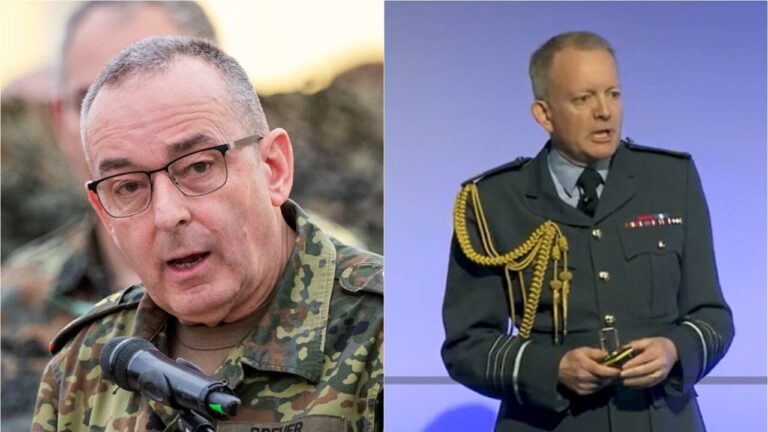
“It’s time to confront uncomfortable truths.” “Difficult” words to digest, just as the choices that Europe must be ready to make regarding defense spending are “difficult”. The highest-ranking officials of Germany and the United Kingdom, the German defense chief, General Carsten Breuer, and the British chief of defense staff Sir Richard Knighton, appealed to European citizens in a letter published jointly by the Guardian in England and Die Welt in Germany: “We write today not only as military leaders of two of Europe’s biggest military spending countries, but as voices of a Europe now confronted with uncomfortable truths about its own security.”
The Breuer and Knighton letter
The two soldiers reviewed the history of recent years: “In the early years of our careers, Europe was emerging from the shadow of the Cold War. Governments of all political stripes chose to adopt what was known as the “peace dividend”: investing in public services and reducing defense spending. At the time, it was an understandable choice. Now it is clear that the threats we face require a radical change in our defense and security. European leaders, together with military and civilian officials, have just discussed the necessary consequences at the annual security conference in Munich”.
Russia’s intentions
In their letter, Breuer and Knighton express their fear of Putin’s “aggressive” behavior: “As military leaders, we see every day, through intelligence and public sources, how Russia’s military posture has shifted decisively westward. Its forces are rearming and learning from the war in Ukraine, reorganizing themselves in ways that could increase the risk of conflict with NATO countries. This is a reality for which we must prepare; we cannot be complacent. Moscow’s military buildup, coupled with its desire to Declaring war on our continent, as painfully demonstrated in Ukraine, represents a growing risk that requires our collective attention. Moscow’s intentions go beyond the current conflict.”
Spending and rearmament
At the Hague summit last year, NATO leaders committed to allocating 5% of GDP to defense and security by 2035, but according to the two military leaders, further investments will be needed: “Reality requires difficult choices and prioritization of public spending for all members. As the defense managers of two of Europe’s largest security providers, we have a duty to explain what is at stake, so that citizens can understand why our governments have committed to constantly increasing defense spending, the largest since the end of the Cold War. This is why it is important to communicate the threat. Citizens must understand the difficult choices governments must make to strengthen deterrence. Rearmament is not an act of war, it is the responsible action of nations determined to protect their people and preserve peace.”
“History teaches us – the letter continues – that deterrence fails when adversaries perceive disunity and weakness. If Russia perceives Europe in this way, it may feel emboldened to extend its aggression beyond Ukraine. We know that Moscow’s intentions go well beyond the current conflict. But the good news is that Europe is powerful. NATO is the most successful military alliance in history and today, together, its military power is unsurpassed. We have sophisticated capabilities in the domains land, maritime, air and cyber, as well as nuclear deterrence. And we have been adapting to the new security reality for some time: through the construction of a new model of European security, based on commitment, readiness and collaboration”.
Military “readiness”.
The two militaries underlined the importance of being ready for any eventuality: “Military readiness must imply a strong European defense industry. Ukraine shows us that industrial bases are fundamental to supporting and, ultimately, winning any major war. The ongoing increase in defense spending in our countries shows that we are taking this issue seriously, as we cannot deter if we cannot produce. Our industries must be able to produce sustainably, producing the munitions, systems and platforms our armed forces need at the rate required by modern conflicts. Britain is building at least six munitions factories, which will ensure an “always on” capacity to supply ammunition supplies. Germany is permanently deploying an entire combat brigade on its eastern flank and has amended its constitution to make essentially unlimited funding available for defense.
The letter arrived immediately after the Munich security conference, in which US Secretary of State Marco Rubio called on Europe “to take greater responsibility for its own defense, after having relied for decades on Washington’s help as the backbone of its security.” “Defense concerns each of us – conclude Breuer and Knighton -. But when Europe acts united, we are a formidable force. And if we act together, we are not just Great Britain and Germany”.