

Italian banks are doing very well, they are considered among the most solid in Europe and are making profits. Yet, the services offered are decreasing and costs are rising. Not only are jobs being cut and bank branches closed, but loans – at least some types – are not recovering the levels of past years: tens of billions of euros are missing from the market. In one case they redistribute wealth: Italian institutions also do well on the stock market and repay investors with rich dividends. However, in the territories the story changes.
How banks fared in 2025
The “Big 5” confirm themselves as profitable machines. The five main Italian banks – Intesa Sanpaolo, Unicredit, Banco Bpm, Mps and Bper – together closed 2025 with approximately 27.7 billion euros in net profits. A figure that even exceeds the Meloni government’s latest budget law. The figure is broken down as follows:
- Intesa Sanpaolo: 9.3 billion;
- UniCredit: 10.6 billion;
- Banco Bpm: 2.08 billion;
- Bper Banca: 1.98 billion;
- Monte dei Paschi di Siena: 2.71 billion.
In the comparison with 2024, the performances are even more evident: the growth percentages of Monte dei Paschi di Siena and Bper stand out, recording +56 and +49 percent respectively. The overall increase is 16.2 percent.
The other main Italian institutions are not doing worse: Mediobanca closed the year with a record profit of 1.33 billion euros driven by the Wealth Management division; Credit Agricole Italia recorded +1.4 billion, Banca Mediolanum grew with 1.13 billion in profits, while Banca Popolare di Sondrio confirmed double-digit profit growth rates, with over 12.7 percent annual growth which brought profits to the historic figure of 648 million. Profits exceeding half a billion euros also for Bcc Iccrea, Credem (549.8 million) and FinecoBank (647 million).
Why banks are so “rich”
Multiple institutions announced a “record profit” in their financial accounts. It’s not the first time this has happened. In recent years, the growth in interest rates has in fact pushed banks’ profits from loans and mortgages, allowing the formation of substantial profits.
Even though rates have recently started to fall again, the banks have compensated by increasing commissions and insurance activity: according to the elaboration of the Fiba foundation of First Cisl, in the last year the two items have increased by 6 and 17.1 percent respectively. Commissions and insurance account for 38.9 percent of operating income, above the estimated average of the major European banking groups which is around 27.
How Andrea Pignataro became the second richest man in Italy (with billions in debt)
Even the so-called “banking risk” played its part: through the unions – BancoBpm with Anima Sgr, Bper and Banca Popolare di Sondrio, Mps and Mediobanca – the accounts of the institutions benefited, with clear repercussions on the stock market. In 2025, banking stocks listed on Piazza Affari reached some of the highest capitalizations in Europe: Intesa Sanpaolo and UniCredit exceeded 100 billion euros, while medium-sized banks such as Mps, Bper and BancoBpm are aiming for 20 billion.
Costs for account holders increase
At the banks’ disposal is the amount of money that Italians have in their current accounts: over 1,500 billion euros. However, keeping money in the bank is not profitable for account holders: according to the latest Abi data, the rate on accounts is 0.29 percent: it means that the bank repays the account holder with 2.9 euros for every 1,000 euros left on deposit. Two years ago it was 0.54.
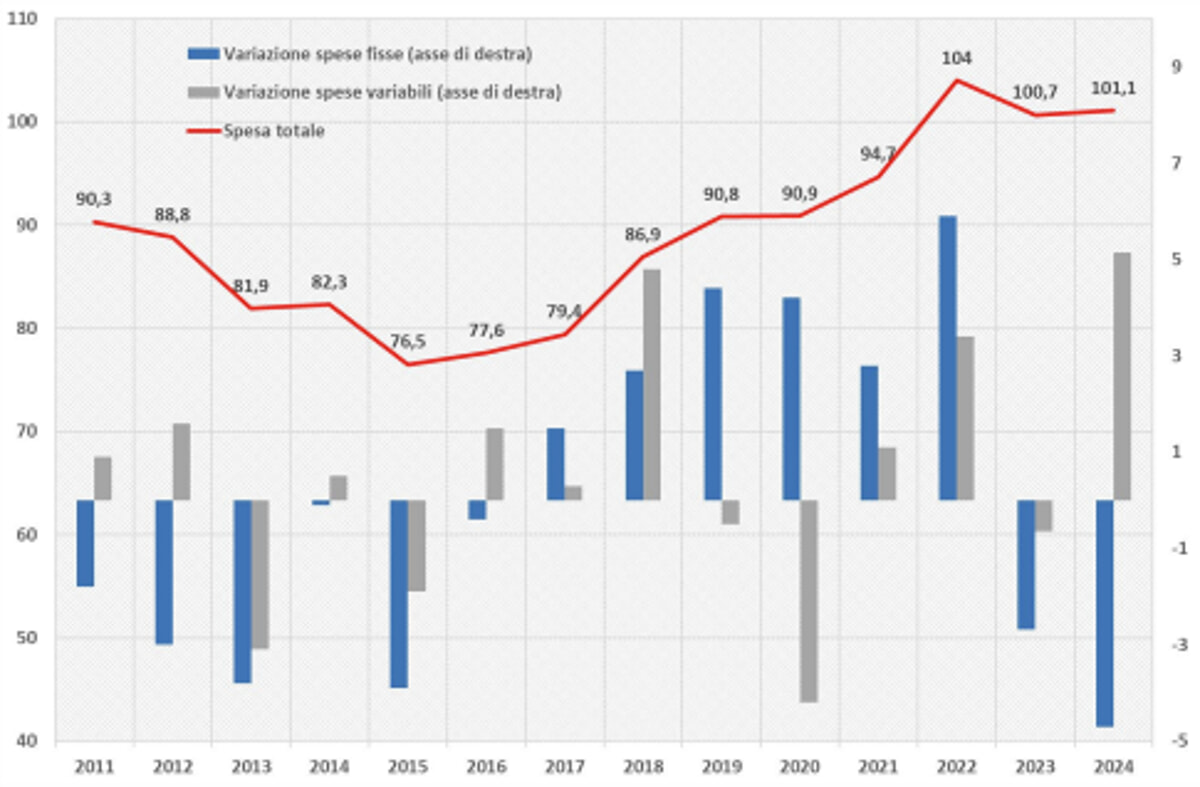
At the same time, the costs of maintaining current accounts have grown in the last 10 years: according to the Bank of Italy, the estimated average annual cost is 101.1 euros – 2024 survey – a figure which has remained substantially unchanged compared to the previous one of 2023.
There are no longer the loans of the past: credit is “overturned”
At the banking system level, loans to families and businesses are growing by 2.3 percent per year. But if we broaden our gaze, the trend of recent years gives us a different result: the data changes, and for the worse.
As Unimpresa points out, the total loans from banks to the private sector – families plus businesses – amounted to 1,327.6 billion euros in 2022, a figure which fell to 1,288.3 billion in 2023 and 1,266.9 billion in 2024, before rising again to 1,290 billion in 2025. The last year therefore records an increase of 23.1 billion compared to 2024, but a reduction of 37.6 billion compared to 2022. The system is therefore recovering, but has not yet closed the gap compared to the 2022 peak.
Juventus and cryptodollars, how much Paolo Ardoino earns: why he bet (everything) on Trump
Looking at businesses, the situation with respect to families is reversed and overall credit goes from 647 billion in 2022 to 617.9 billion in 2023 and 598.9 billion in 2024, to rise again to 606.1 billion in 2025. Therefore, compared to 4 years ago, 40.9 billion are missing.
The accounts smile, the workers and the branches cry
While record profits enter the balance sheets, employees leave the banking sector. In 2025 alone, 8,000 jobs were cut, a figure which, even in this case, worsens if you broaden your gaze: in the last 5 years, over 20,000 employees have been lost.
BlackRock, who is the giant that is buying Italy
This process is accompanied by a gradual decrease in branches and branches: in 2024, bank branches in Italy fell to 19,655 compared to 20,160 at the end of 2023, i.e. 505 branches less in just one year. In 2025 the “banking desertification” did not stop: according to the First Cisl Observatory, another 516 branches were closed, with a national total falling to 19,140 at the end of 2025.
But they are not: even the automatic points are decreasing in number. Bank of Italy showed that in 2024 the number of “active” ATMs decreased by almost 1,900 units. Poste Italiane stepped into the void, bringing its Postamat network above 9,000.