

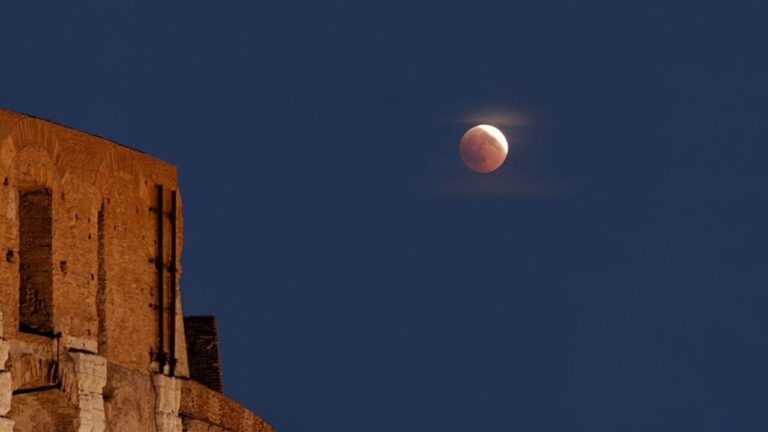
The first total lunar eclipse of 2026 is arriving. On Tuesday 3 March the sky will offer one of the most beautiful and evocative natural phenomena, capable of attracting the attention of enthusiasts from all over the world. The last one occurred on September 7 last year, and was also visible from Italy.
The total lunar eclipse
Unfortunately, the one scheduled for next week will be completely inaccessible from Europe, but it can be followed in live streaming thanks to the technologies of the Virtual Telescope Project. The total lunar eclipse occurs when our satellite, in correspondence with the full phase, scrupulously aligns itself with the Sun and the Earth, completely immersing itself in the latter’s shadow. If the alignment is not exactly perfect, the eclipse will only be partial.
During totality, but also in an advanced partial phase, the Moon acquires a characteristic, elegant bronze color. It derives from the fact that at that moment the Earth’s atmosphere is directing the red portion of the electromagnetic spectrum towards the Moon (it is worth noting that what for us Earthlings is a lunar eclipse, from our satellite would appear like a solar eclipse: in the total phase, from the Moon we would see a reddish halo all around the Earth, that is, our atmosphere directing the reddest radiation towards the satellite).
The March 3 event
The total lunar eclipse on March 3 will be visible from Australia, Asia and the Americas, as well as across the Pacific Ocean: Europe and Africa will be entirely excluded. On the occasion of this extraordinary phenomenon, as in the past for astronomical events inaccessible from our country, the Virtual Telescope Project will offer the opportunity to follow it in live streaming thanks to its international network of collaborators, located in the right areas of the planet. In particular, contributions from Australia, Canada and the United States will be used.
The live streaming
The free live broadcast will begin at 09.30 on March 3, on the Virtual Telescope Project website: at 9.44 the penumbra phase will begin, which will end at 10.50, when the shadow will take over until totality, which will begin at 12.04 and end at 1.03. At that point the eclipse will gradually regress, until it ends at 3.22pm, with the definitive exit from the penumbra.