

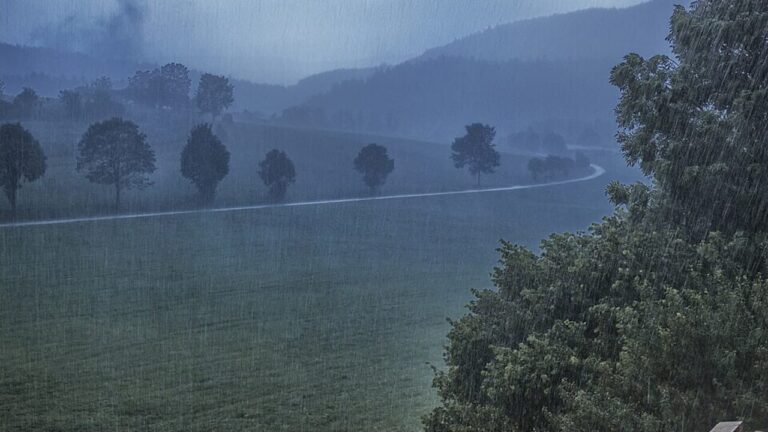
In Italy it rains worse and worse. And it’s not just a sensation, or a fixation of the press. The total amount of rain that falls each year is relatively stable, but its distribution has changed dramatically over time. And therefore the risks that extreme weather events entail: increasingly long periods of drought and authentic bombs of water, sudden, violent and concentrated. This is confirmed by a study led by the University of Milan and published in Natural Hazards and Earth System Sciences, which analyzed 37 years of hourly rainfall data to create a detailed map that shows how the climate is changing in our country.
An innovative method
Until now, many studies had suggested a change in the distribution of rainfall in some areas of our country. But it had always been research based on daily data, which has difficulty in accurately photographing the frequency of those extreme and concentrated weather events that represent the main hydrogeological risk factor in the current scenario.
To overcome these limitations, the new study – carried out by Milanese researchers in collaboration with the Cnr, the Norwegian Meteorological Institute and Rse SpA – carried out a reanalysis, i.e. a reconstruction of past atmospheric conditions that combines available observations with mathematical weather models. In this way he was able to simulate hourly weather conditions over a period of over 30 years, which was necessary to study trends.
The results
The analysis shows that very intense hourly rain events have almost doubled compared to 35 years ago. In summer, the increase is particularly evident in the pre-Alpine areas between Piedmont and Valle d’Aosta, in Lombardy and in Alto Adige, where the average number of extreme events (considering areas of approximately 50 kilometres) has gone from around ten per year in the 1990s to over twenty. The same criterion also shows a significant increase in autumn in some coastal areas of Liguria, the Ionian Sea and Sardinia, where the 2–3 extreme annual episodes typical of the past today often exceed ten.
The driver of this transformation, obviously, is global warming: a warmer atmosphere is able to retain more humidity and energy, which is then released in the form of brief but unprecedentedly violent precipitations. “The results of this research contribute to understanding the effects of climate change on extreme rainfall in Italy – confirms Francesco Cavalleri, researcher at the University of Milan and first author of the Study – and provide useful information for civil protection policies, for the resilience of existing infrastructures and the planning of future ones”.