

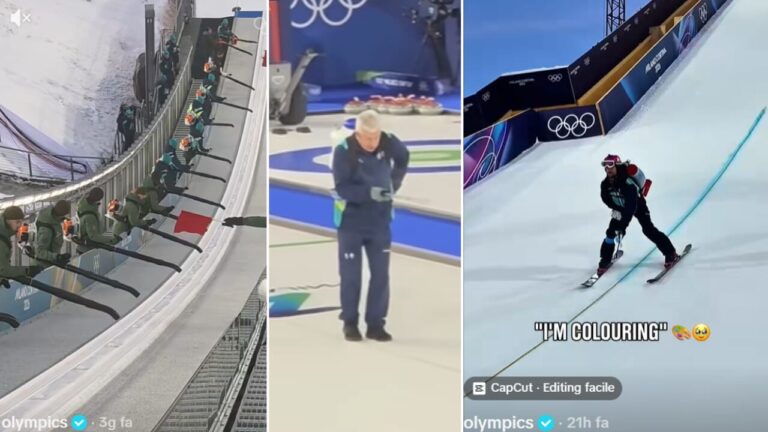
When live television is interrupted by advertising and the audience is distracted with music or interactive games such as kiss-cams, they enter the scene. They are the people who make the Olympics possible, nameless figures that those watching at home often ignore. However, the official social accounts of the International Olympic Committee (IOC) wanted to pay homage to some of these workers to make it clear what happens behind the scenes.
The water man of curling
He became the hero of the Milan-Cortina Games when they had yet to begin. In short, the video that follows him splashing water on a curling rink has reached 10 million views. This is Mark Callan, Development officer and head of ice services for the World curling federation since 2022. A veteran with three Olympics and two Paralympics under his belt, as well as numerous state and international tournaments.
His “dance”, which alternates small and rapid steps backwards with equally frenetic arm movements with a “shower” in hand, won everyone over. Although it may seem unusual, his work is fundamental to the discipline in which the Costantini-Mosaner duo won a gold and a bronze.
Callan, a 61-year-old Scot, explained this to the IOC microphones in another video. In jargon his role is nicknamed “pebbler” because his task is to create a rough surface, called pebble (pebble, in Italian), fundamental for curling.
With his spray bottle he distributes small nebulized drops of water on the ice which create a rough layer crucial for the sliding and bending of the stones: “Without it, the surface would be completely flat and the ‘stone’ would stick”. Thanks to these “impurities” and brooms, effects can be created that allow the stones to go around obstacles and make parabolas.
A question of measurements
But let’s stay on the same playing field. On some occasions viewers and audiences at home were able to witness a standoff. When two or more stones inside the house compete for a point, a referee intervenes with a special device called a “tape measure” or “stick measure”.
The instrument consists of a metal arm with a movable dial on it, at one end there is a pin and at the other a handle. The tip of the pin is inserted into the center of the button, the innermost area of the scoring area, and the meter is moved to the edge of a stone. From here a slat starts which follows the curvature of the stone providing the distance that separates it from the centre. The data is shown on the dial: so the referee assigns the point to the closest team.
The snow dryers
In addition to the more technical figures, there are also a whole series of workers who are employed to keep the tracks and all the environments where the competitions take place safe. For ski jumping, constant maintenance of the ski jump can make a difference in an athlete’s performance.
Between one jump and another, specific employees hold leaf blowers to dry and keep the starting ramp (inrun) free of excess water or snow. Athletes descend at a speed of around 90 kilometers per hour and greater humidity is synonymous with danger, as well as friction.
In the video published by the IOC, some volunteers are seen passing the blower on the trampoline until an official holds up a red flag. When this is withdrawn it means that the staff must step back because the athlete is about to get off.
Who paints the tracks
Have you noticed those blue lines present in the disciplines practiced at altitude, from alpine skiing to snowboarding? They are not a simple artistic quirk, but useful for the safety of skiers and for spectators to better follow the route.
In the rules of the International ski competition we read that in the downhill and super-G “the slope must be marked using dye horizontally along the slope or inside and/or outside the racing line before and after the gate, in particular in the approaches indicating changes in terrain, jumps”.
It wasn’t always like this. For the same purpose, previously only small pine needles or similar material scattered on the most important points were used. This use has not yet disappeared as this photo from Sochi 2014 attests.
He fixes ice for them
Returning to indoor sports, rapper Snoop Dogg made the ice-shaving machine go viral. In the video you can see the singer clinging to the vehicle while cleaning the surface of the Milano Ice skating arena in Assago. The machine is more commonly known as Zamboni, from the surname of the founder Frank Zamboni (1901-1988), an American of Italian origins. In 1953, the inventor obtained the patent for the ice scraper which allowed a rink to be cleared in about 15 minutes.
Zamboni intervenes when it is necessary to clean a track that is too marked by the athletes’ skates. You can see it at work, for example, between one hockey game and another. The machinery hides a very complicated hydraulic system. On the front there is a blade that scrapes a thin layer from the surface of the ice. Then two mechanical spirals come into play: the horizontal one collects the fragments while a vertical one pushes them into the snow tank. The accumulated ice is “washed” with water fed from a tank. The dirty one ends up in a special container. The clean one, however, comes from another tank. The water is then channeled through a hose and evenly distributed over the ice using a spatula.
undefined
However, when there is a need for faster and less invasive interventions, small teams are used. Workers remove excess ice with shovels or, for even more limited repairs, with trowels. Immediately afterwards the hole is covered with a film of water to even out the surface.
We could go on forever quoting those who remove obstacles from the slopes or those who fix the ramps where snowboarders will then land. What makes the Olympics unforgettable are the athletes, with their sacrifices, their stories and their successes. But it is right to also remember all those who keep the show going.