

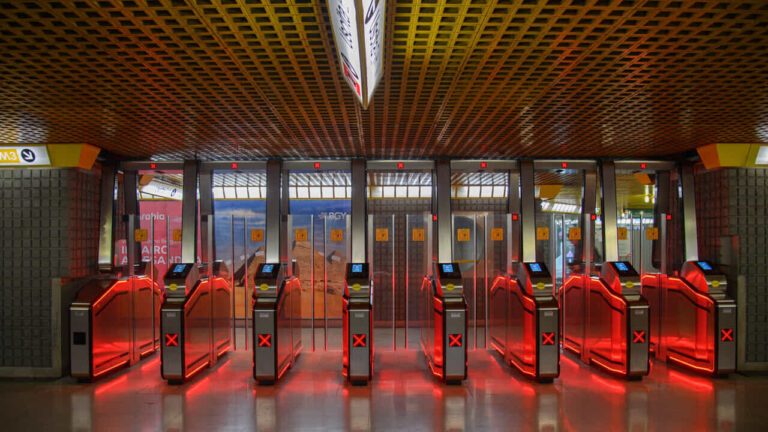
Here we go again: there’s a new strike coming. Friday 27 March 2026 promises to be a day of protests and inconvenience for commuter workers and travellers, with unrest that will simultaneously affect local public transport, the world of schools and the press.
The local public transport strike
In Milan, the workers of the Atm group (Milan transport company) will cross their arms for 24 hours on the initiative of the Al Cobas union. The service may be affected in particular between 8.45am and 3pm and from 6pm until the end of service. Milan, however, is not the only one: in fact, there are several local public transport companies that will strike in other cities. In Naples the staff of the public transport company Eav (an autonomous Volturno body) will strike for 4 hours, from 7pm to 11pm. In Novara the unions have proclaimed a stop for Sun workers from 5.30pm to 9.30pm. In Turin, the Arriva Italia workers’ strike will be from 4pm until the end of service.
The ATM case in Milan
The ATM strike in Milan is especially relevant, which will last 24 hours. The protest, as stated in a note, was called “against the processes of market opening, privatization and use of service contracts currently managed by the ATM group”. Among the main requests is the return to direct public management of local transport – including complementary activities – currently outsourced to Milan and its hinterland. The “Milano Next” project was also contested, together with the hypothesis of transforming ATM into a special company of the Municipality with direct “in house” assignment of the entire service in the metropolitan city, for which it is also proposed to be free.
There are also reasons related to safety and health at the basis of the agitation: calls are made for the restoration of distancing between drivers and passengers and for the blocking of the front door on vehicles. Deficiencies in cleaning and sanitization operations were also reported. Finally, criticism of the management, accused of lacking attention towards the protection of workers most exposed to attacks. Among the demands, contractual and economic aspects also emerge: better management of holidays, transformation of part time into full time on request and a salary increase of 150 euros net for employees up to “parameter 193”, independent of productivity, in addition to the elimination of individual bonuses.
Parameter 193 in the national collective labor agreement for autoferrotranvieri identifies a medium-high salary level, usually associated with the roles of specialized employee (technical-administrative), station manager or operations manager with responsible functions, with a minimum salary (minimum table) of approximately 1,387.15 euros per month, in addition to allowances.
What happens in school
Not just transport. The education and research sector will stop for the entire day of March 27, following the general strike proclaimed at national level by the Sisa union (independent school and environment union). The abstention from work will concern all the main figures of the sector: teachers, school managers, administrative, technical and auxiliary staff (Ata).
At the basis of the mobilization there are several demands. Among the main ones, the increase in salaries by 20% net to compensate for the loss of purchasing power due to inflation, and the establishment of a single role for teachers, with equal hours and economic treatment from nursery school to high school. On the issue of precarious employment, the immediate stabilization of all vacant positions is requested, including those of ATA staff.
Other proposals include the abolition of the competition for school directors, replaced by an internal elective system, the introduction of Arabic, Russian and Chinese languages in high schools, the possibility of early retirement from 2026/2027 for those with a disability greater than 67% and at least thirty years of service, and finally a reduction in the costs of specialization courses (Tfa).
Press strike
The world of information is also preparing for the stop, with the proclamation of a national journalists’ strike by the Fnsi (the National Federation of the Italian press) which has called two days of strike, scheduled for 27 March and 16 April.
The National Press Federation wrote in a note on the strike: “Dignity. This is the slogan that drives Italian journalists to another two days of strike: 27 March and 16 April. Yes, we want information to be recognized with the necessary dignity and above all to guarantee it a future that is also dignified. Today this is not a given, on the contrary. Our employment contract has expired ten years ago, our salaries have been eroded by inflation and have lost their 20% of purchasing power. We are the only category to have been waiting for the renewal for so long. There is a clear economic issue and there is an equally clear issue of authority and independence of the press.”
Fieg’s response
This is how Fieg, the Italian Federation of newspaper publishers, responded: “The Fieg publishers note that we are in the presence of a national employment contract anchored to business models that no longer exist and which guarantees privileges that are no longer sustainable, such as for example the payment of former holidays abolished 50 years ago or the automatic percentage remuneration mechanisms which, moreover, have largely kept journalists free from the effects of inflation”.
And again: “This is the reason why the union did not want to address either the issue of the overall modernization of the contract (which would indeed be essential as a competitiveness tool), nor the introduction of more flexible rules to encourage the hiring of young people, preferring instead to limit itself to exclusively economic requests. And also on the issue of collaborators, Fieg has constantly expressed its desire, even in the relevant institutional bodies, to improve the rules and compensation in force”.